Imagine opening your Google Ads and Meta dashboards on Monday, 9 November. Diwali was yesterday. Spend is on track, but leads are lower, cost per lead looks different, and a campaign that carried your festive weeks has gone quiet. The first instinct is to cut budgets, pause everything, or ask what broke.
Nothing broke. The festive peak has ended, and your accounts are showing you what a normal November looks like. That moment is more useful than it feels, because it is the one week of the year when you can see how much of your performance came from the season and how much came from your own marketing.
This article is a practical guide to using that week well. It covers how to read your numbers fairly, what to change in Google Ads and Meta Ads (and what to leave alone), where to move budget, and a short list of things you can do before the week ends. It is written for marketing heads and founders who run paid campaigns in India and are planning their post-Diwali ad budget, and it needs no new tools.
Why Your Numbers Look Different This Week
Festive weeks are unusual because every advertiser is in the auction at once. Early industry estimates put festive ad spend in India in 2025 up 14 to 15% on the year before, with digital ad costs reaching record highs (Best Media Info, 2025, quoting an estimate from Excellent Publicity). Online retail sales rose 14% year on year in the two weeks before Diwali 2025 (Criteo, via Best Media Info, 2025). When that many advertisers chase the same shoppers, auctions get crowded. One Razorpay Rize guide reports that Meta CPMs rise sharply through Diwali and that Google CPCs can climb 25 to 40% over the same period (Razorpay Rize, 2025). That is a single-source figure, so treat it as directional rather than exact.
The useful part is the direction. Costs rise because competition rises, and competition eases once the festival passes. Some of the change you see this week is the auction relaxing, and some is customers moving on from festive buying. Your job is to tell the two apart before you change anything.
Two points of context. First, India-wide benchmarks vary a lot by industry. A public Meta ad cost tracker shows Indian CPMs for some sectors running well below global averages through 2025, with different seasonal patterns by sector (Superads, December 2024 to December 2025 data). Your own accounts matter more than any benchmark. Second, festive behaviour differs by business. A retailer, a real estate developer, an education institute and an industrial supplier will each feel November differently. The best evidence you have is your own last two Novembers.
Read Before You Cut: Three Checks
Most budget mistakes in the weeks after a festival come from reading numbers too quickly. Run these three checks first.
1. Compare with the right baseline. Do not compare this week with Dhanteras week. Compare it with the weeks before the festive build-up began, and with the same week last year. The Razorpay Rize guide suggests the same approach: build a baseline from the weeks before the season, covering organic sales, direct traffic, branded searches and conversion rates (Razorpay Rize, 2025).
2. Allow for conversion lag. Many buyers click an ad before Diwali and enquire or buy days later. By default, Meta credits a conversion to an ad if it happens within seven days of a click or one day of a view (Meta Business Help Centre, 2026, as summarised by Coinis). Google’s guidance on Smart Bidding says to evaluate results after one or two conversion cycles, because conversions can still arrive after the click (Google Ads Help, 2026). In practice, festive-week leads can still land in your reports this week. Judge the week of 9 November after the following week closes, not on the day.
3. Look at lead quality, not only cost per lead. A festive period often brings a higher volume of casual enquiries. If cost per lead looks better or worse than usual, check how many leads your sales team actually spoke to and how many were genuine. We explain why this matters in The Cheapest Lead Can Be Your Most Expensive Customer.
Google Ads: What to Change and What to Leave Alone
Google’s Smart Bidding already handles a good share of seasonal swings, which helps in the week after Diwali. Four practical points.
- Check that any seasonality adjustment has ended. Seasonality adjustments tell Smart Bidding to expect a short change in conversion rate. Google recommends them for events of one to seven days and notes they work less well beyond 14 days (Google Ads Help, 2026). If your team set one for the festive sale, confirm its end date has passed. A forgotten adjustment keeps bidding as if the sale is still on.
- Retire festive messages. An ad that promises a Diwali offer on 10 November earns a click and then a disappointed visitor. Pause festive ad copy, sitelinks, promotion extensions and landing page banners. Replace them with evergreen messages, or with the next relevant moment for your business, such as the wedding season, year-end purchasing or planning for the next academic year.
- Revisit budget caps. During festive weeks, many campaigns reach their daily budget by noon. After the peak, those same campaigns may have headroom. Check the “limited by budget” status and the impression share lost to budget before you decide whether a campaign needs more or less.
- Change targets in small steps. Google notes that changing a Smart Bidding target does not trigger a learning period or reset what the system has already learned, although you may see some volatility for a conversion cycle or two (Google Ads Help, 2026). That makes target changes a gentler lever than rebuilding campaigns. Move in small steps and give each step a full week.
Then open the search terms report. Festive queries such as “diwali offer” or “gift hamper” will have attracted clicks that do not convert in November. Add the irrelevant ones as negative keywords so your budget returns to people with real intent. Our article The Campaigns You Should Have Killed Last Month shows how to read performance by day, device and audience so you can prune with confidence.
Meta Ads: Protect the Learning, Refresh the Creative
Meta’s delivery system learns from conversions. An ad set generally needs about 50 optimisation events within seven days of its last significant edit to exit the learning phase, and significant edits such as new creative, audience changes or large budget changes can restart it (Meta Business Help Centre, 2026, as summarised by PPC Land). That shapes how you reset after Diwali.
- Refresh festive creative, one ad set at a time. Festive creatives age quickly. Replace them, but stagger the changes so you do not send every ad set back into learning on the same day.
- Move budgets in steps. If you need to bring spend down after the peak, do it in moderate steps across several days rather than in one large cut.
- Retarget the festive audience. People who visited your site, watched your videos or messaged you in October are warmer than a cold audience. A short, helpful follow-up to this group often costs less than new prospecting. For people who messaged you directly, a personal WhatsApp reply usually works better than another ad.
- Check frequency. After weeks of festive delivery, your warm audiences may have seen your ads many times. Rest them for a few days or change the message.
Click-to-WhatsApp ads are worth a look if your sales process runs on conversation. Meta reported click-to-WhatsApp ads growing 60% year on year in its third quarter of 2025 (MediaNews4U, October 2025, citing Meta’s earnings call), and India is WhatsApp’s largest market by users, with over 500 million by most estimates (Ozonetel, 2026, an industry estimate). For businesses where a quick chat moves a buyer faster than a form does, these ads can sit alongside your standard lead ads.
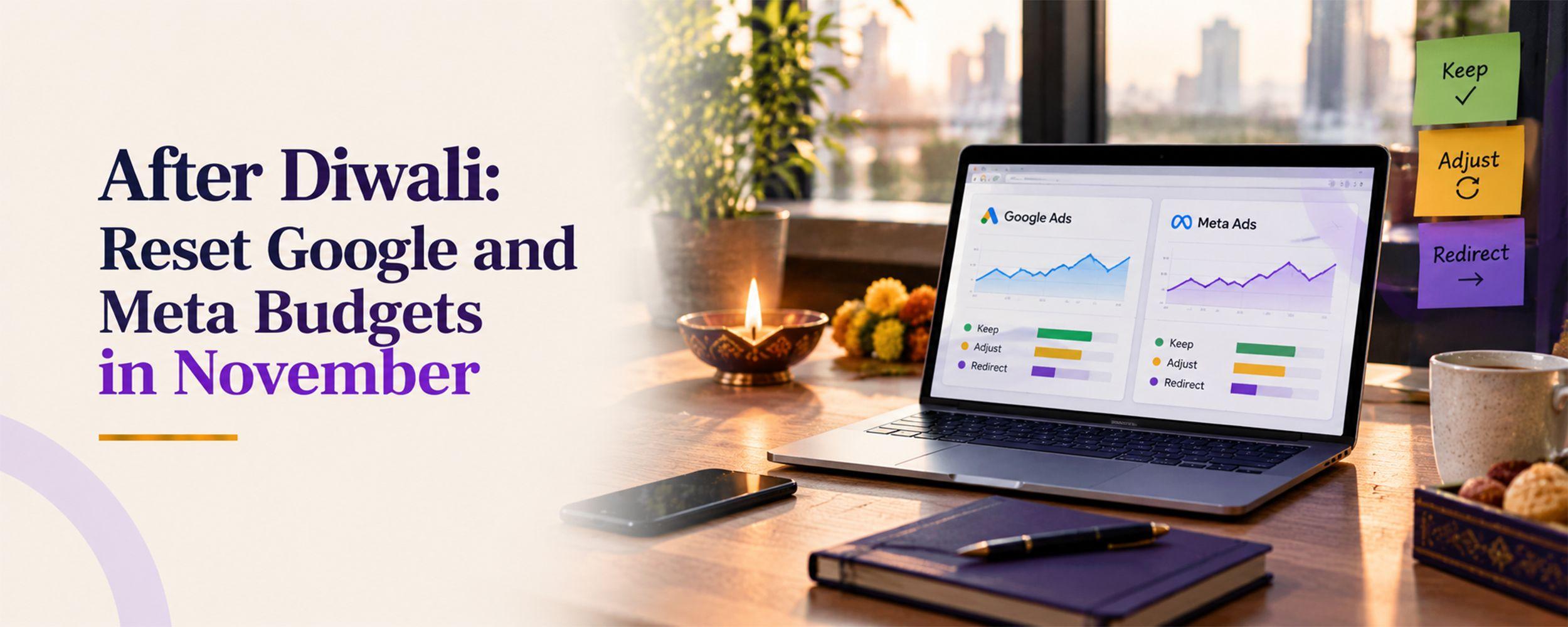
A Simple Reset: Keep, Adjust, Redirect
Instead of one big decision, sort every campaign into one of three groups.
| Group | What it looks like | What to do |
|---|---|---|
| Keep | Cost per qualified lead is steady against your pre-festive baseline | Leave it alone. Review again after seven days. |
| Adjust | Results dipped, but the dip matches last November, or the festive message is now stale | Refresh copy and creative, make small bid changes, clean up search terms. |
| Redirect | Cost per qualified lead stayed high even at the festive peak, or the offer no longer applies | Move part of the budget to a Keep campaign, to follow-up of festive leads, or to a small test. |
This sort follows the thinking in One Big Bet vs Many Small Ones, where we describe a 70-20-10 split: protect what works, scale what shows promise, and keep a small share for testing. After a festival, the protected group is usually your evergreen high-intent campaigns, and the test group is where you try the next seasonal idea.
Where to Put the Budget You Free Up
If you redirect some spend, these three places usually give the fastest returns in November.
1. Festive lead follow-up. Leads captured in the last two weeks are still warm. A call, a WhatsApp message or a useful email in the first fortnight of November often does more than a new ad. Make sure each lead has an owner and a date. If you suspect gaps in tracking, The Leads You’re Losing to Tracking You Can’t See shows a quick check.
2. Your evergreen search campaigns. People searching for your service in November have a problem to solve right now. These campaigns often run on tight budgets during festive weeks because attention goes to promotions. Give them room.
3. Your landing pages. After a high-traffic period you have fresh data on where visitors leave. A small fix to a form, a headline or a page speed issue makes every rupee of paid traffic work harder. Our article on website speed and paid ad budget explains why speed matters here.
If you sell to other businesses, November has its own rhythm. Decision makers return from leave, year-end purchasing and 2027 planning begin, and enquiries often come with longer timelines. In that case, widen your measurement window to match. A two-week view will serve you better than a daily one.
Common Slips in the Week After a Festival
None of these is serious, and each one is easy to avoid.
- Cutting every budget at once. This removes the data your bidding systems need and makes it hard to see what actually changed.
- Judging the week in isolation. Lag means the true result of festive spending is still arriving.
- Leaving festive messages live. An offer that has ended lowers trust.
- Overlooking leads already in hand. Winning a new lead costs more than converting one you already have.
- Making many edits in one day. If results change, you will not know which edit caused it. Change one thing at a time where you can.
For Marketing Heads and Founders: Where to Start This Week
- Export last November’s numbers. Look at cost per qualified lead, not only cost per lead, for the same weeks.
- Sort every campaign into Keep, Adjust or Redirect. One page is enough.
- Retire festive ads and banners. Check Google Ads, Meta Ads, your website and your email footers.
- Give every festive lead an owner and a follow-up date. Start with the most recent.
- Set a review date for next week. Decide your next budget move then, with a full conversion window behind you.
What This Means for Your Business
The week after Diwali is not a slump to get through. It is a clean look at your marketing without the festival’s lift. Read it against the right baseline, allow for lag, protect your learning systems, and move budget towards what is working. Businesses that treat November as a reset, not a retreat, usually enter December and the 2027 planning season with better data and clearer decisions.
Want a Second Pair of Eyes on Your November Numbers
MagicWorks runs Google Ads and Meta Ads as part of one full-funnel programme, with weekly and monthly reviews. Book a discovery call. Thirty minutes, no obligation. We will look at your post-Diwali numbers with you and give you honest next steps.
Explore: Google Ads & Search Marketing, Meta Ads and the Full-Funnel Digital Marketing programme, or book a discovery call.
Sources
- Vedantu, Diwali 2026 (2026), Diwali on Sunday, 8 November 2026: vedantu.com/blog/diwali-2026
- Best Media Info, Something changed this festive season, and it’s redefining how India advertises (2025), festive ad spend estimate and Criteo’s 14% online retail rise: bestmediainfo.com
- Razorpay Rize, Ad spend and CAC survival guide for festive season (2025), Meta CPM and Google CPC festive movement (single-source, directional): rizevault.razorpay.com
- Superads, Facebook Ads CPM benchmarks in India (December 2024 to December 2025 data): superads.ai
- Meta Business Help Centre, About the learning phase (accessed November 2026), as summarised by PPC Land: ppc.land/learning-phase
- Meta Business Help Centre, attribution settings (accessed November 2026), default 7-day click and 1-day view, as summarised by Coinis: coinis.com
- Google Ads Help, Create a seasonality adjustment (accessed November 2026): support.google.com
- Google Ads Help, Setting smarter search bids (accessed November 2026), conversion delay and target changes: support.google.com
- MediaNews4U, Meta’s Messaging Bet Pays Off: Click-to-WhatsApp Ads Jump 60% YoY (30 October 2025), citing Meta’s Q3 2025 earnings call: medianews4u.com
- Ozonetel, WhatsApp for Marketing (2026), India WhatsApp user estimate (industry estimate): ozonetel.com