
Indian families have always spread their savings. Some in gold, some in a bank deposit, some kept as cash at home. Not because any one of them is best, but because a single bad year should never wipe out everything. Spread means you survive to try again.
Google Ads budget allocation deserves the same care. This piece is about where the money goes, drawn from the anchor of this series, Same War, New Weapons, and from Morgan Housel: survival beats optimization. The goal is not to win one big month. It is to stay in the game long enough for good results to compound.
The machine will not split the budget for you
It is worth knowing what the platform does and does not do. Smart Bidding and Performance Max optimize within a campaign. They do not manage money across campaigns for you. Deciding that Search deserves more this week while another campaign pulls back is account-level work, and it stays in human hands.
That matters, because allocation is where a lot of budget quietly leaks. Accounts that reallocate in a disciplined way see meaningful gains, often a 25 to 35 percent lift in return within weeks, while accounts that let campaigns bid against each other can lose 20 to 30 percent to that overlap. The split is not a small setting. It is a strategy.
Why the one big bet feels smart
Pouring the budget into one campaign feels decisive. One audience, one message, all in. If it works, you look bold. The problem is what happens if it does not. A big bet that fails does not just lose money. It ends the run before you have learned anything.
The aim is not to win the month. It is to still be playing next year.
| Metric | One big bet | Many small bets |
|---|---|---|
| If it works | A strong month | A clear winner you can scale |
| If it fails | Budget gone, nothing learned | A small, capped loss and a lesson |
| What you learn | One data point | Several, in parallel |
| Recovery | Slow, you start over | Fast, the other bets carry on |
The 70-20-10 rule, and why it works
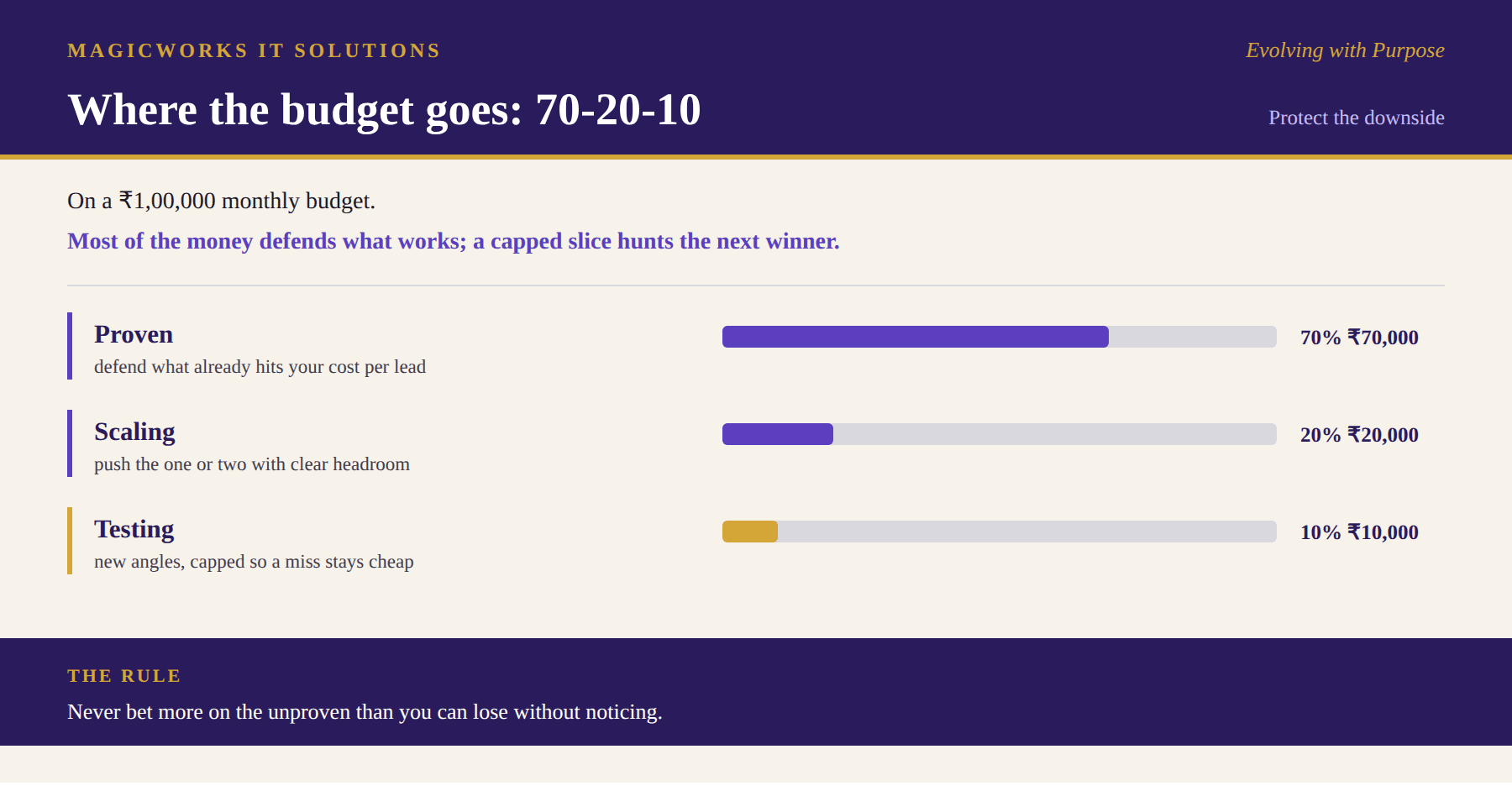
A common, sensible frame for Google Ads budget allocation is 70-20-10. Put about 70 percent on proven campaigns that reliably hit your cost per lead. Put about 20 percent on scaling the ones showing clear headroom. Keep about 10 percent for genuine tests of new angles, audiences, or formats.
The numbers are not sacred. The shape is. Most of your money defends what works. A slice pushes on what is growing. A small, capped slice looks for the next winner. Survival first, growth second, discovery last.
How to spend it in practice
Cap anything unproven at that small slice, so a bad idea costs a little, not a lot. When a campaign earns its place, scale it in steps of roughly 15 to 20 percent, not in one jump, so Smart Bidding does not reset its learning. And when you are unsure, use campaign experiments to test a new budget level on part of the traffic before you commit the whole account to it.
The same idea works inside a single campaign. Do not let one keyword or one audience quietly eat the whole budget before you know it converts.
A worked example: the split on a real budget
Numbers make it concrete. Take a monthly budget of one lakh rupees and apply the 70-20-10 split.
Now the discipline. That ₹10,000 test bucket is a ceiling, not a target. If a single test would need more than it, that is not a test, it is a bet, and it belongs in a different conversation. And the ₹70,000 is not frozen. As a test proves itself, it graduates into the proven bucket and earns a share of the 70. The shape holds; the campaigns inside it keep moving.
How budget talks to Smart Bidding
Budget is not just a spending cap. It is an input the bidding system reads. Two mistakes hurt most here.
The first is starving a learning campaign. When you launch on automated bidding, the system needs a run of conversions to find its feet. Set the budget too low and it never gathers enough to learn, so it stays clumsy, and you blame the tool for your own throttle.
The second is the yo-yo. Big, sudden budget swings reset that learning. Raising budget in steps of roughly 15 to 20 percent, and holding each step for a week or two, lets the system adjust without starting from scratch. Patience is a setting here, even though the dashboard never labels it one.
Two honest exceptions. Seasonality: when you know a real surge is coming, an admission season, a festival, a sale, raise budget ahead of it, not after, so you are not throttled on your best days. And shared budgets: pooling one budget across campaigns feels tidy, but it lets your strongest campaign get starved by a weaker one drawing from the same pot. Keep the important campaigns on their own budgets, where you can see and defend them.
Read the signals before you move money
Scaling is not just spending more. It is spending more where the account can absorb it. Three signals say a campaign has room: it has held your target cost per lead for at least two weeks, it is losing impression share to budget rather than to rank, and its conversion rate is steady. Push those.
Hold back where the opposite is true. A campaign already near the top of its impression share has little room left, and spending past it just buys weaker traffic. A campaign with jumpy recent numbers needs time, not money. Raise budget in steps, and let each step settle before the next.
And watch the quiet drain of cannibalization. When two of your campaigns chase the same searches, they bid against each other and you pay more for the same lead. Clean structure and negatives keep your own campaigns out of each other's way.
Three ways allocation quietly goes wrong
- Scaling everything at once. Raising every budget together buries your winners among your losers. Front-load the proven, hold the rest.
- Reviewing only once a quarter. Budgets drift daily. A monthly read, at least, keeps money moving toward what works.
- Letting one line item run wild. A single keyword or audience can eat a campaign before it has proven it converts. Cap first, scale later.
What a healthy account looks like after a year
Zoom out, and the point of all this becomes clear. Allocation is not one decision. It is a habit that compounds.
An account run this way looks calm from the outside and busy underneath. The proven bucket fills with campaigns that earned their place, one graduating test at a time. The scaling bucket rotates as different campaigns find headroom. The testing bucket never stops running small, cheap experiments, most of which fail quietly and cost little. Nothing dramatic happens in any single month. Over a year, the winners have been fed and the losers starved, again and again, and the results pull steadily upward.
Compare that to the spiky account: one big bet each month, a good month followed by a scramble, budgets swinging, learning resetting. It feels more exciting. It performs worse, because it never lets anything compound.
How do you know a test has earned promotion? When it has held your target cost per lead across a fair sample of conversions, not a lucky week. Promote it, give it a slice of the proven budget, and open the test slot for the next idea. Slow, boring, and quietly hard to beat.
If you take one habit from all of this, make it the monthly split. Sit down once a month, look at what each bucket actually did, and move the money to match. Not a grand rethink, just a steady hand on the tiller. That single habit, repeated, quietly beats any clever one-time move.
The Rule
Never put more on the unproven than you can afford to lose without noticing. Prove it small, scale it in steps, and keep most of your money on what already works.
Free Download
A simple sheet to plan your 70-20-10 split and cap your test spend. Free to download, no sign-up.
Download the Budget-split calculator (XLSX).
Not Sure How to Split the Budget?
We help teams plan an allocation that protects the downside and still leaves room to find the next winner. Steady beats spiky.
Talk to us about media planning
Part of the Same War, New Weapons series on the performance marketing principles that survive every platform update.