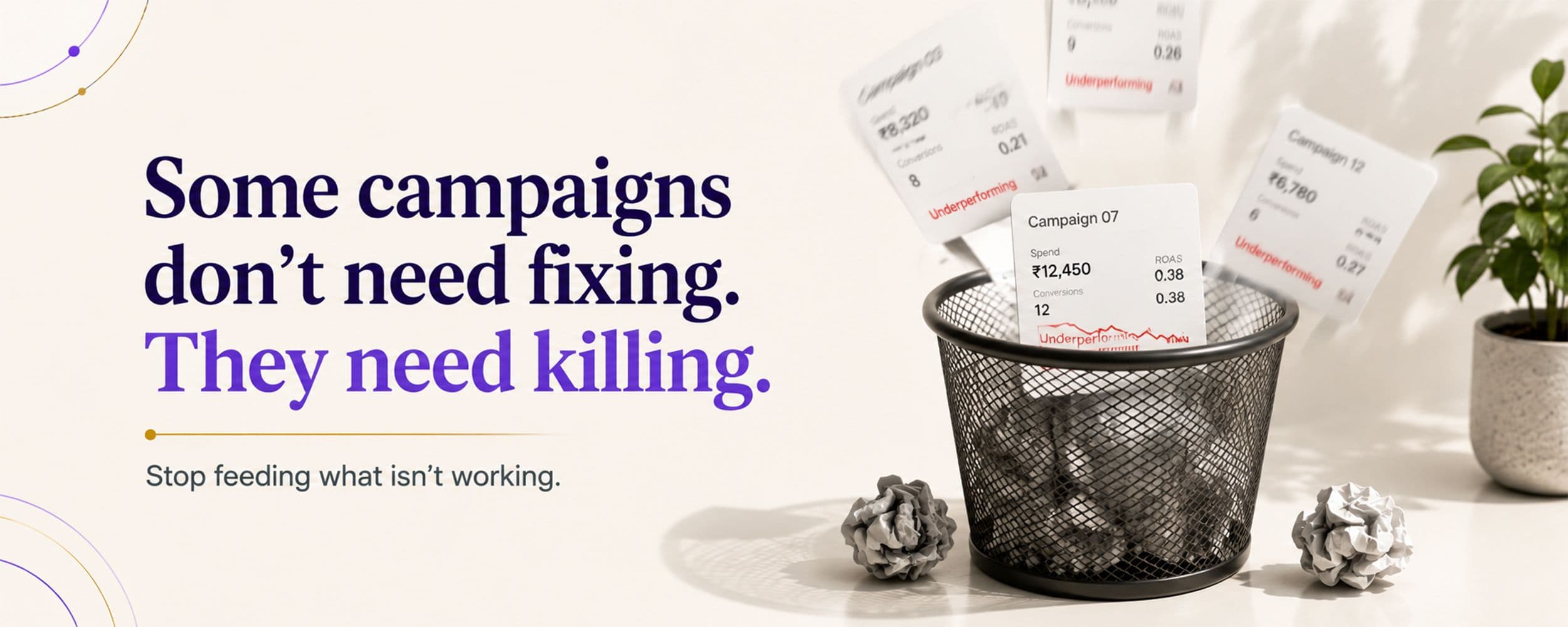
A good gardener cuts the dead branch. Not out of anger, but because the tree only has so much to give. Cut the branch that will not recover, and the tree feeds the ones that will. The plant grows stronger for the loss.
Campaigns work the same way, and most accounts forget it. This is a piece about Google Ads campaign performance analysis, built on one idea from the anchor of this series, Same War, New Weapons, and from Sun Tzu: do not reinforce defeat. A weak campaign rarely turns around because you feed it more money. Good commanders move resources to where they are already winning.
We keep the losers on life support
When a campaign struggles, the instinct is to save it. More budget. More time. One more week. It feels responsible. It is usually the sunk cost talking. The money already spent is gone. The only question that matters is where the next rupee works hardest.
Cutting is not failure, and it is not rare. Gartner found that 87 percent of marketing leaders hit campaign performance problems in a year, and 45 percent now end campaigns early when the numbers slip. The best operators are not the ones who never have a weak campaign. They are the ones who read it early and act.
Reading weakness by the day
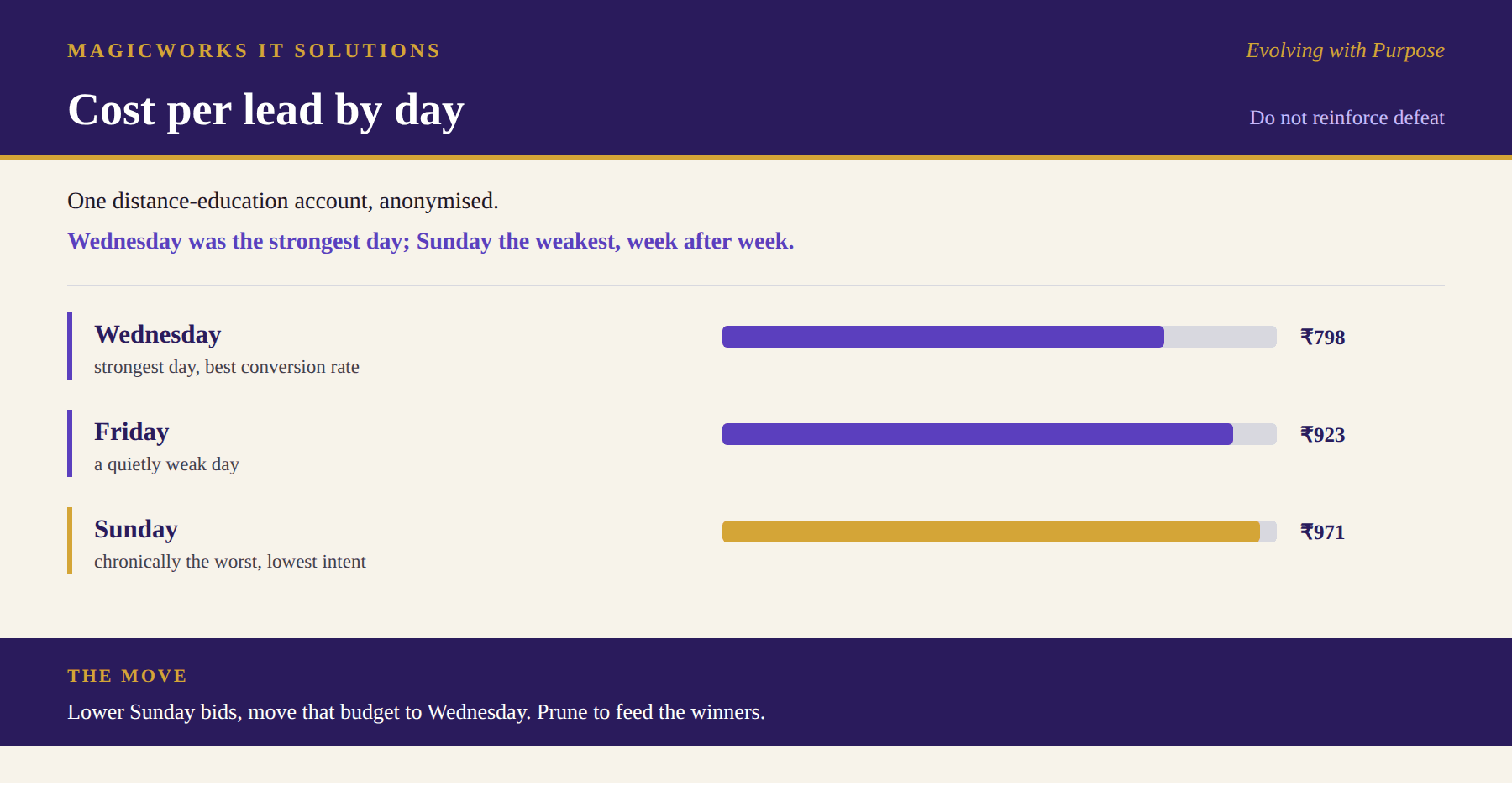
This is what performance analysis really is: breaking the numbers down until the weakness has nowhere to hide. Weakness hides in averages. Split by day, device, and audience, and the soft spots appear. On one distance-education account, a day-of-week read told a clear story.
| Metric | Cost per lead | Read |
|---|---|---|
| Wednesday | ~₹798 | Strongest day, best conversion rate |
| Friday | ~₹923 | A quietly weak day |
| Sunday | ~₹971 | Chronically the worst, lowest intent |
Sunday was not a one-off. It was the weakest day, week after week. Feeding it the same budget as Wednesday was reinforcing defeat, every single week.
That is the real value of a regular performance analysis. It is not a report you file. It is how you catch both the slow weakness and the sudden one, before either one drains a month.
The five cuts that reveal weakness
A real performance analysis is not one number. It is the same spend, sliced five ways, until the weak part shows itself.
- By day. Chronically weak days, like the Sunday above, that quietly drag the average down.
- By device. Mobile and desktop often convert at very different costs. One may be carrying the other.
- By audience. A segment that clicks a lot and converts little is spending your budget to look busy.
- By search term. The search terms report shows what people actually typed, and where irrelevant clicks hide.
- By hour. Some hours bring browsers, not buyers. Dayparting turns that into a bid decision.
Run these five, and the campaign you should have killed usually names itself.
Do not cut on too little data
Cutting is powerful, which is why it needs a rule. One bad day is noise, not a verdict. Give a segment enough conversions to judge it fairly before you pause it, and separate a structural weakness, one that repeats week after week, from a single off day. The Sunday pattern earned its cut because it showed up every week. A quiet Tuesday once does not.
How to run the analysis, step by step
A performance analysis works best as a routine, not a rescue mission. Here is a simple monthly pass.
- Set the window. Pull the last 30 to 90 days, enough for patterns to show and single-day noise to settle.
- Start wide, then narrow. Look at the account, then campaigns, then ad groups, then the five cuts. Let the weak spot surface on its own.
- Compare, do not just read. A cost per lead means little alone. Next to the account average and last month, it tells a story.
- Write the kill-list. Three to five specific moves. Pause this, lower bids there, move that budget here.
- Note what you changed. So next month you can see whether the cut worked, instead of guessing.
How much data is enough? Judge a segment on conversions, not clicks. A handful of conversions is a hint, not a verdict. Wait for a fair sample before you pause something, or you will cut a good campaign on a bad week.
The usual sources of a weak campaign
Weakness is not random. It tends to come from a few familiar places, and naming the source tells you whether to cut or to fix.
Mismatched intent is the most common. The keyword, the ad, and the page are pulling in three directions, so clicks arrive and leave. That is a structure fix, not a kill. Wrong audience or place is next: a campaign spending in regions or on devices that never convert, which is a targeting cut. Then there is timing, the Sunday problem, where the same money simply works less hard on certain days, which is a bid adjustment.
And sometimes it is genuine saturation: a campaign that has already reached everyone worth reaching, where more budget only buys weaker clicks. That one you hold, not feed. Read the source before you act. Cutting a campaign that only needed a page fix throws away a winner in disguise.
The numbers that flag a weak campaign
Five metrics do most of the diagnosing. Read them together, not alone, and the weak campaigns light up.
- Cost per lead, versus the account average. The first flag. A campaign well above the average is either mispriced or mismatched.
- Conversion rate. Plenty of clicks and few conversions points at the page or the offer, not the bid.
- Impression share lost to rank. Losing views because your ads rank poorly is a quality and relevance problem, not a budget one.
- Impression share lost to budget. The opposite signal. A strong campaign capped by budget is not weakness, it is a scaling opportunity.
- Search terms. The rawest truth in the account. What people actually typed shows the irrelevant clicks you are funding.
Auction insights add one more layer. If a competitor has moved in hard on your best terms, a rising cost per lead may not be your campaign weakening at all. It may be the ground shifting under it. That changes the move: not a cut, but a decision about whether that fight is still worth having.
One caution the dashboard cannot show you is lead quality. A campaign with a low cost per lead that sends junk is not a winner, it only looks like one. Where you can, check with sales on which campaigns send leads that actually close, and weigh that against the on-screen numbers before you crown a winner or cut a loser.
Field Note: The Automated Pause
What happened: one Sunday, the platform's automated low-activity system paused keywords across 21 campaigns at once, with no one asking for it. The cost: leads nearly halved that day, from about 55 to 29, and cost per lead jumped from roughly ₹694 to ₹1,127 overnight. The lesson: weakness is not always yours to cause. An automated change can create it. You still have to read it, and reverse it.
Cutting is reallocation, not failure
Killing a weak segment is not admitting defeat. It is moving strength to strength. Pause the day that never pays. Lower bids where intent is low. Send that budget to Wednesday, where it works. Do this once a month and it becomes a habit. A short kill-list, read from the data, not the hope.
The bravest thing in an account is often the pause button.
None of this is about being ruthless. It is about being honest. A campaign is not a colleague, and pausing one is not a failure of loyalty. It is how you free the budget your best work has already earned. The kindest thing you can do for a strong campaign is to stop feeding the weak one beside it. Do it every month, write down what you changed, and the account gets quietly stronger while your competitors keep hoping their weak campaigns turn around on their own.
The Monthly Kill-List
Once a month, pull performance by day, device, and audience. Mark the segments that never pay. Pause or cut their bids, and move the budget to what already wins. Prune to feed the winners.
Free Download
The exact prompts and cuts to run your own monthly kill-list. Free to download, no sign-up.
Download the Weakness-audit prompt pack (PDF).
Want a Fresh Read on What to Cut?
We run an optimization sprint that finds the segments quietly draining your budget, and moves that spend to what converts.
Part of the Same War, New Weapons series on the performance marketing principles that survive every platform update.