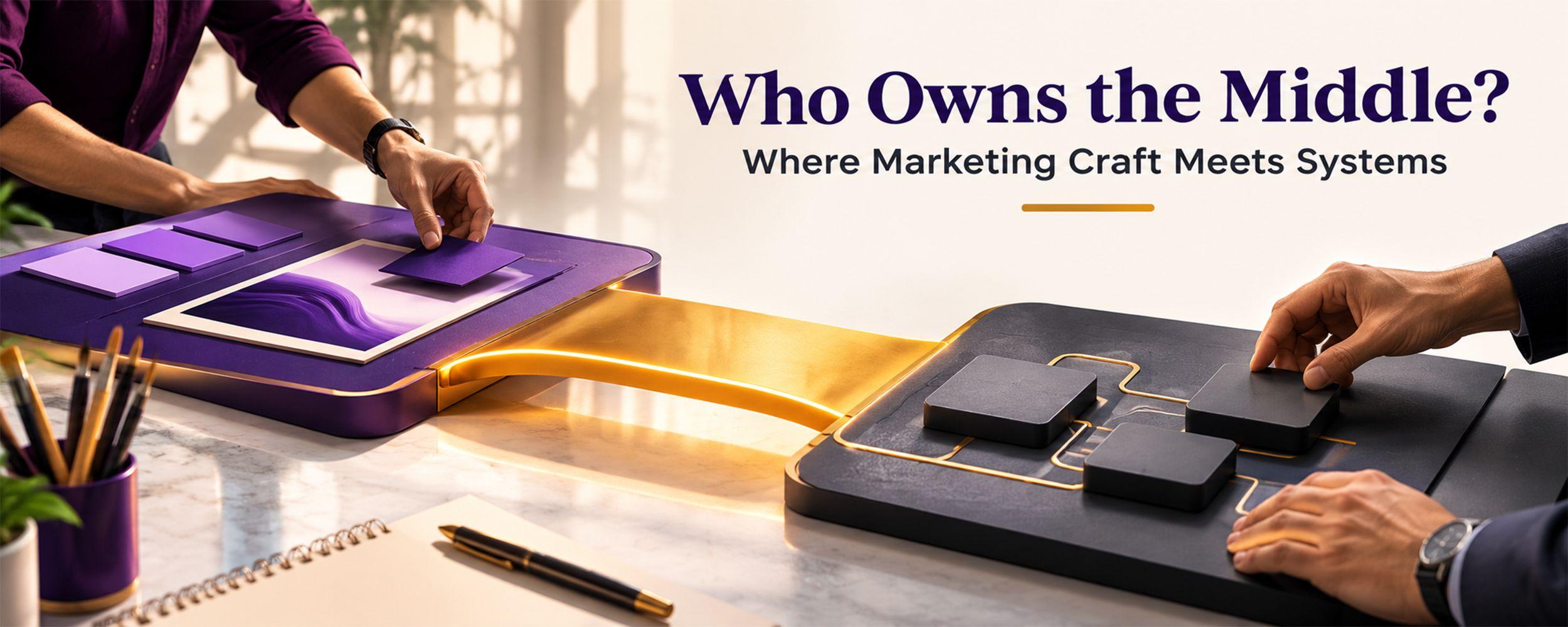
Craft gives your brand meaning. Systems give it momentum. The middle gives it direction.
Look at how marketing teams are organised today and you will notice a pattern. The work is settling into two disciplines, marketing craft and marketing systems, each with its own skills, tools and leaders. This shift has been building for years. AI is now making it easier to see.
It is a healthy development. Deeper specialisation produces sharper creative work and sturdier systems. It also raises one question that deserves a clear answer: who owns the middle, the place where the two disciplines meet and turn into revenue?
This article explains what each discipline brings, what the middle really is, and why AI raises its importance. You will also see how to assign ownership in a way that suits your business, and a short plan you can start this week.
Two disciplines, two sets of strengths
Think of marketing systems as the science. It covers data, technology, AI, measurement, acquisition and retention. The people here enjoy clean dashboards, tested hypotheses and repeatable processes. Their gift is making results predictable and scalable.
Think of marketing craft as the art. It covers brand, positioning, customer understanding, creative and strategy. The people here enjoy a sharp insight, a memorable idea and a story that makes a buyer feel understood. Their gift is making a business matter to the people it serves.
- Marketing systems (the science): data and analytics, technology and automation, AI, measurement, acquisition and retention.
- Marketing craft (the art): brand, positioning, customer understanding, creative and strategy.
Some topics sit in both camps. Customer understanding, for example, needs research craft and data discipline together. Treat the two lists as two centres of gravity rather than two sealed boxes.
Why specialisation is good news
Specialisation lets people go deep. A systems specialist can build a measurement model that a generalist would never have time to design. A craft specialist can spend weeks understanding why buyers hesitate, then turn that into a positioning line that does real work.
Deep skill is a competitive advantage, and it is worth protecting. The opportunity is to pair each specialist with a clear way of working together. Teams that do this keep the depth and gain alignment.
Research on B2B growth points the same way. Work by Les Binet and Peter Field with the LinkedIn B2B Institute found that B2B effectiveness tends to peak when roughly 46% of budget goes to brand building and 54% to activation (Binet and Field, LinkedIn B2B Institute, 2019). The exact ratio varies by category and context, so treat it as a guide rather than a rule. The useful lesson is that craft and systems both earn their share, and someone needs to decide the balance.
What the middle actually is
The middle is the set of decisions that neither discipline can make alone. It includes questions such as these:
- Which audience do we prioritise this quarter, and why?
- Which metric tells us our positioning is working?
- What should automation handle, and what should stay human?
- How do we split budget between building the brand and capturing demand?
- Which tools earn a place in the stack, and what will we use them for?
When these decisions have an owner, craft and systems amplify each other. When they do not, two quiet patterns tend to appear. Both are easy to spot early, which is good news.
Pattern one: efficient systems, unclear direction
A well-built system optimises whatever it is pointed at. If the direction is vague, it becomes very efficient at pursuing the wrong goal. Cost per lead improves while lead quality stays flat. The dashboard looks healthy, and the sales team still asks for better enquiries.
Pattern two: strong craft, loose operations
A great idea needs a route to revenue. Without tracking, clean handoffs and consistent follow-up, even a beautiful campaign leaves little evidence of what it achieved. The creative team feels proud, and the finance team cannot see the link to pipeline.
Both patterns are signals, not failures. They tell you the middle is ready for an owner.
A useful data point: technology without shared direction
Gartner's 2023 Marketing Technology Survey of 405 marketing leaders found that organisations used only 33% of their martech stack's capabilities on average. That compares with 42% in 2022 and 58% in 2020. In the same research, technology took about a quarter of marketing budgets (Gartner, 2023).
Gartner named complexity, customer data challenges and inflexible governance as the most common impediments. Our reading is that this is also a middle opportunity. Tools are often chosen on the systems side, while the craft side defines what those tools should help customers feel and do. When both voices shape tool selection and the roadmap, utilisation has a much better chance to rise.
The same research carries encouraging news. Organisations using more than half of their stack were significantly less likely to be asked to cut martech budgets (Gartner, 2023). Better use earns trust and continued investment.
Why AI raises the importance of the middle
AI touches both disciplines. It drafts content, builds audiences, analyses performance and automates follow-up. That makes it everybody's tool, and so it can easily become nobody's responsibility. Many teams ask who should own AI. A more useful question is where AI decisions get made.
AI decisions have two halves. The craft half asks: what do we want to say, to whom, and in what voice? The systems half asks: what data feeds this, how do we measure it, and what are the guardrails? An AI programme with only the systems half produces fast, generic output. One with only the craft half produces strong ideas that cannot scale.
At MagicWorks, we describe this as human strategy, machine acceleration. People set the direction. Machines carry it further and faster. That sentence works only when direction and acceleration are planned together, and that planning happens in the middle.
Search visibility is a good example. AI answer engines favour content that is clearly positioned, which is craft, and well structured, which is systems. Our work in search and answer engine optimisation and thought leadership for generative engines sits in exactly this overlap.
This is why AI belongs in the middle rather than inside a single team. Placing it there lets every function benefit and keeps accountability clear.
Who should own the middle? Five candidates compared
Each candidate brings a real strength. The best choice depends on which strength your business needs most at its current stage, and which supporting strengths you pair with it.
| Candidate | Natural strength | Best paired with |
|---|---|---|
| CMO | Owns strategy, brand and budget, and answers for growth | A strong systems lead who turns strategy into measurement |
| CRO | Owns revenue and sees the full pipeline | A craft voice that protects positioning and brand beyond the quarter |
| RevOps | Owns process, data and the handoffs between marketing and sales | Craft input on messaging and customer understanding |
| Marketing ops | Owns tools, workflows and reporting | A senior sponsor who sets direction and priorities |
| A new integrator role | Built for the middle, with fluency in both disciplines | Clear authority, a shared scorecard and executive backing |
No single title wins everywhere. Size and stage matter. In a smaller team, the CMO or Head of Marketing usually carries the middle naturally. As the team grows and the systems side deepens, a dedicated integrator, such as a Head of Marketing Strategy and Operations, starts to pay off.
One person or shared accountability?
Our answer is both, applied to different things. Give one person ownership of the middle. Share accountability for the outcomes it produces.
One owner matters because decisions in the middle need a tiebreaker. When the brand view and the performance view differ, someone should be able to decide, explain the reasoning and move forward. Without that person, decisions wait for consensus and momentum slows.
Shared accountability matters because results come from both sides. Craft and systems leaders should be measured on the same outcomes: qualified pipeline, customer retention and revenue per marketing rupee. When both carry the same scorecard, collaboration becomes the natural choice.
Does this person need to be an expert in both disciplines? No. They need enough fluency to ask good questions on both sides, respect for both specialisms and the authority to align them. Curiosity matters more than a perfect CV.
Three working agreements that make the middle work
1. One shared scorecard
Build a single scorecard that mixes craft indicators and systems indicators. Branded search demand, enquiry quality, sales cycle length, win rate, cost per qualified opportunity and retention can sit together. Both teams review the same page every month.
2. A monthly bridge review
Hold one standing 60-minute meeting where craft and systems leads review the scorecard, agree one priority and decide what to stop. Keep the agenda short: what we learned, what we will change and who owns it.
3. An AI use-case register
List every AI use in marketing in one shared document. For each one, record the craft brief (audience, message and voice), the systems guardrail (data source, measure and review step) and a named owner. The register keeps AI work visible, consistent and easy to improve.
Where to start this week
You do not need a reorganisation to begin. Five small steps are enough to make the middle visible.
- Map your middle. List the five decisions that currently fall between craft and systems in your team. Note who makes each one today.
- Name an owner. Pick one person to own those decisions for the next quarter. Write the decision rights on a single page.
- Draft the scorecard. Choose six to eight indicators, half from craft and half from systems. Agree where each number will come from.
- Start the AI register. Add every AI tool your team uses today, with an owner for each.
- Book the first bridge review. Place it on the calendar within four weeks and invite both leads.
Small, visible steps build trust quickly. Within one quarter, you will have a clearer picture of how craft and systems support each other in your business.
The opportunity ahead
Marketing is becoming richer, not more fragmented. Craft gives your business meaning. Systems give it momentum. The middle gives it direction. Businesses that name an owner for the middle, give it a shared scorecard and place AI inside it will compound results faster than those that leave it to chance.
At MagicWorks, we bring both disciplines together for growth-minded businesses, with strategy, creative, web engineering and automation working as one system. If you would like to see how the middle looks in your own marketing, we would be glad to help.
Ready to strengthen the middle of your marketing?
Book a discovery call or get a free audit, and we will show you where craft and systems can work better together.
Book a discovery call or get a free audit.
Sources
- Gartner, "Gartner Survey Finds 63% of Marketing Leaders Plan to Invest in Generative AI in the Next 24 Months", press release, 23 August 2023 (2023 Marketing Technology Survey of 405 marketing leaders, conducted May and June 2023). Primary source: gartner.com.
- LinkedIn B2B Institute, with Les Binet and Peter Field, "How B2B marketing really drives growth", LinkedIn Marketing Solutions blog, 2019 (46% brand building to 54% activation guidance for B2B). Primary source: business.linkedin.com.