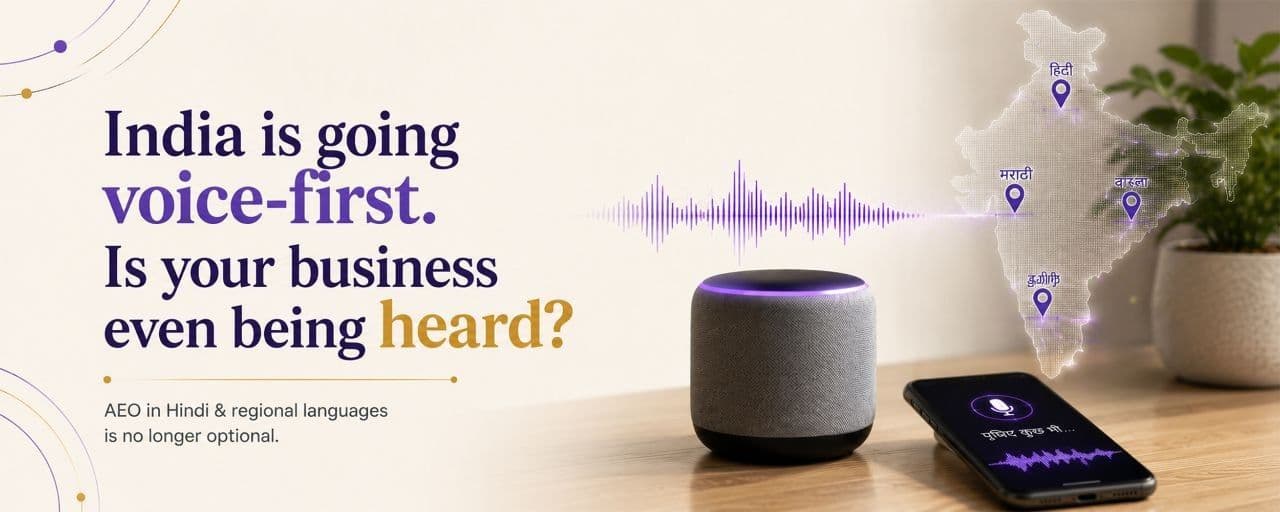
Every AEO checklist your business has probably read assumes one thing without ever saying it out loud: that the question being asked of ChatGPT, Gemini, or Google's AI Overviews is typed or spoken in English. For the 488 million Indians online from rural India alone, now the single largest segment of the country's internet base, that assumption is already wrong.
The Blind Spot Nobody Is Auditing For
Answer Engine Optimisation exists to make sure your business is the source an AI model reaches for when someone asks it a question. Over the past year, MagicWorks has helped clients structure content, schema, and citations so that ChatGPT, Perplexity, and Google's AI Overviews recognise them as an authority. Almost all of that work, across the industry and not just for us, has happened in English.
That gap is now large enough to matter commercially. India's internet growth has not been led by English-first metro users for several years. Rural India alone accounts for over half of the country's active internet base, and the fastest-growing segment of voice and conversational queries is happening in Hindi, Marathi, Tamil, Telugu, Bengali, and a handful of other Indian languages, often mixed naturally with English in the same sentence.
This matters more for AI answer engines than it ever did for traditional SEO. A Hindi-speaking user searching on Google a decade ago would eventually find an English result and make do, because search results were a list to sift through. An AI answer engine does not hand over a list. It picks one version of the truth, states it as if it were the only version, and reads it aloud or displays it as the final word. If your business is not part of the material that answer is built from, the AI does not leave a gap where you should be. It fills that gap with someone else's information, or with none at all.
If your website, your FAQ schema, and your Google Business Profile only speak English, you are not underperforming with this audience. You are structurally invisible to it, because there is nothing in your language for an AI model to retrieve, cite, or read aloud.
Why This Is an AI Answer Problem, Not Just a Translation Problem
It is tempting to treat this as a simple fix: translate the website, add a language switcher, move on. That approach solves for human readers and misses what actually decides AI visibility.
Answer engines do not all retrieve information the same way. Google's AI Mode and AI Overviews lean on the Knowledge Graph and structured data, so a business that has schema markup only in English effectively has no structured presence in Hindi at all, no matter how good the English site is. ChatGPT relies more on semantic understanding of well-organised, comprehensive content, which means a page that is machine-translated word for word, without being restructured for how a Hindi or Marathi speaker actually asks a question, tends to read as thin and gets skipped. Perplexity weights citation density and real-time indexed sources, so if there is no vernacular source to cite, it will either default back to an English competitor or, more riskily, stitch together an answer from whatever low-quality regional content exists elsewhere about your category, including content that has nothing to do with your business.
That last scenario is the one worth sitting with. It is not that your business goes unmentioned. It is that an AI model, faced with a Hindi-language query and no authoritative source from you, may confidently generate an answer about your category using someone else's information, or worse, outdated or incorrect information about you. Invisibility in one language is rarely neutral. It is usually filled by whoever showed up instead.
The Scale of What Is Being Missed
A few verified data points make the size of this gap concrete rather than theoretical.
- Rural India now accounts for 55% of the country's 886 million active internet users, 488 million people, and is growing faster than urban India, according to the IAMAI-Kantar Internet in India Report 2024.
- 98% of Indian internet users consume at least some content in an Indic language, and 57% of urban internet users actively prefer regional-language content over English, per the same IAMAI-Kantar report.
- At the Google for India 2024 event, Google's Search product lead stated that 40% of Gemini's Indian-language users already rely on voice input, which is why the company expanded Gemini Live from English into Hindi and eight additional Indian languages, including Marathi, Tamil, Telugu, Bengali, Gujarati, Kannada, and Malayalam.
- At the same event, Google confirmed it was extending AI Overviews in Search from English and Hindi into Bengali, Telugu, and Marathi.
None of this is a niche consideration for businesses that only sell in metro English-speaking markets. Education, real estate, manufacturing, healthcare, and professional services, the exact industries MagicWorks works with most, all have buyers who research and ask AI tools questions in their first language, even when they are comfortable enough in English to complete a form.
What a Real Vernacular AEO Audit Should Check
Before writing a single line of regional content, run the same kind of self-audit we run for English AEO, just in the languages your buyers actually use.
1. Test the actual query, not the English equivalent
Open an incognito window and ask ChatGPT, Perplexity, and Google's AI mode the question a real customer would ask, phrased the way they would phrase it. “Pune mein sabse accha web development company kaun sa hai” is a different query, retrieved differently, than “best web development company in Pune.” Run both and compare what comes back. Note which sources each model cites, whether it recognises your business at all, and whether the answer it gives in Hindi matches the accuracy of the English answer. Screenshot both, because this becomes your baseline to measure against once regional content is live.
2. Check whether your schema exists in the language at all
FAQ schema, service schema, and local business schema should exist in Hindi or the relevant regional language as its own structured block, not as an afterthought bolted onto an English page. Google's systems read structured data literally, so a schema block that says “English” in its language attribute while displaying Hindi text on the page confuses rather than helps. If your website was built without a content management setup that supports multilingual schema, this is usually the first technical gap a web development audit should catch, well before anyone starts writing regional content.
3. Rewrite, do not machine-translate, the FAQ layer
The highest-leverage content for AEO is the FAQ block, because it mirrors how people actually ask AI tools questions. A Hindi FAQ section written the way a Hindi speaker naturally asks a question outperforms a translated English FAQ every time, because it matches the phrasing an AI model is trying to answer. This usually means starting from a blank page in the regional language rather than opening a translation tool, since natural phrasing, common misspellings, and the mix of English loan words that shows up in real Hindi or Marathi typing are exactly what a machine translation smooths over and removes.
4. Extend Google Business Profile into the regional language
Posts, the Q&A section, and service descriptions on Google Business Profile should exist in the dominant regional language of each location you serve. This single step is disproportionately effective for local and voice-driven queries, and it is frequently skipped, largely because it takes a few hours of manual work rather than a redesign. For a business with multiple locations across different states, this also means the regional language should match the actual location, not a single default language applied uniformly across every listing.
5. Decide script and transliteration deliberately
Hinglish written in Roman script, Hindi in Devanagari, and formal regional-language content each serve different query patterns. A single business often needs more than one of these, matched to how its specific audience types or speaks, not a single default. A younger, urban audience searching on a phone is more likely to type in Roman-script Hinglish, while a voice query in the same city is more likely to be spoken in full Hindi or the local regional language, which means the written and spoken versions of your content may need to diverge slightly to match both behaviours.
What This Looks Like in Practice
Consider a hypothetical, but realistic, scenario: an education consultancy with a strong English-language website, solid AEO fundamentals, and consistent placement in AI Overviews and ChatGPT answers when a prospective student searches in English. Its actual enquiry funnel, however, includes a large number of parents in Tier 2 cities who research admissions counselling in Hindi or a regional language before ever visiting the website. Run the incognito test from the first checklist item, and the gap becomes visible immediately. The English query returns a confident, well-cited answer naming the consultancy. The Hindi equivalent returns a generic answer about admissions counselling in general, citing a mix of unrelated blogs and forum threads, with no mention of the business at all.
The fix is not a full website rebuild. It typically starts with rewriting the five or six FAQ questions parents actually ask, in Hindi, as their own structured block with proper schema, extending the Google Business Profile posts and Q&A into Hindi, and re-running the same incognito test after a few weeks to see whether the AI models have picked up the new content. This is the same sequence MagicWorks runs for English AEO engagements, applied to a language layer that most competitors in the education space have not touched yet, which is exactly why it tends to move faster than saturated English-language competition.
Getting Started Without Overhauling Everything
The instinct when facing a gap this size is to treat it as a full localisation project, complete with a translated website, a language switcher, and a parallel content calendar. That is usually the wrong place to start, because it is slow, expensive, and delays the parts of this that actually move AI visibility.
A more realistic sequence looks like this. Start with the incognito audit across your two or three highest-intent queries, in the language your actual buyers use. Fix the FAQ and schema layer for just those queries first, rather than the entire site. Extend Google Business Profile immediately, since it requires no development work at all. Only after those three steps show measurable movement in what AI tools retrieve and cite should a broader regional content calendar or a fully localised site structure be considered. This keeps the work tied to evidence rather than to an assumption that more content in more languages automatically means more visibility.
Where This Connects Back to the Work
This is not a side project bolted onto an existing GEO or AEO engagement. It is the same discipline, applied to the language your next customer is actually going to use. MagicWorks' Digital Marketing and SEO/AEO work already builds the entity structure, schema, and citation-worthy content frameworks that get a brand recognised by AI models. Extending that into Hindi and regional languages is a natural, high-leverage next step for any client whose buyers sit outside the English-first metro bubble, which, for most Indian businesses, is a majority of the country.
The businesses that treat this as infrastructure now, not a translation task for later, will be the ones an AI model actually finds when Bharat asks the question out loud.
Want Help Running This Audit
MagicWorks helps businesses find and close the vernacular AEO gap: structured Hindi/regional FAQ and schema, Google Business Profile extension, and the same incognito-test methodology described above. Book a discovery call to see where your current AI visibility stands in the languages your buyers actually use.
Purva Desai is a Digital Marketing Executive at MagicWorks IT Solutions, Pune, working across SEO, AEO, GEO, and content strategy.