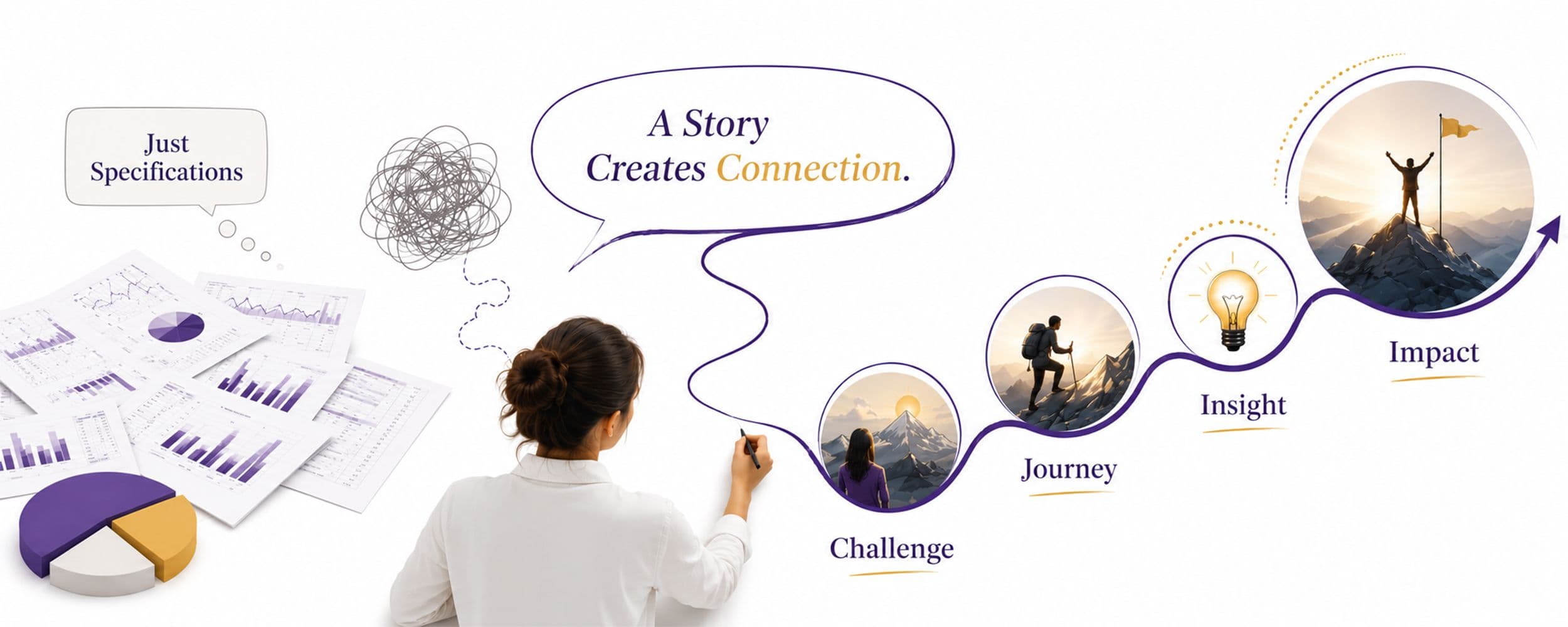
Give a room of people a ten-minute presentation full of statistics, and ask them a week later what they remember. Most researchers who have run this experiment get the same uncomfortable answer: almost nothing. One well-documented study found that only 5% of an audience could recall a single statistic from a presentation a week after hearing it. The same audience, when a presenter wrapped similar information inside a story, recalled it at a rate of 63% (John Millen, 2025, citing Stanford's Jennifer Aaker). This is the actual, measured reason why storytelling sells better than a spec sheet ever will, and it is not a copywriting opinion.
Why Your Brain Treats Stories Differently
Stanford marketing professor Jennifer Aaker's research is widely cited for a striking claim: that a fact wrapped in a story can be up to 22 times more memorable than the same fact presented alone (Jeff Bloomfield, 2026). The exact multiplier has been debated, since Aaker's own published work does not fully document how the number was calculated. But the underlying mechanism is well established through decades of separate research. A 1969 Stanford study found that when students were asked to memorise a list of twelve unrelated words, those who built the words into a short story recalled 93% of the list later, compared with just 13% among students who tried to memorise the list directly (LinkedIn, 2024, Patience Davies, a useful independent audit of where the "22 times" figure actually comes from). The story did not just make the words more interesting. It made them stick.
Neuroscience explains why. Facts and figures engage only the language-processing regions of your brain. A well-told story engages your emotional centres and your decision-making regions at the same time, and Princeton neuroscientist Uri Hasson has documented a phenomenon called neural coupling, where a listener's brain activity begins to physically mirror the storyteller's while the story unfolds (Jeff Bloomfield, 2026). A spec sheet cannot do that. A story can.
The One-Minute Pitch Experiment
Aaker's most cited study asked business school students to each deliver a one-minute persuasive pitch to their classmates. Nine out of ten students built their pitch almost entirely around statistics, an average of two and a half data points each. Only one student told a story instead. When the audience was later asked to write down everything they remembered from every pitch, the story consistently outperformed the statistics-heavy pitches by a wide margin (Nicole Clark Consulting, 2023, a small consultancy blog worth treating as one supporting data point rather than an independently audited study). The irony is that most business presentations are built exactly like the nine losing pitches, not the one winning one.
What This Means for a B2B Sales Deck
This is not an argument against data. It is an argument for where data belongs. A specification sheet answers the question what does this do. A story answers the far more persuasive question: what happens to a business like mine when this works. The strongest B2B sales materials use both, but in the right order: a short, specific story about a real situation and a real outcome, followed by the data that proves the story was not an exception.
Picture two versions of the same case study. One opens with our platform reduced processing time by 34%. The other opens with a finance team that spent six hours every Friday reconciling reports by hand until one change eliminated the task entirely. Both contain the same fact. Only one gives your buyer's brain a scene to remember: a person, a problem, a before and after. The 34% belongs in the second paragraph, as proof, not the first, as the hook.
Why Technical Buyers Are Not the Exception
There is a persistent assumption that engineers, IT leaders, and other deeply technical buyers want pure specifications and nothing else. In practice, technical buyers are just as susceptible to narrative, they simply want the story told in their own vocabulary. A story about a system that kept failing under load at 2am, and the specific architectural change that ended it, lands harder with a technical audience than a raw uptime percentage, because it still gives their brain a scene, just one built from technical detail instead of business outcome. The mistake is not using stories with technical buyers. It is telling the wrong kind of story to the wrong audience.
Building a Story Bank, Not Just a Case Study Page
Businesses that use storytelling well treat it as infrastructure, not inspiration. Aaker's own guidance to companies is to build an internal story bank, a searchable collection of real client outcomes, employee experiences, and turning points, so the right story is available whenever a proposal, pitch, or piece of content needs one (Stanford Graduate School of Business). Most businesses have this material scattered across old emails and forgotten chat threads. The ones who win the memory game are the ones who collected it on purpose.
For Marketing and Sales Leaders: Where to Start This Week
The research above explains why a good story beats a good spec sheet. Here is how to act on it:
- Find the one sentence in your last proposal or case study that leads with a number, and rewrite it to lead with a moment: a person, a problem, a specific before and after.
- Move your strongest statistic to the second paragraph, where it serves as proof rather than the hook, in every sales asset you produce going forward.
- Start a story bank today, even a shared document is enough. Collect real client outcomes, turning points, and specific moments as they happen, rather than scrambling to remember one the night before a big pitch.
If you want help building a structured story bank and the content programme to go with it, our Thought Leadership & GEO team works through exactly this with clients.
Stories build trust and stick in memory long after your buyer has forgotten every number on your pricing page. But a compelling story still is not always enough to move someone off the fence at the exact moment you need a decision. That requires a different kind of psychology entirely, one built on a very specific, well-documented fear. That is where we turn next in this series.
What This Means for Your Business
Find the one sentence in your last proposal or case study that leads with a number, and rewrite it to lead with a moment: a person, a problem, a specific before and after. Move your strongest statistic to the second paragraph, where it serves as proof rather than the hook. Start collecting real client stories in one place before you need them, not while you are staring at a blank pitch deck.
Want Help Building This
MagicWorks helps businesses build story banks and sales content that lead with a moment, not a number. Book a discovery call to review your current case studies and pitch materials.