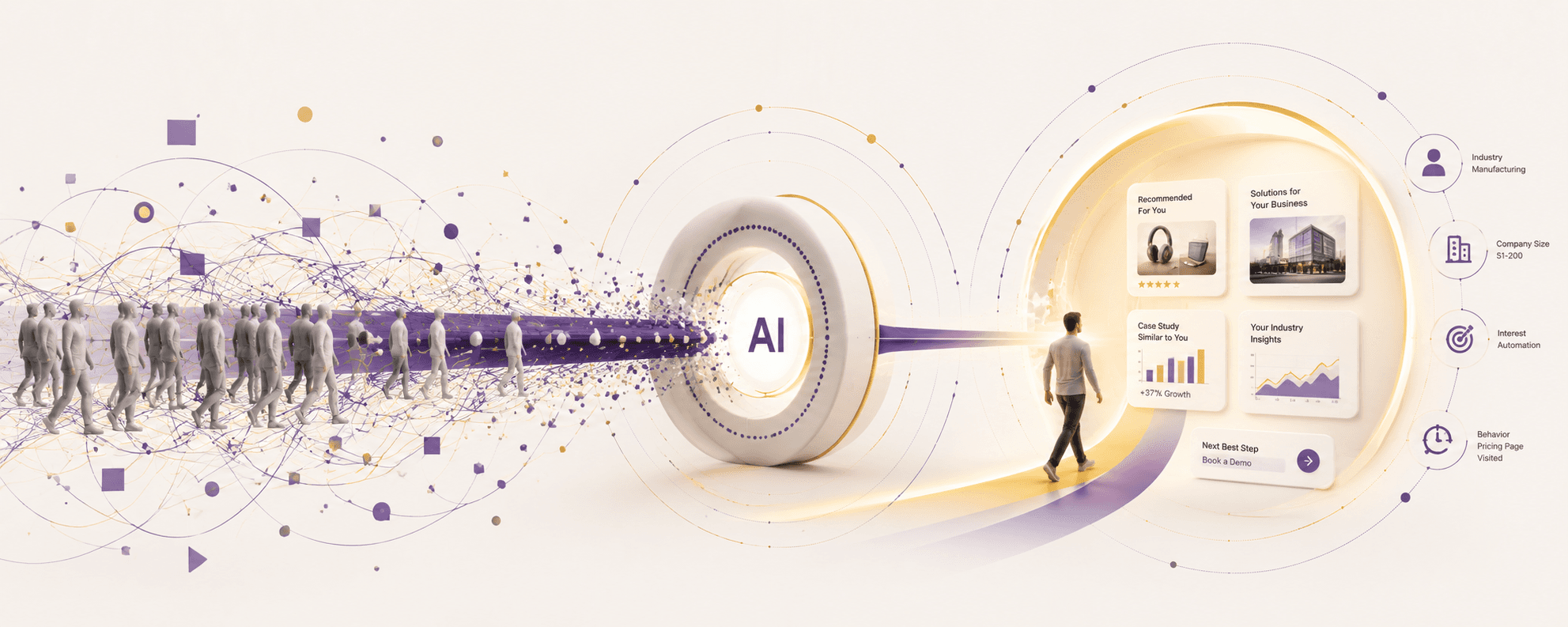
Picture two visitors landing on your website in the same minute. One sees your homepage exactly as it is built: a generic hero banner, a generic offer, a generic call to action. The other sees a version shaped by what they searched for last week, the industry they work in, and the page they lingered on. Which one stays longer? Which one buys?
You already know the answer. Psychology explains why. The visitor who feels ignored decides, in seconds, that your website was not built for them. Their brain stops paying attention, whether or not you can see it happening in your funnel numbers.
For years, personalisation meant dropping a first name into an email subject line. That was never psychology. It was a trick, and buyers eventually spot tricks. What actually works is AI personalisation psychology: using data to reduce a buyer's effort, not just to sharpen your aim at them. AI has changed what is possible. It can now personalise at a depth and speed no human team could manage by hand. The businesses using it well are pulling ahead. The ones still sending the same message to everyone are falling behind, often without knowing why.
Why Your Buyer's Brain Ignores Generic Marketing
Human brains conserve energy wherever they can. Every decision, including whether to keep reading or click away, runs through a simple filter: does this feel like it is about me? If yes, the brain pays attention. If no, it moves on. This is not a modern habit. It is a survival instinct, repurposed for shopping.
When your message matches a buyer's actual situation, their brain treats it as worth the effort. When it does not, the brain filters it out, along with hundreds of other signals it ignores every day.
The data backs this up clearly. Consumers are 91% more likely to shop with brands that offer personalised experiences, and AI-powered personalisation has lifted conversion rates by as much as 202% in some implementations (Averi, 2026). Fast-growing companies also pull a meaningfully larger share of revenue from personalisation than slower-growing competitors (Envive, 2026). Worth noting honestly: these particular figures come from industry analyses rather than peer-reviewed or big-four research, so treat the exact multipliers as directional evidence of a real trend, not numbers to build a business case on line by line. Relevance is no longer a bonus feature. It is one of the main filters your buyer uses to decide whether you deserve their attention.
What AI Sees That You Cannot Track
Before AI, personalisation depended on a marketer's memory or a spreadsheet segment: age, city, maybe a past purchase category. That is a thin slice of what a buyer actually does. AI now tracks browsing sequences, time on page, scroll depth, search terms, cart abandonment, and response timing, and updates that picture in real time, not once a quarter.
This is why 73% of marketing leaders say AI now plays a direct role in building personalised experiences (Omnisend, 2026). Marketing teams have shifted roughly 40% of their budgets toward personalisation, nearly double the 22% share from 2023 (Marketing LTB, 2026). Your buyers expect this now. It is the baseline, not the bonus.
Three shifts follow for a growing business:
- Recommendations built on what a visitor has actually shown interest in, not a generic bestseller list
- Email sequences that adjust based on how far someone has already moved through a decision, not a fixed drip schedule
- Website content that changes by industry or company size, instead of showing every visitor the same homepage
The Trust Gap Nobody Talks About
Here is where most businesses get it wrong. Being understood and feeling watched sit close together in a buyer's mind. Gartner's 2025 research found only 15% of consumers fully trust brands with their data, yet 84% want more control over how personalisation is used on them (Omnibound, 2026). Over half of the personalisation attempts Gartner studied felt intrusive to the people receiving them, not helpful.
This is not a case against personalisation. It is a case for a specific kind: active personalisation, using data to reduce a buyer's uncertainty rather than chase them across the internet with the same product. Teams that make this shift see up to 2.3 times better purchase completion rates than teams running traditional retargeting (Omnibound, 2026).
Think This Is Just a B2C Problem? It Isn't.
There is a common assumption that this psychology matters mainly for consumer shopping, not B2B decisions. The data says otherwise. 73% of B2B buyers now want a personalised, consumer-grade experience from vendors, not a generic proposal template (InsightMark Research, 2026). One retail case documented by McKinsey found that raising personalisation depth from 20% to 95% of email campaigns produced a 41% lift in click-through rates and a 25% improvement in overall email performance, inside a B2B context, not a consumer storefront (InsightMark Research, 2026).
If you are deciding where to invest next, this reframes personalisation. It is not a digital nice-to-have. It is a measurable lever on pipeline.
The One Question to Ask Before You Personalise Anything
Before deploying AI-driven personalisation, ask one question: does this make the buyer's next decision easier, or does it just make our targeting sharper? Reducing friction, showing someone the exact service tier for their company size, answering the question they searched for, builds trust. Sharper targeting without added value erodes it. The technology can do both. Which one you build is still a human decision, made by the people running the campaign, not the algorithm inside it.
None of this works if you cannot tell what a buyer actually wants next, only what they wanted yesterday. That is a different problem, and it is the one we tackle next in this series: how AI replaces guesswork about buyer behaviour with something closer to a real prediction.
For Marketing and Sales Leaders: Where to Start This Week
The section above is the case for why this matters. Here is where to actually start, whether you run the marketing function or carry a number:
- Audit one high-traffic page, your homepage or top landing page, for a single element you could personalise first: the headline, the featured case study, or the primary call to action, based on visitor industry or company size.
- Check whether your tracking goes beyond page views. If you cannot currently see scroll depth, time on page, or content downloads per visitor, that is your first infrastructure gap to close, not a new AI tool to buy.
- Ask any vendor for a realistic timeline in writing before you sign. Personalisation that actually works is a multi-month programme, not a one-time setup, and a promise of instant results is a reason to look closer, not a reason to move faster.
If you want a structured way to run this audit properly rather than guessing at priorities, our AI Marketing & Personalisation team works through exactly this process with clients.
What This Means for Your Business
If your personalisation strategy only uses AI to sharpen targeting, you are one misstep away from the trust penalty this data describes. The businesses winning with AI personalisation use it to remove friction and answer specific buyer questions faster, not to follow buyers around with the same offer. Audit your current personalisation touchpoints against one test: does this make the buyer's next decision easier, or does it just make our targeting sharper?
Want Help Building This
MagicWorks helps growth-stage businesses design AI personalisation that builds trust instead of eroding it. Book a discovery call to see where your current approach stands.
About the author: Purva Desai is a content strategist and digital marketing specialist at MagicWorks IT Solutions Pvt. Ltd. She writes on AI, buyer psychology, and digital marketing strategy.