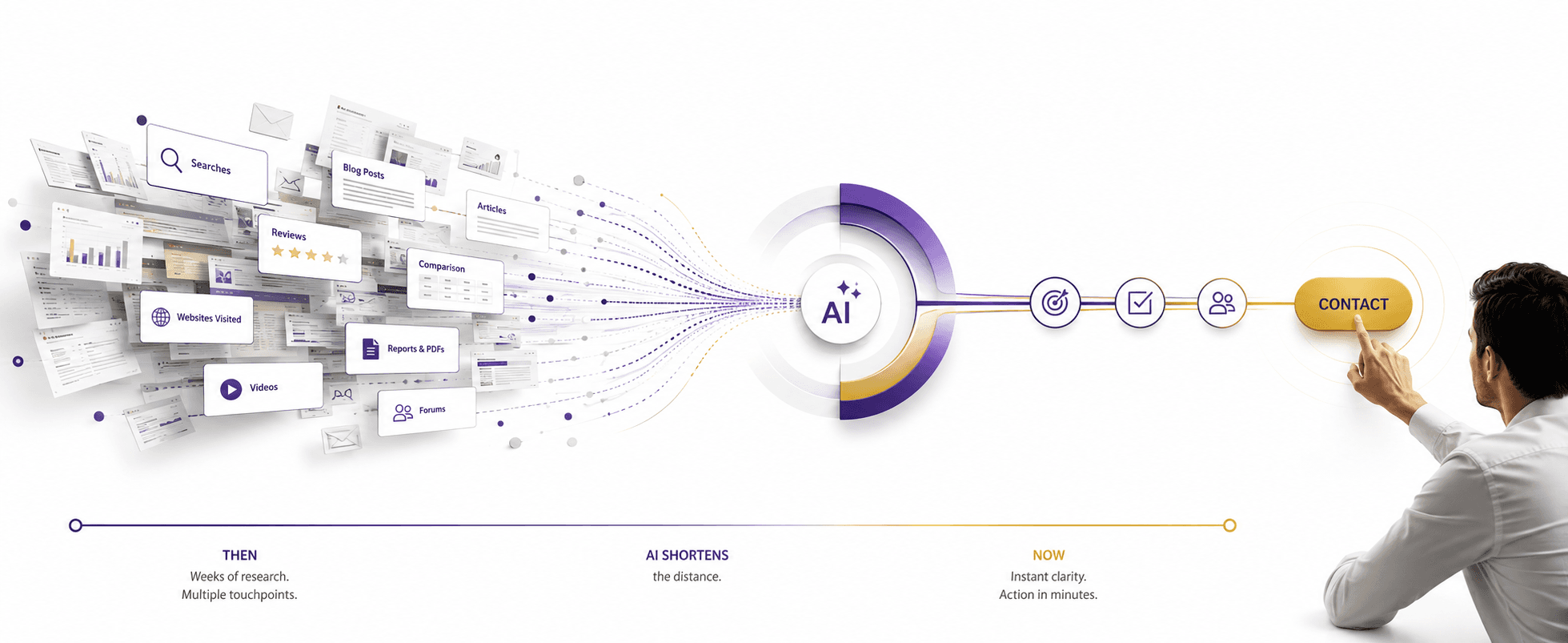
There used to be a predictable gap between a buyer noticing your brand and a buyer buying from it. They saw an ad, thought about it, mentioned it to a colleague, searched again weeks later, and eventually made contact. That gap gave your sales team time to nurture a lead through a long, visible funnel.
That gap has mostly disappeared. Understanding the B2B buyer journey AI has created is now a precondition for getting your marketing calendar right, and most businesses have not adjusted it to match.
The last two pieces in this series covered personalisation and prediction - in other words, knowing what a buyer wants and guessing what they will do next. This piece is about time: how much of it you actually have before they decide.
The Buyer Has Already Decided Before You Know They Exist
The data is unambiguous. B2B buyers now complete 61% of their purchase journey before making first contact with a vendor, down from 69% a year earlier. That pulls contact roughly six to seven weeks earlier in the process (Corporate Visions, 2026, citing 6sense's 2025 Buyer Experience Report). 83% of buyers say they have already defined their purchase requirements before they speak with a salesperson (6sense, 2025). By the time your team runs the "discovery call," the buyer usually already knows what they want. The call validates a decision. It does not create one.
This compression comes almost entirely from AI-assisted research. 94% of B2B buyers now use large language models during their buying process. 89% ultimately buy from vendors whose solutions include AI capability, treating it as baseline, not a differentiator (6sense, 2025). Your buyer is not waiting for a rep to explain your category. They are asking an AI tool to summarise it, compare vendors, and shortlist options, often before your marketing team logs the visit.
Why Your Buyer Would Rather Ask AI Than Call You
This is not just about better tools. It reflects something basic about how the brain handles uncertainty. Faced with a decision, the brain wants the fastest route to a confident answer. For most of digital marketing's history, that route still meant multiple searches, several site visits, and manual comparison. AI collapsed those steps into one conversational exchange. Your buyer can now ask a single question and get a synthesised, comparative answer in seconds.
The effect on awareness-stage content is significant. B2B buyers review an average of 11.4 pieces of content before they are ready to contact a vendor (The SEO Works, 2026). 72% encountered an AI-generated overview during their research, and 90% of those buyers clicked through to at least one cited source (The SEO Works, 2026). If your content is not part of what AI tools surface and cite, you are invisible for 61% of the journey - the part that happens before anyone reaches out.
The Day-One Shortlist Problem
Here is the number every marketing head should sit with: 92% of B2B buyers start their research with at least one vendor already in mind, and 95% of the time, the eventual winner was already on that day-one shortlist (The SEO Works, 2026, citing 6sense). The first-choice vendor on that list wins the business roughly 80% of the time. The real competition for a sale is not won on the sales call. It is won, or lost, at the awareness stage, weeks before a buyer identifies themselves.
This changes what "top of funnel" content is for. It is no longer a broad net for volume. It is the deciding round of a competition that finishes before your sales team is invited to compete.
Faster Does Not Mean Easier
Do not read "shortened distance" as "shorter journey." Dreamdata's 2026 benchmarking across 3.5 million B2B customer journeys found the average path from first impression to closed revenue actually stretched to 320 days, involving 6.8 stakeholders across 3.7 channels and roughly 76 touchpoints (The Wise Marketer, 2026). What compressed is the visible part - the part your sales team sees. What expanded is the invisible part: research, comparison, and internal discussion happening across AI tools, review sites, and peer conversations before anyone contacts you. Marketing now owns most of this journey. Dreamdata's data shows marketing touchpoints account for roughly 81% of the total timeline (Prospeo, 2026). The distance shortened only at the visible end. The work before that point grew.
Three Things to Change This Quarter
First, content quality at the awareness stage now matters more than content quantity, because it needs to earn a place on a shortlist that forms before contact. Second, being cited inside AI research tools is becoming as important as ranking in search results, since research increasingly happens inside AI conversations. Third, brief your sales team on what a lead already knows before contact. Treating an 83%-informed buyer like a cold lead wastes the credibility you already built.
The Upside Nobody Mentions
None of this is bad news if you adapt. A shorter distance between awareness and action means a well-positioned brand converts attention into revenue faster than the old, linear funnel ever allowed. The businesses losing ground here are not facing tougher competition. They are still building marketing calendars for a twelve-week consideration phase that, for most of their buyers, no longer exists.
A Quick Way to Check Where You Stand
Ask your team one question this week: if a prospect asked an AI tool to compare us against our two closest competitors right now, what would it say, and would our website even be in the answer? Most leadership teams have never tried this experiment on themselves. It takes ten minutes, and it tells you more about your real market position than most quarterly reports do, because it shows you exactly what your buyer sees during the part of the journey you cannot watch happen.
None of this compression works in your favour if the AI running your campaigns has no human strategy behind it. That risk is quiet, and it is costly. It is where we turn next in this series.
For Marketing and Sales Leaders: Where to Start This Week
The case above explains why this matters. Here is where to actually begin:
- Run the AI shortlist test from the section above literally - this week, with your two real competitors named, and write down exactly what came back. That fifteen-minute exercise is more diagnostic than most quarterly marketing reports.
- Pull your last ten closed deals and ask sales what the buyer already knew by the time they made contact. If reps are consistently surprised by how informed buyers already are, your content is not reaching the awareness stage the way it needs to.
- Check whether your best content is structured for a single scan-read - a clear answer in the first two sentences of each section - before deciding you need more content rather than better-structured content.
If you want a structured audit of where your business actually stands in AI-driven research today, our Search & Answer Engine Optimisation team runs exactly this assessment with clients.
What This Means for Your Business
Review your content and website for what a buyer encounters in the first 60% of their research, before they intend to contact you. That is where deals are now won or lost. Brief your sales team to treat inbound contact as a validation conversation with an informed buyer, not an introduction, and check whether your content is structured clearly enough for AI research tools to cite accurately.
Want Help Building This
MagicWorks helps businesses get found and cited during the part of the buyer journey they cannot see happening. Book a discovery call to find out where you currently stand.
About the author: Purva Desai is a content strategist and digital marketing specialist at MagicWorks IT Solutions Pvt. Ltd. She writes on AI, buyer psychology, and digital marketing strategy.