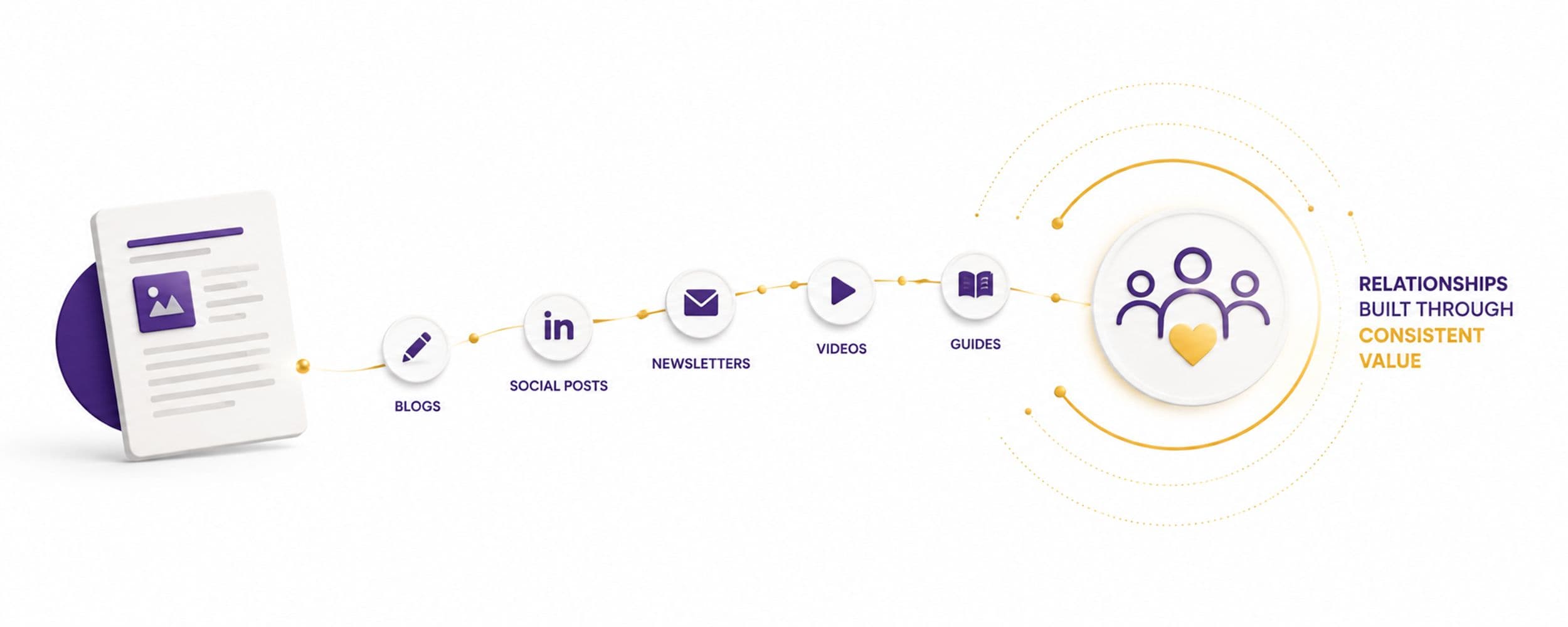
You have almost certainly bought something, or chosen a vendor, or picked a brand over an equally good competitor, for one reason you would struggle to fully explain: you had simply seen them before. Not because you researched them more thoroughly. Just because they were familiar. This is content marketing relationship building in its purest form, and it explains a pattern most businesses misread as luck.
The Psychology Behind Familiarity
This is not a coincidence or a personal quirk. Social psychologist Robert Zajonc demonstrated it experimentally in 1968, in a study now considered a foundational finding in psychology. Participants were shown unfamiliar stimuli, nonsense words, symbols, Chinese characters they could not read, some only once, others many times. Later, participants rated the frequently shown stimuli more positively than the rarely shown ones, despite having no actual knowledge of what any of them meant (Simply Put Psych, 2026, citing Zajonc's original 1968 research). Zajonc called this the mere exposure effect, and it has been replicated across advertising, interpersonal relationships, music, and branding ever since.
The mechanism is almost embarrassingly simple. Your brain treats familiar things as safer and less risky than unfamiliar things, a shortcut that made sense for most of human history and still runs quietly in the background of every buying decision your customers make today (Human Performance, 2026). Repetition does not need to be persuasive. It just needs to happen.
Why This Reframes What Content Is Actually For
If content only existed to generate leads, a single excellent piece would be enough, and you could stop once it converted. But content's other job, the one most businesses underinvest in, is manufacturing the exact kind of repeated, low-pressure exposure that Zajonc's research shows builds preference over time. Every blog post, every LinkedIn update, every newsletter is not primarily competing to convert a reader on that visit. It is one more rep in a much longer game of becoming familiar enough to feel safe.
This is why a consistent publishing cadence outperforms a single brilliant campaign, even when the campaign gets more attention in the short term. A burst of visibility fades. Repetition compounds.
What This Looks Like Done Well
Consider two SaaS companies solving the same problem. One publishes a major campaign twice a year with significant paid spend behind it, then goes quiet. The other publishes a modest, genuinely useful piece of content every single week, with no big spikes and no big gaps. A year in, the second company's name feels more familiar to its target buyers, not because any single piece of their content was more impressive, but because there was simply more surface area for repeated, low-stakes contact. When a buying decision finally comes up, the second company gets shortlisted more often, for reasons the buyer would describe as we know them, without necessarily being able to say why.
Why Familiarity Beats a Single Great Pitch
There is a reason a well-known but average competitor often still beats a lesser-known but genuinely superior alternative, and it frustrates business owners who cannot understand why the better product keeps losing. The mere exposure effect explains this without requiring any assumption that the buyer is being irrational. A familiar option feels like less risk, and reduced perceived risk is worth more to most buyers than a marginal improvement in features they cannot fully evaluate anyway before purchase. Your job is not only to be the better option. It is to make sure you are also the more familiar one by the time that comparison actually happens, since one of these you can control through consistent content and the other you may never get the chance to prove until after you have already lost the deal.
The Line Between Familiar and Annoying
Mere exposure has a ceiling. Overexposure can flip into irritation, and a jingle repeated too many times stops feeling comforting and starts feeling like an intrusion (Simply Put Psych, 2026). The businesses that use this well are not the loudest. They are the most consistent, publishing steadily enough to stay familiar without publishing so aggressively that the familiarity curdles into fatigue. The right cadence is the one your audience barely notices, because it never spikes hard enough to feel like noise.
From Familiarity to Something That Feels Like a Relationship
This is what makes content fundamentally different from a single advertisement or a single sales pitch. A relationship, in the ordinary human sense, is built through repeated, low-stakes contact over time, not through one impressive first meeting. Content is the only marketing tool that can do this at scale, reaching thousands of people with the same slow, repeated familiarity that used to only be possible one relationship at a time. That is not a metaphor for what good content marketing does. It is a fairly literal description of the psychological mechanism underneath it.
For Marketing and Sales Leaders: Where to Start This Week
The research above explains why consistency matters more than intensity. Here is how to act on it:
- Pull up your content calendar for the last six months and look for gaps longer than a few weeks. Every gap resets part of the familiarity you had built, whether or not it shows up immediately in your metrics.
- Trade one big campaign idea for four smaller, steady pieces published over the same period. The research above suggests this consistently outperforms a single spike in visibility.
- Set a publishing cadence you can actually sustain for a year, not a quarter, since the compounding effect this piece describes only shows up after sustained repetition, not after a short burst.
If you want help building a sustainable publishing programme instead of a one-off campaign, our Thought Leadership & GEO team designs cadence-first content strategies for clients.
None of this relationship-building matters, though, if a visitor never sticks around long enough to experience a second piece of content, let alone a tenth. Which brings us to a much blunter problem: a large share of your visitors are leaving before any relationship has a chance to start. That is where we turn next.
What This Means for Your Business
Look at your content calendar for the last six months and check for a steady publishing rhythm, not a handful of big campaigns surrounded by long silences. If you have gaps longer than a few weeks, you are losing the compounding effect that makes familiarity work. Consistency at a sustainable pace will build more trust over a year than one expensive campaign that fades from memory within weeks.
Want Help Building This
MagicWorks builds sustainable publishing programmes designed around the psychology of familiarity, not campaign spikes. Book a discovery call to review your current content cadence.