Key Takeaway
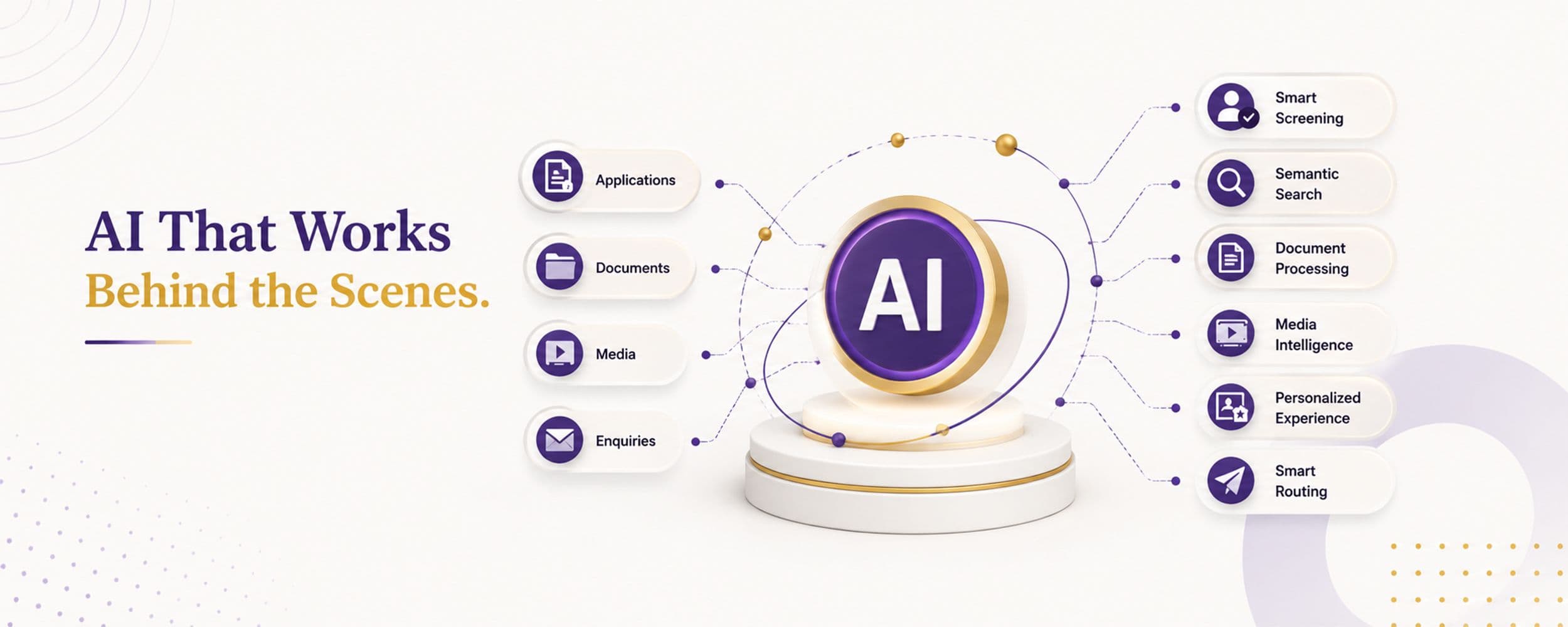
When businesses picture AI on a website, they picture a chat bubble. But the AI that changes how a business runs is mostly invisible: capabilities that read, evaluate, organise, and process behind the scenes. Six of them are mature enough to build today: application screening, semantic search, document intake, media processing, content personalisation, and quality-and-routing automation. Each replaces a specific human bottleneck, which is exactly how each should be judged.
There is a reflex we encounter in almost every AI-Native website conversation. The client pictures artificial intelligence on a website, and the picture is always the same: a chat bubble in the bottom corner.
Conversational AI is real and valuable, and it is its own discipline with its own products, which is precisely why this article is not about it. This article is about the other kind: the AI a visitor never talks to, working inside the website's machinery, doing jobs your team currently does by hand or does not do at all. In our experience this invisible layer is where most of the operational return actually lives.
1. Application and submission screening
The bottleneck: anything your website collects at volume that a human must then evaluate, job applications, admission enquiries, vendor registrations, grant submissions, membership requests. Someone opens each one, judges it against criteria, and sorts it, which means the judging happens slowly, inconsistently, and often days after the applicant has moved on.
The capability: the website performs the first evaluation itself. A careers portal reads each incoming resume, scores it against the actual requirements of the role, and presents the team a ranked pipeline with reasoning attached. The human decision is not replaced; it is relocated to where it adds value, choosing among a qualified shortlist rather than excavating one from two hundred files.
What to demand from the build: transparent criteria you control, visible reasoning per score so the team can audit and correct it, and a design that treats the AI as a first filter with human judgment firmly on top.
2. Search that understands questions
The bottleneck: the search box that only matches keywords. If your value lives in deep content, courses, documentation, articles, a large catalogue, then every failed search is a visitor who could not find something you actually have. Keyword search fails silently and constantly, and nobody files a complaint; they just leave.
The capability: semantic search, where the visitor asks in their own words and the site answers from its own content, surfacing the relevant material even when no words match. For knowledge-heavy businesses this quietly changes the website's economics: the existing content library starts earning attention it always deserved and never received.
There is a strategic bonus. Building this forces your content into the clean, structured, well-organised form that also makes it more extractable by external AI answer engines. The same work improves the search inside your site and your citability outside it.
3. Document intake that reads what it receives
The bottleneck: the inbox where uploaded documents go to wait. RFQs, requirement briefs, purchase orders, application paperwork: a person opens each file, extracts the relevant details, re-types them into a system, and routes the result to a colleague. It is pure processing labour, and it sits directly on top of your response time to potential customers.
The capability: the website reads what it receives. An uploaded requirement document is parsed on arrival, the key details are extracted and structured, the enquiry is routed to the right person, and a first-response draft is prepared for human review. For B2B businesses where speed of response wins deals, this converts a days-long queue into a same-hour reply, and it is frequently the single highest-return capability on this list.
4. Media that processes itself
The bottleneck: the recorded content that never becomes usable content. Webinars, community sessions, lectures, event recordings: hours of valuable material that would need an editor's week to clip, title, and organise, so it sits whole and unwatched in a folder instead.
The capability: the platform processes its own media. Long recordings are analysed on upload, meaningful segments are identified and clipped, titles and summaries are drafted, and the library organises itself for members to browse. For community platforms, education businesses, and content operations, this turns a production bottleneck into a property of the website, and the content library compounds instead of accumulating.
5. Personalisation that respects the visitor
The bottleneck: one website speaking identically to every visitor, when your audiences are visibly different. The first-time researcher, the returning comparer, and the ready buyer all see the same page, so the page serves each of them at half strength.
The capability: the site adapts what it emphasises, surfacing the right case studies to the returning visitor, the right programme to the student whose behaviour signals their level, the right next step to someone deep in a decision. Done honestly, this is relevance, not manipulation.
What to demand from the build: restraint. Personalisation earns its keep only with genuinely distinct audience needs and enough traffic to matter, and it must be built on privacy-respecting signals with disclosure where appropriate.
6. Quality and routing automation across the pipeline
The bottleneck: the small judgment tasks stitched through every website operation. Is this form submission spam or real? Which office should this enquiry go to? Does this user-submitted listing meet the guidelines? Each micro-decision is trivial alone and, at volume, consumes a surprising share of someone's week.
The capability: the website makes the routine calls itself, flags the uncertain ones for a human, and routes everything to the right destination the moment it arrives. This is the least glamorous capability here and often the fastest to pay back, because it removes friction from every other process the site runs.
How to choose, and how to judge the return
Do not buy the list. Buy the bottleneck.
The selection method is one exercise: ask where your team spends hours doing repetitive judgment work that touches the website, or where work is not being done at all because no one has the hours. That answer, not a features menu, picks your first capability. One bottleneck, removed properly, beats four capabilities installed shallowly.
The evaluation method is equally plain: every capability above replaces measurable human effort or captures measurably lost value, so the return can be estimated before the build and verified after it. Hours saved per week, response time before and after, share of content library actually consumed. If a proposed AI feature cannot name its bottleneck and its measure, it is decoration, whatever the demo looks like.