
Think of an exam hall. The result is not decided in those three hours. It is decided in the months before, in the preparation. On the day, you are only carrying out work that is already done. You cannot cram in the hall.
A Google Ads campaign works the same way. Most of the result is set before the campaign goes live. The auction feels like the main event, but by then the big choices are already made. This is a Google Ads campaign setup checklist built on that truth, and on one idea from the anchor of this series, Same War, New Weapons, and from Sun Tzu: battles are won before they are fought.
The stakes are not small. Audits routinely find that 20 to 40 percent of a Google Ads budget leaks away on irrelevant clicks, based on a WordStream analysis of more than 17,000 accounts. On a one lakh rupee monthly budget, that is twenty to forty thousand rupees gone every month, with nothing to show for it. Most of that leak is set at setup, not in the auction. Below are the five decisions that decide it.
The auction only plays the hand you deal it
The platforms have changed. The State of PPC 2026 survey of over 1,300 professionals found more than half now say paid search is harder to manage than it was two years ago, mostly because the tools automate more and reveal less. When you control less inside the auction, the choices you make before it matter more. Structure, targeting, the offer, tracking, and negatives are the levers you still hold. Set them well and the auction works with you. Set them poorly and it quietly spends against you.
Decision 1: Structure — group by intent, not by convenience
Structure is the quietest decision and the most powerful. When keywords with different intent share one ad group, one ad has to speak to all of them. It ends up speaking clearly to none.
The current best practice is the single-theme ad group: a handful of keywords, roughly five to fifteen, that share one intent. It replaced the older single-keyword approach because Google's bidding now needs conversion volume to learn, and splitting the account too finely starves it. Group by what the searcher wants, not by the exact word they typed. A person comparing options and a person ready to enrol are on different errands. They deserve different ad groups, different messages, different landing pages.
Here is what that looks like in practice. On one online-education account, about 16,300 phrase-match keywords were sorted by intent before launch. Six groups came out of it. Only about 3 percent were purchase-ready, searches like "online mba admission" or "apply for distance mba". The other 97 percent wanted something else first: to compare, to research, or to look up a specific institute. Each group needed its own bid and its own message.
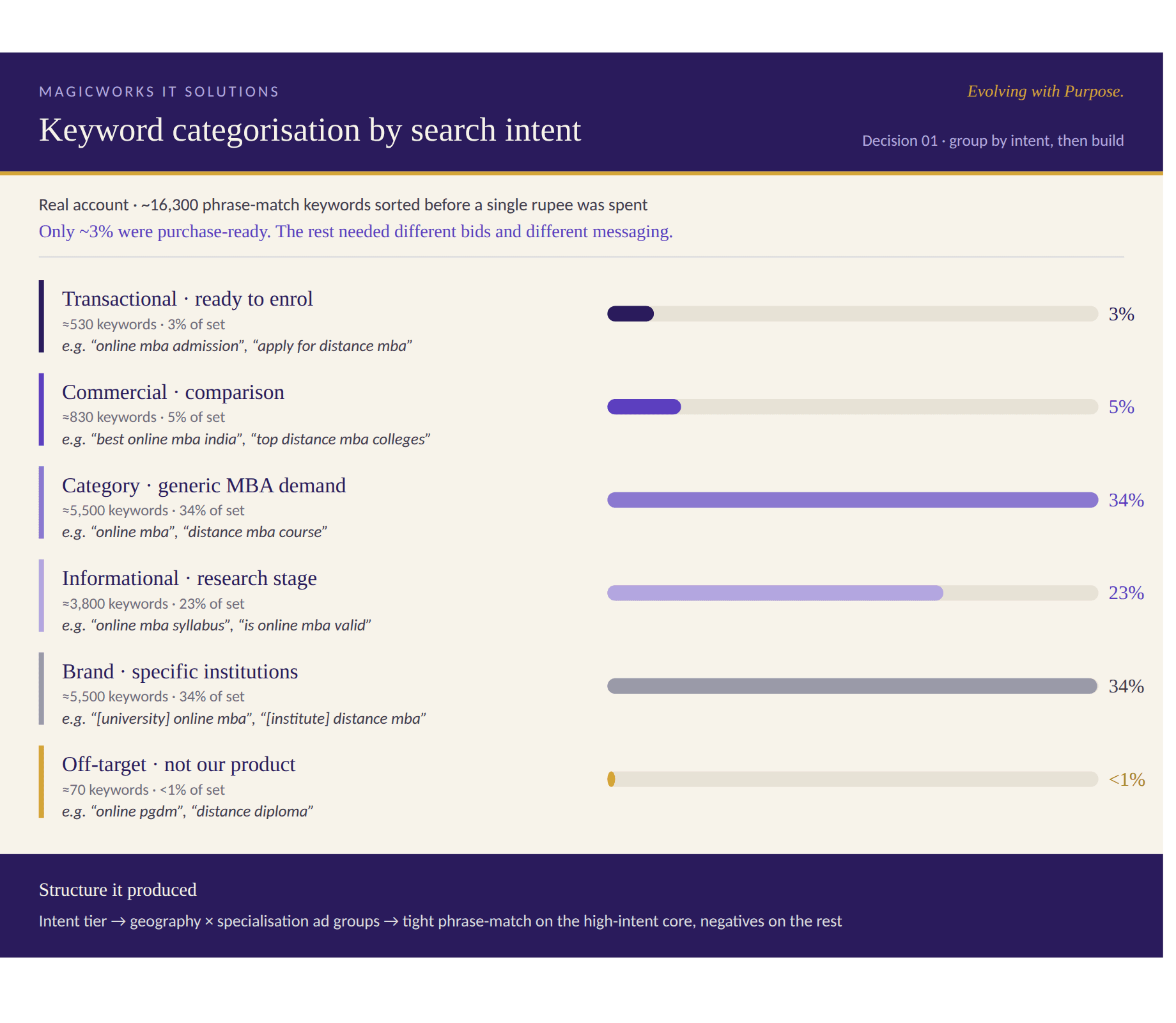
That sorting is what produced the structure. Intent tier first, then ad groups split by geography and specialisation, tight phrase-match on the high-intent core, and negatives to hold back the rest.
Decision 2: Targeting — decide who you let in
Loose match types are an open gate. They let in traffic that looks related but never converts, and you pay for every visit. This matters more in 2026, not less. Broad match has grown more aggressive, and AI Max now matches searches beyond your keyword list. The platform reaches wider by default, in its own interest.
So decide the gate at setup. Start tight, with phrase and exact match on your high-intent terms, and clear location and audience choices. Widen later, once you have conversion data to guide it. It is far easier to let good traffic in than to stop paying for bad traffic you invited on day one.
Decision 3: The offer — the auction cannot sell a weak promise
No bid strategy can save a weak offer. If the promise on the page is dull, more spend just buys more people who say no. It also costs you twice. A weak match between ad, keyword, and landing page drags down Quality Score, and a lower Quality Score raises the price you pay for every future click.
So decide the offer before launch. Make it clear, specific, and worth the click. Point each ad group at a landing page built for that exact intent. A strong offer lifts every number after it: click-through, conversion rate, cost per lead. This is strategy, not settings, and it is where too little time usually goes.
Decision 4: Tracking — decide what counts, and check it fires
If tracking is wrong, every choice after it is wrong too. Measurement now comes before structure, not after it. Google's own guidance treats conversion tracking as the foundation every automated bid depends on. Break it, and no amount of clever structure saves you.
There is a volume angle too. Automated bidding wants roughly 30 conversions a month per campaign to learn well. If half of those go uncounted, the algorithm learns from a lie. So before budget goes up, decide what a real conversion is, set it up, and test that it fires with your own hands. This is not glamorous. It is the difference between steering and guessing.
Decision 5: Negatives — decide who you refuse to pay for
A negative keyword list is a decision about who you will not pay for. It is also the cheapest, most neglected lever in paid media. Refining negatives from the search terms report can win back 10 to 25 percent of wasted spend, yet most accounts build the list late, after the money is already gone.
Build it before launch, not after. Start with the obvious misfits for your offer, layer account-level negatives for terms that are never relevant, and add to the list every week from the search terms report. It is a small habit that quietly protects the budget, month after month, and in a world of broad match and AI matching, the thing you exclude is one of the few things you still fully control.
The Pre-Launch Checklist
Run these five before you raise the budget.
- Keywords sorted by intent, ad groups built to match
- Match types and audiences set to keep the wrong traffic out
- Offer is clear, specific, and worth the click
- Conversion tracking is set up and verified firing
- A starting negative keyword list is in place
Free Download
The five decisions above as a one-page check you run before every launch. Free to download, no sign-up.
Download the campaign pre-launch checklist (PDF).
Five ways good setups quietly go wrong
- Over-splitting the account. Hundreds of tiny ad groups feel precise, but they starve the algorithm of the data it needs to learn.
- Launching with no negatives. Every day without a seed list is a day you fund irrelevant clicks.
- Trusting tracking you never tested. If you did not fire the conversion yourself, you do not know it works.
- One broad ad group for everything. Mixed intent means the ad speaks to no one, and Quality Score suffers.
- A landing page that does not match the ad. The click is only won when the page keeps the promise.
None of these is dramatic. That is why they last. They fail an account slowly, the same way in 2016 and in 2026, which is the whole point of this series: the weapons change, the ways you lose stay the same.
The order to actually build a campaign
Knowing the five decisions is one thing. The order you make them in matters too, because each one rests on the one before it.
- Tracking first. Set up and test conversions before anything else. Every later choice reads from this number.
- Then the offer and pages. Decide what you promise, and where the click lands, before you pick a single keyword.
- Then structure. Sort keywords by intent and build ad groups to match.
- Then targeting and negatives. Set the gate, and the starting list of who you will not pay for.
- Budget last, and small. Start low, confirm the data is clean, then scale in steps.
Most rushed launches invert this. They pick keywords first and bolt on tracking last, which is exactly how a month of spend ends up teaching nothing. Build in the right order, and the campaign is honest from its first click.
Want a Second Pair of Eyes Before You Spend?
We audit account setup before budget scales, so the structure, targeting, offer, tracking, and negatives are right from day one. Most wasted spend is decided here, not in the auction.
This is the second piece in the Same War, New Weapons series on the performance marketing principles that survive every platform update.