Say the words just do it to almost anyone on the planet, and they will finish the sentence with a brand name before they finish the thought. No product description required. No logo needed. Three words, monosyllabic, unrhymed, doing more branding work than most companies manage with their entire marketing budget. This is memorable brand taglines psychology at work, and it is far more mechanical than most boardrooms assume.
Why Three Words Can Outlast a Decade of Campaigns
The brain has a documented preference for information that is easy to process, a phenomenon researchers call processing fluency, and taglines exploit it ruthlessly. Nike's tagline works partly because all three words are monosyllabic and use vocabulary most people learn before the age of five (Advergize, 2026). Simple is not a stylistic choice here. It is a memory mechanism. Every extra syllable, every uncommon word, adds a small tax to the brain's ability to store and later retrieve the phrase.
The Rhyme-as-Reason Effect
Rhyme does something even stranger than aid memory. Academic research from Colby College on what psychologists call the rhyme-as-reason effect found that people judge rhyming statements as more truthful than semantically identical statements that do not rhyme (CogBlog, 2019, citing Filkuková and Klempe, 2013, the strongest independent sourcing anywhere in this piece). The rhythm itself is quietly doing persuasion work that has nothing to do with the actual argument being made. This is why De Beers built an entire category of consumer behaviour around a four-word rhyming phrase about diamonds and permanence, and why decades later the phrase is still doing exactly the emotional work it was built for (Lead Craft, 2026, a marketing content site rather than an academic source, though consistent with the CogBlog research above).
M&M's built the same mechanism into a different shape: a rhyming, rhythmic promise about chocolate not melting in your hand, which activates both the auditory cortex through its musical quality and the motor cortex through its rhythm, engaging more of the brain than a plain, unrhymed sentence ever could (Marketing Scoop, 2026).
What Happens When a Tagline Names a Feeling Instead of a Feature
The taglines that survive the longest rarely describe what a product does. They describe how choosing it will make someone feel. KFC's tagline promises a specific sensory payoff, finger lickin' good, evoking taste and craving in just three words, rather than describing ingredients or process (Marketing Scoop, 2026). Nike's tagline is a command that bypasses decision paralysis entirely, telling you to act rather than asking you to think (Advergize, 2026). Neither tagline explains a single product feature. Both have outlived multiple product lines, multiple CEOs, and several complete redesigns of the products they were originally written to sell.
The Uncomfortable Truth About Most Taglines
For every tagline that becomes cultural shorthand, hundreds are written, tested, and quietly retired without anyone outside the marketing department ever noticing they existed. The difference is rarely cleverness. It is whether the tagline was built using the actual mechanics of memory, brevity, rhythm, sensory or emotional language, repetition, rather than built to sound impressive in a boardroom presentation. A tagline that makes executives nod in a meeting and a tagline that survives being repeated a million times by strangers are not always the same thing, and businesses that confuse the two end up with taglines nobody outside the company can recall a year after launch.
Why Boardrooms Keep Choosing the Wrong Tagline
The failure mode is predictable once you see it. A tagline gets written, presented to leadership, and judged in a quiet conference room by people who have spent weeks thinking about the brand and already understand its full strategy. In that setting, a clever, layered, slightly abstract line often wins the room, because the people voting on it can fill in context the eventual audience never will. The tagline that would actually survive in the world, simple, rhythmic, emotionally direct, can look almost too plain by comparison, and gets passed over for something that sounds more sophisticated in a meeting and less memorable everywhere else. The fix is procedural: test taglines with people who have no context and thirty seconds of attention, not with the executives who already know the whole strategy behind them.
For Marketing and Brand Leaders: Where to Start This Week
The research above explains why boardroom instinct often picks the wrong tagline. Here is how to test properly instead:
- Read your current tagline aloud to someone outside your company, with no context given beforehand, and ask them to repeat it back five minutes later without looking. If they cannot, it has already failed the only test that matters.
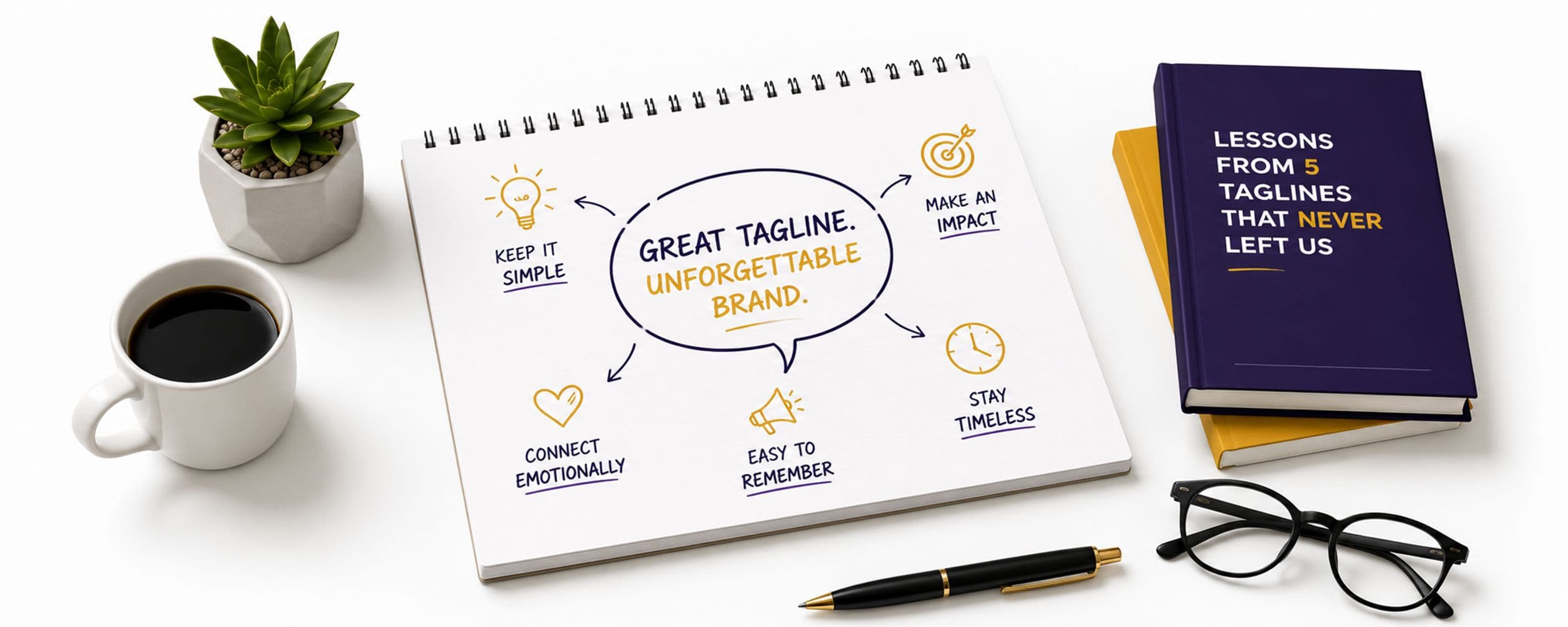
- Score any tagline candidate against three questions before it reaches a boardroom vote: does it use simple, common words, does it have a rhythm or rhyme that is pleasant to say, and does it promise a feeling rather than a feature.
- Test with people who have thirty seconds of attention and no context, not with executives who already understand your full brand strategy. The people voting on a tagline internally are the worst-placed judges of whether it will actually stick.
If you want structured help writing and testing a tagline against this exact research, our Brand Identity Design team runs this process with clients.
A great tagline can outlive the campaign that created it and the product it was written for. But a tagline is still just one asset in a much bigger system of things your brain uses to recognise a brand, most of which have nothing to do with words at all. That is where we finish this segment.
What This Means for Your Business
Read your current tagline aloud to someone outside your company and ask them to repeat it back five minutes later without looking. If they cannot, it is failing the only test that actually matters for a tagline. Rewrite it around simple words, a rhythm that is pleasant to say, and a feeling rather than a feature, since those three mechanisms account for nearly every tagline that has survived more than a decade in the public's memory.
Want Help Building This
MagicWorks helps businesses write and test taglines against the actual mechanics of memory, not boardroom instinct. Book a discovery call to pressure-test your current tagline.