Key Takeaway
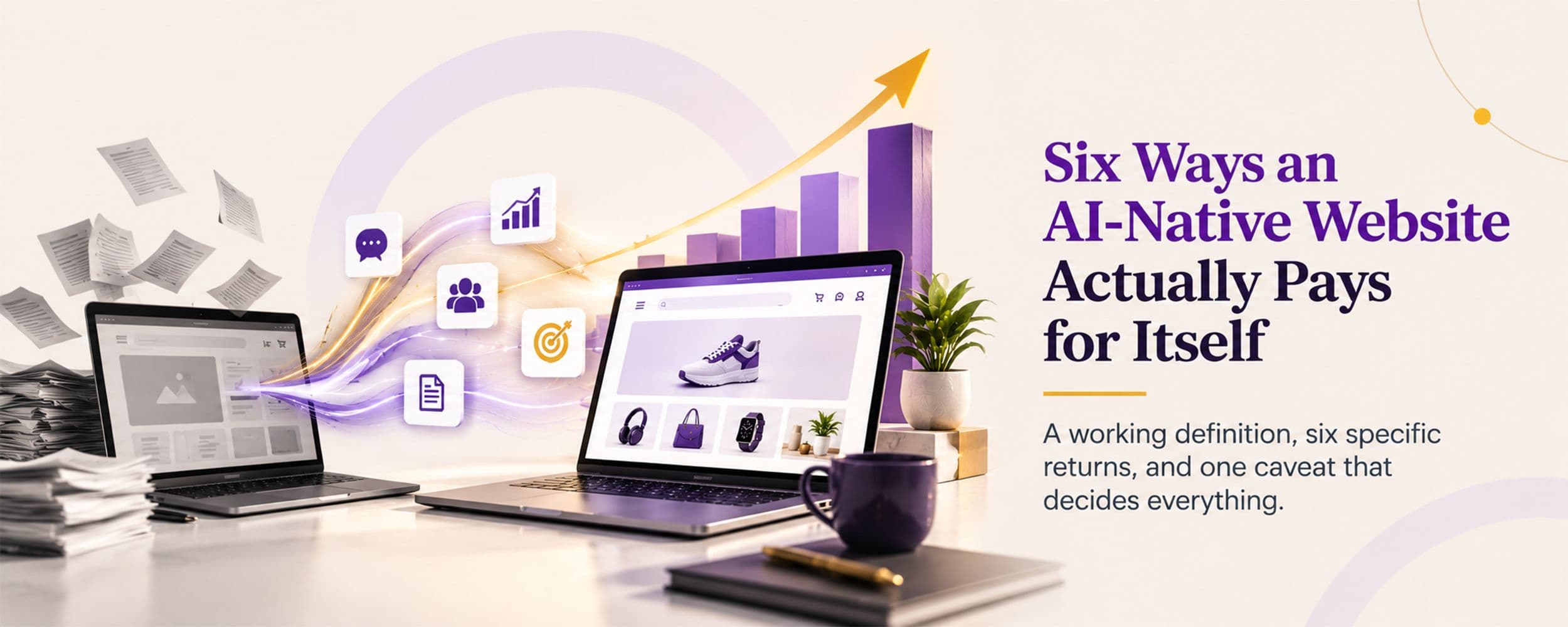
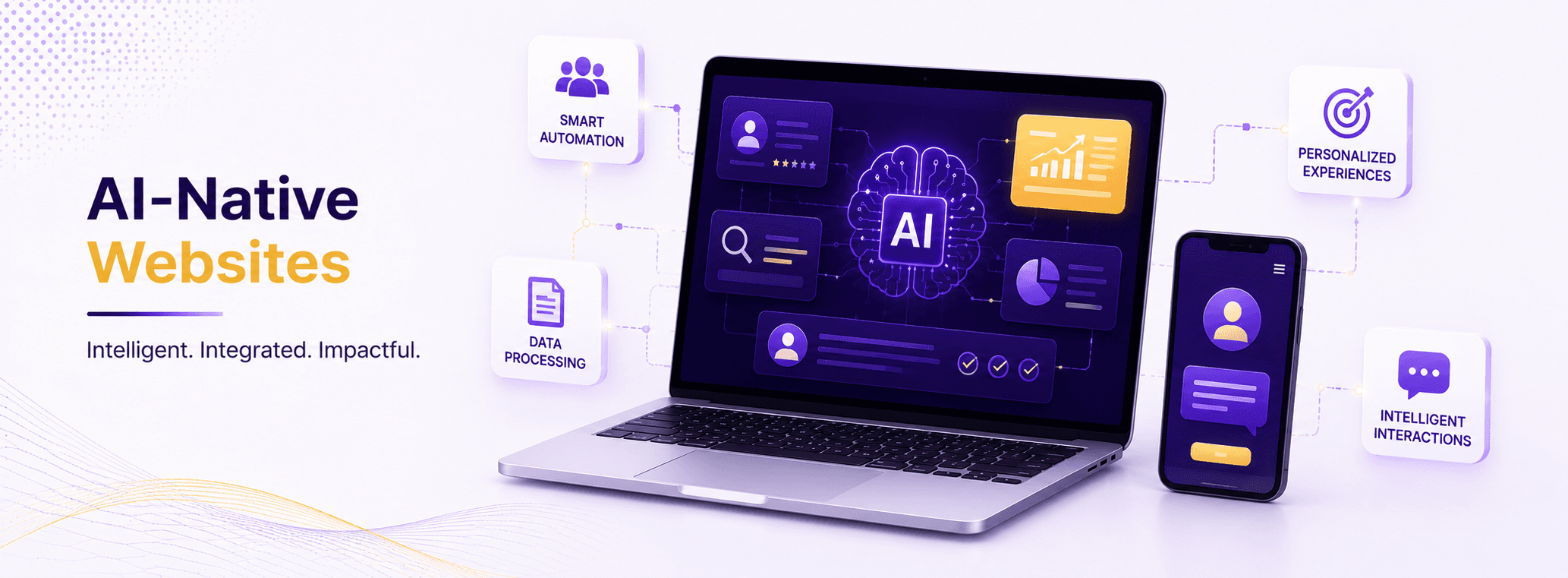
An AI-Native website is one where artificial intelligence is built into how the site works, processing, deciding, and acting on the business's behalf, rather than bolted on as a chat widget or used merely to generate the pages. A careers site that reads and scores every incoming application is AI-Native. A brochure site with AI-written text is not. The difference is architectural, it has to be designed in from the start, and it is quietly redrawing what a website is for.
The term "AI website" now means at least three completely different things, and vendors are happily selling all three under one label. Before you commission your next build, you deserve the precise definition, because two of the three are not worth premium money.
Three things "AI website" gets used to mean
The AI-generated website. Tools that produce a site from a prompt: pages, text, images, done in an afternoon. Impressive as a demo, and legitimate for a hobby project or a landing page test. But the AI's involvement ends at generation. What you get is a static brochure that happened to be written by a machine, often visibly templated, and carrying no intelligence whatsoever once live.
The AI-decorated website. A conventional site with an AI feature attached to the surface, almost always a chat widget. The site itself is unchanged underneath; the intelligence sits in a bolt-on that could be removed tomorrow without the site noticing. Conversational assistants have real value in the right role, but a widget does not make a website intelligent any more than a radio makes a car self-driving.
The AI-Native website. Intelligence built into the site's actual functioning: the site reads, evaluates, organises, personalises, or processes as part of how it does its job. Remove the AI and the site does not lose a feature. It loses its central capability.
The first is generation. The second is decoration. Only the third is architecture, and architecture is what you should mean when you pay for AI-Native.
What AI-Native looks like in practice
Definitions stick better as examples, so here are the kinds of builds that earn the label.
A careers site that does the first screening itself. Applications arrive, and the site reads each resume, evaluates it against the role's actual requirements, scores it, and organises the pipeline so the HR team opens a ranked shortlist instead of a folder of two hundred PDFs. The website is not displaying job listings. It is performing the first round of recruitment.
A community content platform that processes its own media. Long recordings are uploaded, and the platform identifies the meaningful segments, clips them, titles them, and organises them for members, work that previously consumed an editor's week, now happening as a property of the platform itself.
A knowledge-heavy site whose search actually understands questions. Instead of keyword matching, visitors ask in their own words and the site answers from its own content, the way they have learned to ask everything else. For a business with deep documentation, courses, or a large catalogue, this single capability changes what the website is worth.
A portal that reads the documents it receives. Enquiry forms, uploaded requirements, RFQ documents: the site extracts what matters, structures it, routes it to the right person, and drafts the first response for human review. The common thread in every example: the site has a job beyond displaying pages, and the AI is how that job gets done.
Why this requires different architecture, not a plugin
Here is the part vendors gloss over. AI-Native capability cannot be retrofitted onto a template site with a plugin, for reasons that are structural rather than commercial.
Intelligent features are backend capabilities: they need server-side logic that calls language models, processes data, stores results, and enforces rules about cost, privacy, and quality. A traditional theme-and-plugins site has no natural home for that layer. The builds that carry it well are engineered on a modern stack: a framework like Next.js providing the application layer, a headless CMS managing content separately from presentation, and LLM-backed services doing the intelligent work behind well-designed seams.
This stack brings two side benefits that justify themselves even before the AI does. Performance: sites built this way are fast by construction, which, as we covered in our ad ROI article, is itself a revenue property. And structural clarity: clean, semantic, well-organised output of the kind Google's documentation rewards, which also happens to be exactly what AI answer engines extract from best. An AI-Native build is, almost incidentally, an Answer Engine Optimisation asset.
One honest boundary from our own architecture: conversational AI for sales, the assistant that qualifies leads in chat, is a distinct discipline with its own product category, and we treat it as adjacent to web development rather than part of it. This article, and the AI-Native definition, is about intelligence inside the site's own functioning. The two complement each other; they should not be confused for each other.
Who actually needs one, and who does not
Premium architecture deserves an honest qualification test, so here it is in both directions.
You likely need AI-Native if your website sits in the middle of a repetitive judgment process: screening, sorting, matching, evaluating, or answering, at a volume where humans currently do it slowly or not at all. Recruitment flows, education platforms matching students to programmes, content communities, B2B portals digesting enquiries and documents, knowledge businesses whose value is locked in content nobody can search well. In each case the AI does not decorate the site. It removes an operational bottleneck, and the build pays back in saved hours and faster responses, which is exactly how it should be evaluated.
You likely do not need AI-Native if your website's whole job is presence and credibility: a services brochure, a portfolio, a simple local business site. Intelligence with nothing to process is expense with nothing to return, and the honest recommendation for that situation is a fast, well-structured conventional build. We say this as a company that sells AI-Native development: the qualification question protects both sides, and any vendor who thinks every business needs this is selling architecture as fashion.
The deciding question is one sentence: what judgment or processing work would the website take off your team's hands? A specific answer means you have an AI-Native project. A vague one means you have a brochure requirement, and there is no shame in that.
Why "your next build," not "someday"
The reason to take this seriously now rather than in some future redesign cycle comes down to how websites age.
A website is typically a five-to-seven year asset. A site commissioned today on yesterday's architecture will spend its entire life unable to take on the intelligent capabilities its owner will, at some point in those years, certainly want, because the foundation has no place to put them. The AI-Native decision is not really about which features launch on day one. It is about whether the asset you are paying for can grow intelligence over its lifetime or is sealed at birth.
That is why the question belongs at the start of your next build conversation, whoever you have it with: not "can we add AI," but "what work should this website be doing for us, and is the architecture being proposed capable of doing it?"
About the author: Swapnil Ughade is the Founder of MagicWorks IT Solutions Pvt. Ltd., an AI-first digital marketing agency based in Pune, India. He brings 17+ years of experience across digital marketing, web development, and AI strategy. MagicWorks builds AI-Native websites on Next.js, headless CMS, and LLM-backed backends.