Key Takeaway
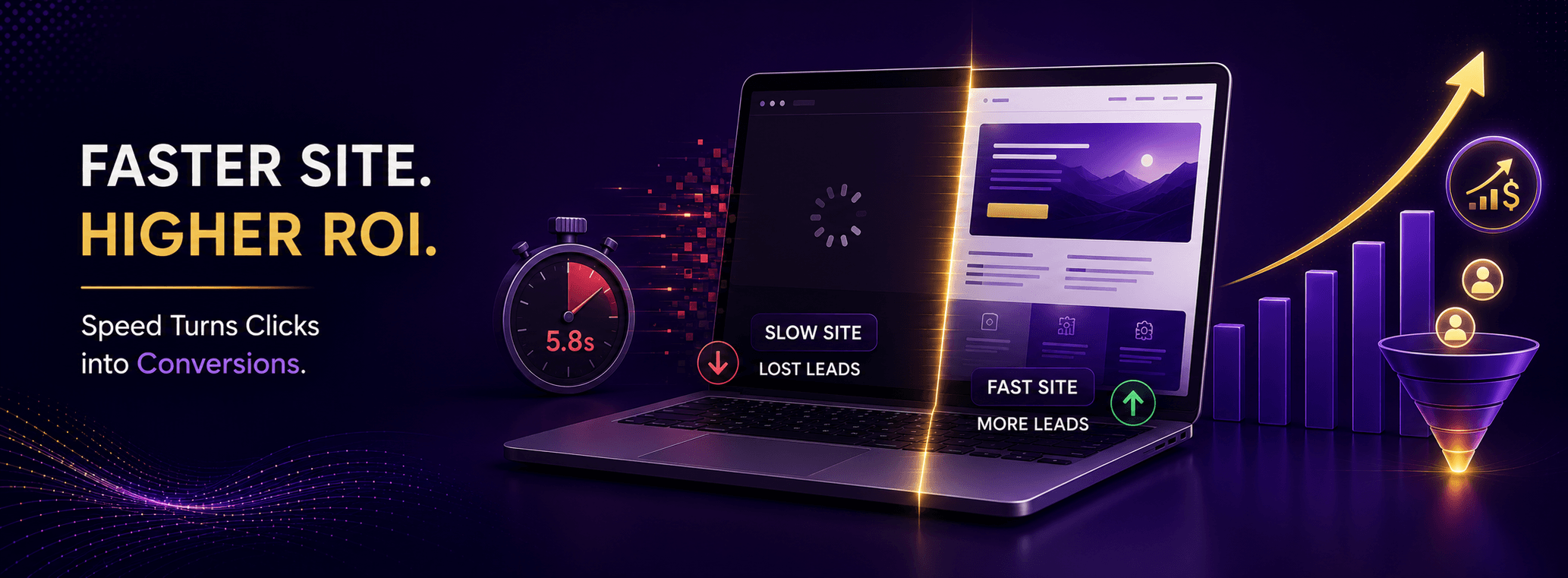
Every visitor from a paid campaign is a visitor you bought. When your site loads slowly, a share of those bought visitors leave before the page ever appears, which means a slow website is not a technical inconvenience but a recurring tax on every rupee of ad spend. Worse, Google's ad auction factors landing page experience into what you pay per click. This article explains the mechanism, gives you a one-hour diagnosis, and ranks the fixes by payback.
Here is an audit finding that repeats so often it has become a ritual. An advertiser is unhappy with campaign results. The account gets inspected: targeting is reasonable, ads are decent, bids are sane. Then someone opens the landing page on a mid-range phone over a mobile network, and everyone sits in silence watching a white screen.
The campaigns were never the problem. The campaigns were delivering paid traffic, at full price, to a page that was quietly discarding it.
The mechanism: you bought that visitor
Organic traffic makes slowness feel free. A visitor bounces, and no invoice arrives. Paid traffic removes the illusion, because the economics are brutally direct.
You paid a real price for the click the moment it happened. Whether that click becomes a lead is then decided in the next few seconds by your page. Users abandon slow pages at rates that climb steeply with every additional second of load time, a relationship Google's performance research has documented for years and which the Core Web Vitals initiative at web.dev exists to address. Every abandoned load is spend converted directly into nothing.
Run your own numbers with a simple thought experiment. Take your monthly ad spend, your average cost per click, and an honest estimate of the share of visitors your load time is losing. That share of your budget is not underperforming. It is being incinerated before your marketing gets a chance to fail on its own merits. For a commission-tier advertiser spending lakhs a month, this line item alone often exceeds the cost of fixing the site.
And this is why speed is a marketing decision wearing a developer's clothes. The person who feels the pain owns the ad budget, not the codebase.
The second tax: the auction is watching your landing page
The abandonment loss would be bad enough alone. But Google adds a second, less visible penalty: landing page experience is a component of the quality assessment inside the ad auction, as Google's own documentation sets out.
The practical translation: two advertisers bidding on the same keyword do not pay the same price. The one whose landing page loads fast and serves the visitor well earns better ad positions at lower cost per click. The one with the slow page pays a premium on every single auction, forever, without ever seeing the surcharge itemised anywhere.
So the slow site charges you twice. Once in abandoned visitors, and again in inflated click prices across the entire account. Fixing speed is one of the few interventions in paid marketing that lowers costs and raises conversions simultaneously.
What the metrics actually mean
Core Web Vitals get discussed like an occult science, but the three metrics describe things any business owner immediately understands.
Largest Contentful Paint (LCP) measures how long until the main content is visibly there: the moment your visitor stops looking at a blank or half-built screen. This is the metric most directly tied to abandonment.
Interaction to Next Paint (INP) measures responsiveness: when the visitor taps a button or opens your enquiry form, how quickly the page reacts. A page that loads fast but stalls when someone tries to submit a form fails at the most expensive possible moment.
Cumulative Layout Shift (CLS) measures visual stability: whether content jumps around as things load. Layout shift is the reason visitors tap "call now" and land on something else, and it quietly murders form completion on mobile.
The thresholds and details live at web.dev; the strategic point is simpler. These are not developer vanity metrics. They are a numerical description of whether the visitor you paid for can actually use what you bought them.
The one-hour diagnosis
You do not need a consultant to find out whether this article is about you. One hour, three steps.
Step 1, ten minutes: run your top three ad landing pages, not just the home page, through PageSpeed Insights. Read the field data section first, which reflects real visitor experience where available, before the lab score. Mobile results are the ones that matter.
Step 2, twenty minutes: do what the tools cannot and become your own worst-case visitor. Load those same pages on a mid-range Android phone over mobile data, not office Wi-Fi, because that is the device and network reality for a large share of Indian traffic. Time the wait to usable content. Try to complete your own enquiry form. This test has changed more marketing budgets than any dashboard.
Step 3, thirty minutes: connect the finding to money. Compare conversion rates by device in your analytics; a mobile rate dramatically below desktop is speed announcing itself in your revenue data. Then apply the thought-experiment math above to your actual spend.
If the pages are fast and the form flows, congratulations, close this tab and go optimise your ads. If not, here is the priority order.
Fix in this order, not alphabetically
Speed work fails when it is bought as an undifferentiated "optimisation" bundle. The payback order is consistent across most sites we audit.
First, images. Oversized, uncompressed images are the single most common cause of slow load in the wild, and the cheapest to fix: modern formats, proper sizing, and lazy loading below the fold. Days of work, immediate improvement.
Second, the script pile. Years of accumulated tags, chat widgets, plugins, and trackers, many loading before your content and some serving tools nobody has opened since 2023. Audit ruthlessly, remove the dead, and defer the rest so the visitor sees your page before your tooling does.
Third, hosting and delivery. Budget shared hosting has a response-time ceiling no front-end tuning can break through, and a site serving all of India from one distant server pays a distance tax on every visit. Right-sized hosting and a content delivery network fix the floor everything else stands on.
Fourth, the render path. Blocking stylesheets and scripts, unused framework weight, theme bloat. This is deeper engineering with real payback, but only after the first three are done, which is why it comes fourth despite being where technical proposals love to start.
And know when to stop patching. Some sites, typically old themes carrying a decade of plugins, are architecturally slow, and each optimisation round buys less than the last. Past that point the honest recommendation is a rebuild on a modern stack, where performance is a starting property rather than a renovation project. That is a bigger conversation than this article, but the wrong answer is paying the double tax for another two years because the rebuild felt like a big decision.
The takeaway for the person who owns the budget
If you run meaningful paid spend, your website's speed is a line item in your marketing economics whether or not anyone has ever presented it that way. It decides how many bought visitors survive to see your offer, and it decides what the auction charges you for each of them.
Run the one-hour diagnosis this week. If it comes back clean, you have eliminated a suspect. If it does not, you have found the highest-ROI project in your marketing plan, and it is not a campaign.
About the author: Swapnil Ughade is the Founder of MagicWorks IT Solutions Pvt. Ltd., an AI-first digital marketing agency based in Pune, India. He brings 17+ years of experience across digital marketing, web development, and AI strategy. MagicWorks delivers site performance and conversion optimisation engagements for advertisers regardless of who originally built their website.