'AI-native website' is fast becoming the phrase most likely to be misused in an Indian business meeting. It gets stuck to landing pages that are frankly not AI-native, and it gets withheld from platforms that already are. The confusion is not accidental. When a term is new and expensive-sounding, everyone wants to be seen using it, and nobody wants to explain what it means.
So here is the working definition we use at MagicWorks. An AI-native website is a website where AI is engineered into the backend and the workflow of the business, not bolted on as a chatbot or a paragraph generator. It is not a site that used AI to write the copy. It is a site that uses AI, every day, in ways the visitor may not even see, to make the business behind it faster, cheaper and easier to reach.
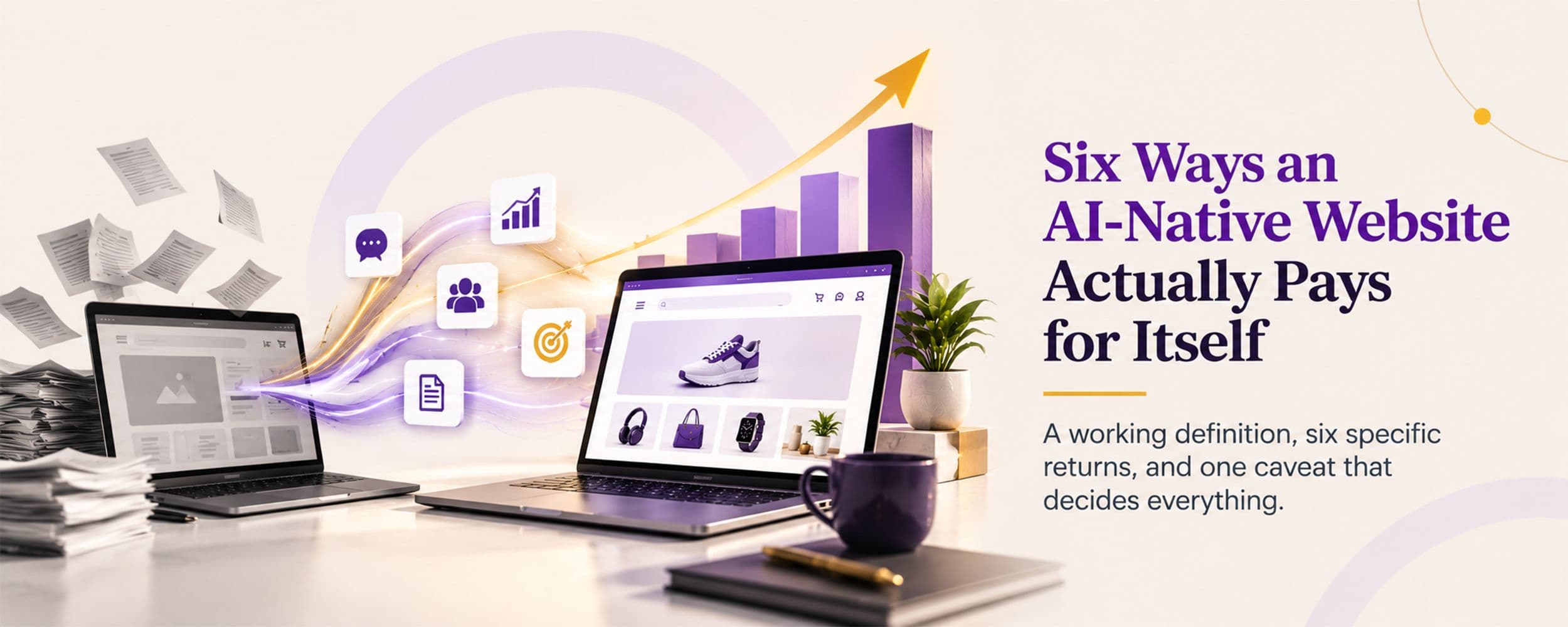
The question that follows, quite rightly, is whether an AI-native website actually pays for itself. It is a fair question. The build cost is higher, the design cycle is longer, and the results are harder to see in the first month. This piece answers that question directly. Six concrete ways an AI-native website returns real money, plus one caveat that decides whether any of it works.
1. It qualifies leads while your sales team is asleep
The average B2B website in India receives its next lead at 2:47 AM, from a country the sales team does not track, in an industry the sales team does not know well. That lead sits in the CRM until Monday. By Tuesday, three competitors have replied. By Wednesday, the lead is cold.
An AI-native website closes that gap. When a visitor fills a form or engages a conversational surface, the site reads the message, checks it against the business's own qualification rules, tags it, scores it, routes it to the right person, and sends the visitor a genuine reply. Not a scripted acknowledgement. A reply that reflects what the business actually offers. The qualification does not wait for a human to arrive at their desk.
The most visible version of this is a recruitment portal we built where the AI reads incoming resumes, scores them against the role's live requirements, flags the top ten percent for interview, and drafts the first outreach message. The HR team walked into Monday with the week's shortlist already prepared. That is not a chatbot. That is qualification wired into the site's plumbing.
“'AI-native' is not about how a website talks to its visitors. It is about how the website thinks about them.”
2. It answers correctly, in context, at three in the morning
The old assumption was that a website's job at 3 AM is to look presentable and hope. The AI-native assumption is that the site should be able to answer, in the business's own voice, whatever a visitor actually asks. Not from a pre-written script. From the same understanding the sales team would bring.
This changes a specific number: the conversion rate on off-hours enquiries. Traditional sites lose most of them, because the visitor either leaves the form empty, or fills it and never hears back before their attention moves on. An AI-native site holds the conversation, answers the answerable, escalates what needs a human, and books the meeting if the visitor is ready. All while the office is dark.
The uplift here compounds with time zones. A Pune business selling to Dubai, London or New York used to accept that half the buying day was wasted. An AI-native site turns those hours from dead time into pipeline.
3. Its content is written to be found by AI, not just by Google
AI search is not a future problem. It is a current one. When a founder in Bengaluru asks ChatGPT 'which agencies in India do performance marketing for education businesses?', the answer they receive names some agencies and not others. The naming logic is not the same as Google's ranking logic. GEO, or Generative Engine Optimisation, is how you get named.
AI-native websites are built with this in mind. The content is structured so AI search engines can lift a specific, useful, verifiable claim from it. The author's authority is signalled properly through schema. The internal linking creates a citation graph, not just a navigation menu. The technical hygiene, the semantic markup and the answer-first paragraph structure are all decided before design opens.
The most complete example we can point to is a Pune-based wellness and mindfulness platform, The Holistic Care, whose site is now cited over 3.3 million times a year across AI answer engines, with more than 118,000 of those citations confirmed through Microsoft Bing Webmaster Tools. Traffic that was never chasing a Google ranking, and would never have arrived through a traditional SEO plan alone.
4. It personalises without a data team
Personalisation used to require a rules engine, a data warehouse, and a very patient analyst. Most Indian businesses concluded, sensibly, that it was not worth the cost. The result was a decade of websites that treated every visitor the same, and a lot of bounce.
An AI-native site handles this natively. It reads behaviour signals in real time, adapts what it shows, and does so without needing a person to write and maintain a hundred rules. The founder browsing pricing is shown case studies from businesses their size. The marketer researching a service is shown the outcome data. The buyer returning for the third time is shown what has changed since they last visited.
The measurable effect is on the same numbers your team already tracks: bounce goes down, time on page goes up, and the percentage of visitors who move to a demo or a contact form increases. What used to be an enterprise-only capability is now a starting expectation.
5. It removes routine operational work from your team
Some of the most useful AI-native features are the ones the visitor never sees. A community platform we built auto-clips highlight moments from a two-hour founder session, drafts the descriptions, and publishes the clips to the members' library without a person opening a video editor. The site does the work the team used to do.
Multiplied across dozens of small workflows, the accumulation matters. A property portal that auto-generates listing descriptions from a photo and a specification sheet. A publisher whose CMS auto-suggests internal links between articles. An education platform whose backend groups new learners into cohorts by capability rather than by enrolment date. Each of these removes one meeting, or two hours, or a whole role's worth of manual effort.
The financial return here is not usually a new revenue stream. It is time freed up in the team you already pay, which means the business scales without headcount growing in lockstep.
6. It compounds. The site gets more valuable with time.
A traditional website is at its most valuable on the day it launches. From that day forward, it depreciates, quietly, until someone decides to redesign it three years later. It is a static asset, and static assets do not appreciate.
An AI-native website behaves the opposite way. The more it is used, the better it gets at recognising what visitors want, the more content it accumulates for AI search engines to cite, the sharper its personalisation becomes, and the more of the team's operational load it absorbs. Twelve months in, it is worth more than it was on day one. Twenty-four months in, considerably more.
This is the return that is hardest to quantify in a first-month spreadsheet, and it is also the biggest. Every other item on this list has a short-term measurement. This one is the reason the whole build makes sense over a three-year horizon.
The one caveat that decides whether any of this works
The caveat
An AI-native website only pays for itself when the AI is built into the business, not layered onto the site.
A chatbot bolted on to an existing template is not AI-native. A landing page whose copy was drafted in ChatGPT is not AI-native. A site with a search bar that calls an LLM is not AI-native. These are cosmetic uses of AI. They can look impressive and return nothing.
The projects that pay back are the ones where a real business workflow, resume screening, lead qualification, content generation, internal search, cohort formation, video segmentation, is redesigned around what AI does well, and the website is the surface that workflow lives on. That is engineering. It takes longer to scope, longer to build, and it costs more. It is also the only version of this that is worth paying for.
If a proposal for an AI-native website does not name, precisely, which business workflow the AI is going to run and what number it is going to move, it is not an AI-native project. It is a redesign with an 'AI' sticker on it, and it will not pay for itself.
Planning an AI-native website
MagicWorks scopes AI-native builds around a named business workflow and the number it is meant to move, before design opens.
Explore our AI-native website development service, or
book a discovery call to talk through which of your workflows belong on the site.