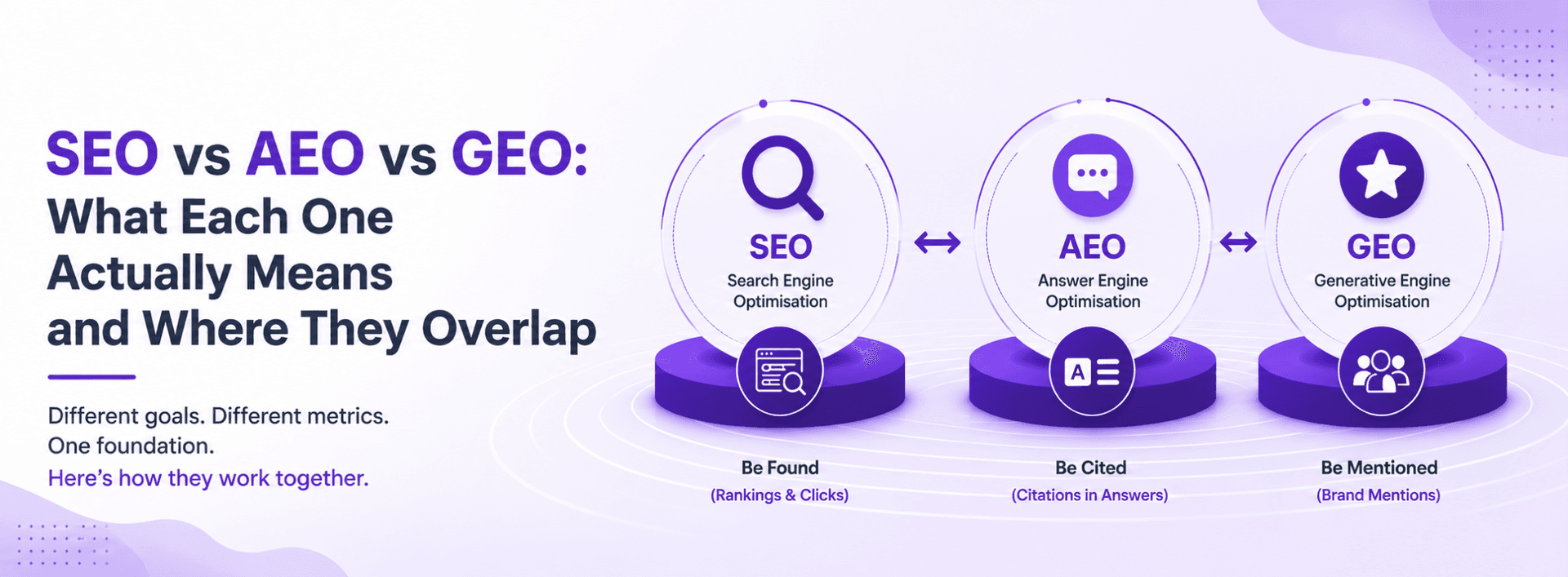
Key Takeaway
SEO (Search Engine Optimisation) earns rankings and clicks from search engines. AEO (Answer Engine Optimisation) earns citations from AI systems that answer questions directly. GEO (Generative Engine Optimisation) earns brand mentions inside AI-generated answers through sustained, expert content. They share one foundation but have three different units of success, and most businesses need a deliberate mix, not all three at equal weight.
The marketing industry has produced three acronyms in three years, and vendors are now selling them as three separate products. That is confusing at best and expensive at worst.
This article gives you plain definitions, an honest map of where the disciplines overlap, and a straightforward way to decide which one deserves your budget. It is also where we explain how we name these services ourselves, and why.
What is SEO?
Search Engine Optimisation is the practice of improving your website so search engines rank it higher for the queries your buyers type. It covers technical health (crawlability, speed, mobile performance), on-page relevance (content, structure, internal linking), and authority (backlinks and reputation).
The unit of success is a ranking, and the business outcome is a click. Someone searches, sees your page in the results, and visits your site. SEO has been the backbone of organic growth for two decades, and despite yearly obituaries, it still is. Search engines remain the largest discovery layer on the internet, and every newer discipline in this article depends on the infrastructure SEO builds.
What is AEO?
Answer Engine Optimisation is the practice of structuring content so AI-powered systems can extract it and cite it when they answer a user's question directly. Answer engines include Google's AI Overviews, Microsoft Copilot, ChatGPT, and Perplexity: systems that respond with an answer instead of a list of links.
The unit of success is a citation. The user may never click, but your brand appears as the source of the answer at the exact moment they are forming an opinion. AEO work includes question-first content structure, direct extractable answers, structured data such as the vocabulary documented at schema.org, and entity clarity, meaning the engine knows precisely who you are and what you do.
If you want the full mechanics, we published a complete practical guide to Answer Engine Optimisation, including the Citation Signals framework we use in client work. This article stays at the map level.
What is GEO?
Generative Engine Optimisation is the practice of earning brand mentions and citations inside AI-generated answers through a sustained programme of high-quality, expert-attributed content. Where AEO is largely about how content is structured, GEO is about whether the content deserves to exist at all: original points of view, first-hand data, named expertise, and consistency over months.
The unit of success is a mention: your brand or your founder named inside an AI answer as an authority on the topic, whether or not a link accompanies it. When someone asks an AI assistant who the credible voices on AI adoption in Indian manufacturing are, the names that appear did not get there through schema markup. They got there through a body of work the models learned to associate with the topic.
That distinction matters because it changes who does the work. Structure is a technical job. A body of work is an editorial one.
The overlap: one foundation, three layers
Here is the part most vendor pitches skip. The three disciplines are not parallel silos. They stack.
The shared foundation is a technically healthy, crawlable, fast website with honest content. Google's own documentation on AI features in Search confirms that AI surfaces draw on the same index and quality signals as classic search. An answer engine cannot cite a page it cannot crawl. A generative model cannot learn your expertise from content that does not exist. SEO builds the ground floor.
AEO is a structural layer on top of that foundation. The same page that ranks can be restructured to become citable: question headings, extractable summaries, structured data, named authors. Good AEO work usually improves rankings too, because clarity helps humans and crawlers alike.
GEO is an editorial layer on top of both. It cannot be retrofitted onto a page. It is earned through publishing, consistently, in a named expert voice, across your website and the wider web, until the models corroborate your authority from multiple directions.
Where they differ is the unit of optimisation, the metric, and the owner. SEO optimises pages, measures rankings and traffic, and belongs to your technical and content team. AEO optimises passages, measures citations, and belongs to the same team with a structural playbook. GEO optimises a body of work, measures brand mentions in AI answers, and belongs to your most senior voices, because models cite expertise, and expertise has a name attached.
How we name these disciplines, and why
At MagicWorks we deliberately do not sell three acronyms. We sell two services, and the naming is intentional.
Search & Answer Engine Optimisation is one combined technical discipline. We never split it, because in practice the work is inseparable: the same audit, the same content restructuring, the same schema, the same measurement loop covers both search rankings and answer-engine citations. Selling them separately would mean billing you twice for one job.
Thought Leadership & GEO is a separate service, and GEO lives there on purpose. Generative Engine Optimisation is achieved through consistent, quality, founder-attributed content production, not through technical optimisation alone. It belongs with the editorial programme that produces that content: long-form articles, points of view, and the sustained publishing calendar that turns a senior person's expertise into something AI models cite. The buyer is usually a founder or CXO building personal authority, and the company earns the halo.
You do not have to adopt our naming. But you should demand that whoever you hire can explain where their technical work ends and their editorial work begins. If a proposal charges separately for "SEO," "AEO," and "GEO" without a clear answer to that question, you are likely paying three times for overlapping effort.
Which one does your business actually need?
A practical decision guide, by situation rather than by acronym.
If your website is slow, thin, or poorly structured: start with the foundation. No citation strategy survives a site that engines cannot crawl and users will not stay on. This is Search & Answer Engine Optimisation work, and the answer-engine layer comes along with it.
If you rank reasonably well but never appear in AI answers: your problem is structural. Question-first headings, extractable answers, entity clarity, and structured data will move you faster than more backlinks will.
If your category's AI answers name your competitors as the authorities: your problem is editorial. You need a sustained thought-leadership programme with a named senior voice, which is GEO territory, and it is a months-long commitment rather than a project.
If you are a founder or CXO whose personal authority drives the business: GEO through thought leadership is the highest-leverage option on this page, because models increasingly attribute expertise to people, and your company inherits the trust.
Most businesses we audit need the first two together and underestimate the third. Almost none need three separate retainers.
The one-line summary
SEO gets you found. AEO gets you cited. GEO gets you named. They share one foundation, and the honest way to buy them is as two disciplines: one technical, one editorial.
About the author: Swapnil Ughade is the Founder of MagicWorks IT Solutions Pvt. Ltd., an AI-first digital marketing agency based in Pune, India. He brings 17+ years of experience across digital marketing, web development, and AI strategy, and leads the agency's Search & Answer Engine Optimisation practice.