Key Takeaway
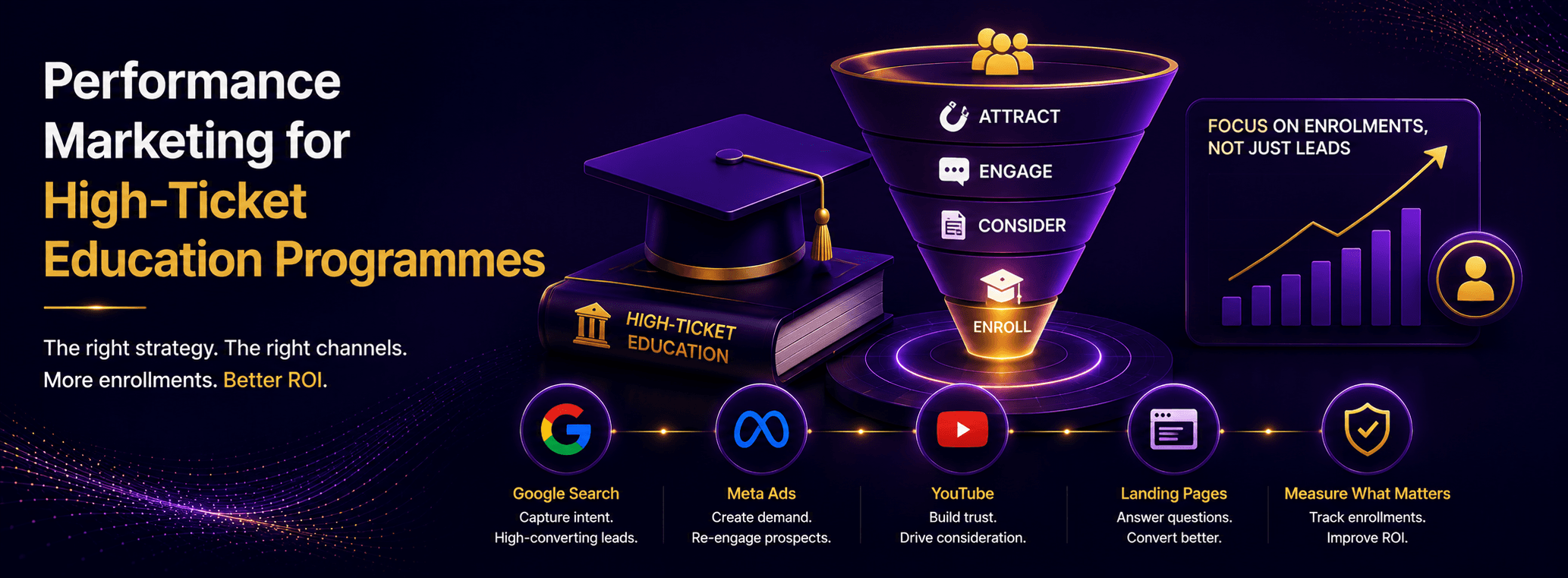
High-ticket education marketing is a different sport from volume lead generation. When a programme fee runs into lakhs, the decision cycle stretches to weeks or months, a second decision-maker usually holds the money, and one enrolment justifies significant acquisition cost. The playbook that wins starts from enrolment economics and works backward: allowable cost per enrolment first, then channel roles, then campaign structure, then measurement that counts students rather than form-fills.
There are two kinds of education marketing, and confusing them is expensive.
The first optimises for volume: low-fee courses, short decision cycles, success measured in cheap enquiries. The second is the high-ticket game: MBA and executive programmes, professional certifications, premium K-12 admissions, study-abroad pathways, where fees run from one lakh to twenty and beyond. Here the enquiry is not the product. The enrolment is, and everything about how you buy, structure, and measure campaigns has to change accordingly.
Having managed education portfolios at serious scale, including sustained campaigns generating tens of thousands of qualified admissions leads, here is the playbook we run for the high-ticket version of this sport.
Start with the math, not the media plan
Every high-ticket campaign should begin with three numbers written on one page, before a single ad exists.
First, revenue per enrolment: the programme fee, plus any realistic lifetime extension such as alumni programmes or progression courses. Second, your enquiry-to-enrolment rate from the last full cycle, honestly measured by source if you have it. Third, from those two, your allowable cost per enrolment: the acquisition cost at which the economics still work after delivery costs and margin.
Divide allowable cost per enrolment by your enquiry-to-enrolment rate and you get your allowable cost per enquiry, which is the only sane way to judge whether your campaigns are expensive or cheap. A Rs 900 enquiry looks costly next to a competitor's Rs 300 one, right up until you learn that yours converts at five times the rate because of how it was targeted and qualified. The institution that knows its math buys students. The institution that does not buys spreadsheet rows.
This is also why high-ticket education sits naturally in commission-tier ad budgets: the value of a single enrolment supports real spend, and the account complexity justifies real management. We wrote separately about when that pricing model works and when it does not.
Assign each channel one job
The most common structural error in education accounts is asking every channel to do everything. High-ticket buying journeys have stages, and channels map to stages.
Google Search owns intent capture. When someone types a programme category with buying intent, comparison intent, or your brand name, Search is where the decision surfaces. This is the channel that should never be starved, and Google's own documentation covers the mechanics; the strategy layer is below.
Meta owns demand creation and re-engagement. Facebook and Instagram find the professional who has not yet searched: the mid-career manager who did not know an executive programme fits their situation, the parent early in the school research cycle. Meta also carries the remarketing load across a long decision cycle, which in high-ticket education is where much of its value actually sits. Meta's platform documentation covers formats; the discipline is keeping its job separate from Search's.
YouTube owns consideration. Nobody commits lakhs to a programme from a headline. Campus and faculty content, alumni outcomes, and honest programme explanations do the mid-funnel persuasion that text ads cannot, and they make every other channel's clicks convert better.
The test of a well-structured account: you can state each campaign's single job in one sentence, and its metrics match that job. Demand-creation campaigns judged on last-click enrolments will always look like failures, right up until you switch them off and watch Search volume quietly fall.
Structure Search the high-ticket way
Four structural rules cover most of what goes wrong inside education Search accounts.
Defend your brand ruthlessly. In admission season, competitors and aggregators bid on institution names. Your brand campaign is the cheapest, highest-converting spend in the account, and ceding it means paying an aggregator tomorrow for the student who searched for you today.
Build campaigns around programme-level intent, not institution-level vanity. The buyer searches for the programme category and the outcome, with their city or "online" attached. Campaign structure should mirror that: one intent theme per campaign, with ad copy and landing page matched to it, rather than one generic campaign pointing everything at the home page.
Treat aggregator-dominated queries with respect and math. In many education categories, comparison portals dominate the expensive head terms. Sometimes the right move is to outbid them on your strongest programmes; often the smarter one is to win the longer, more specific queries they ignore, where intent is higher and clicks are cheaper.
Qualify inside the ad experience. Fee ranges stated in ad copy, qualifying questions in lead forms, and landing pages that are honest about who the programme is for will lower your enquiry volume and raise everything that matters afterward. In high-ticket, the form is a filter, not a net. This connects directly to the funnel discipline we covered in our enquiry-to-enrolment article, because campaigns and counsellors are one system.
Respect the second decision-maker
High-ticket education almost always has two buyers. For younger students, a parent controls the money. For working professionals, a spouse or an employer shares the decision. Campaigns that speak only to the applicant leave the economic buyer unconvinced and the enrolment unsigned.
Practically, this means remarketing and consideration content that answers the second decision-maker's questions: outcomes, placement and salary evidence, accreditation, safety, return on the fee. It also means landing pages with a section that an applicant can literally forward to the person they need to convince. The institutions that market to the whole decision unit close the enrolments their competitors' campaigns started.
Plan spend around the intake calendar, not the monthly budget
Education demand is seasonal and the auction knows it. Costs per click climb as deadlines approach and every institution floods the same weeks.
The high-ticket answer is to start earlier than feels natural. Demand creation and consideration content should run in the quiet months, building an audience of educated prospects at low cost, so that when the intake window opens, your Search and remarketing campaigns are harvesting warm demand rather than bidding cold against the whole market at peak prices. The budget curve should look like a ramp that peaks before the deadline crush, not a spike inside it. Institutions that discover performance marketing six weeks before their deadline pay the panic tax, every single cycle.
Measure enrolments, and feed them back
The closing discipline, and the one that separates professional accounts from busy ones: outcomes must flow back into the platforms.
That means passing enrolment and qualified-stage data back against source, campaign, and ad, through offline conversion imports, so that both your reporting and the platforms' own optimisation learn from students rather than form-fills. Judged on cost per enquiry, the algorithm will happily manufacture cheap phone numbers. Judged on cost per qualified applicant and enrolment, it starts hunting the profiles that actually become students.
Report the account monthly on exactly four numbers per source: spend, qualified enquiries, applications, enrolments, with the cost of each stage. Everything else in the dashboard is commentary.
High-ticket education marketing rewards patience, math, and structure, in that order. The institutions that treat it as a volume game buy enquiries. The ones that run this playbook buy students.
About the author: Swapnil Ughade is the Founder of MagicWorks IT Solutions Pvt. Ltd., an AI-first digital marketing agency based in Pune, India. He brings 17+ years of experience across digital marketing, web development, and AI strategy, with education among the agency's priority verticals and admissions performance marketing among its anchor engagements.