Key Takeaway
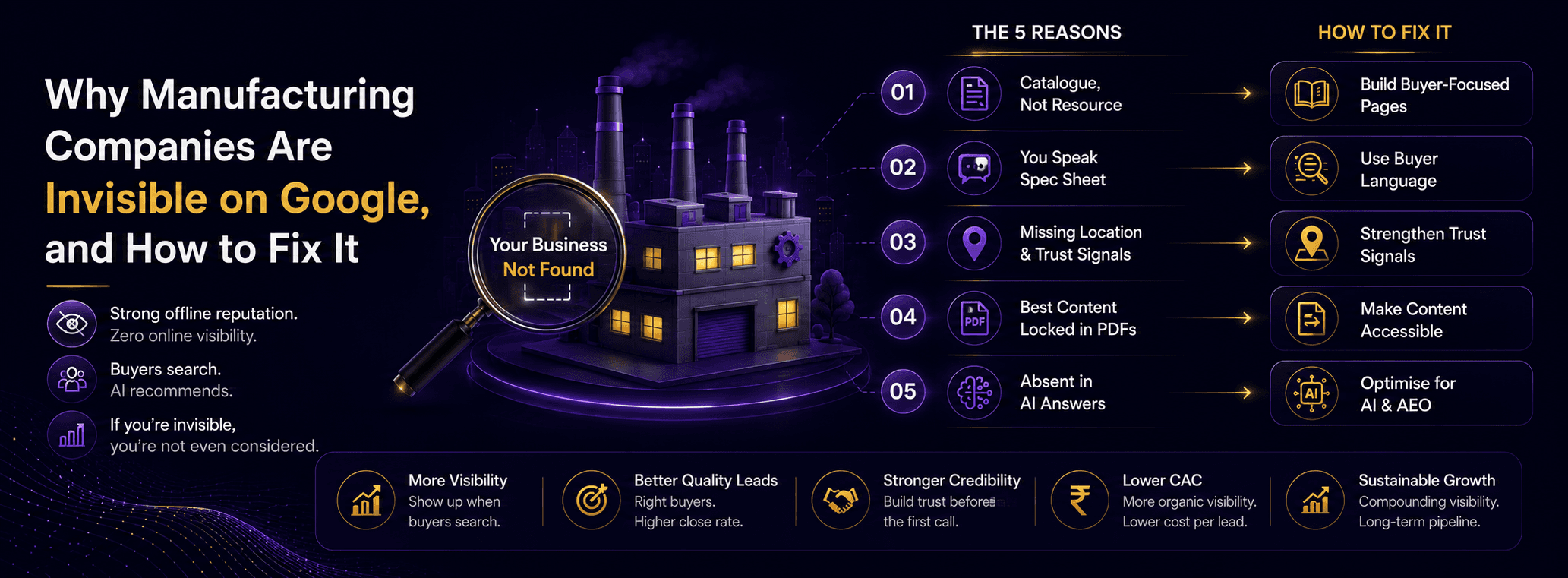
Most Indian manufacturers are invisible online for five specific reasons: their websites are product catalogues instead of buyer resources, their language matches spec sheets instead of search queries, their location and capability signals are missing, their best content is locked inside PDFs, and they have no presence in the AI answers where younger procurement teams now begin supplier research. Each one is fixable, and this article gives the roadmap.
Here is a conversation we have had many times with manufacturing founders. The company has run for twenty years. Its offline reputation is excellent. Its order book is built on relationships, referrals, and trade exhibitions. And when a procurement engineer in another city searches for exactly what the company makes, the company is nowhere.
The founder usually knows this and has usually made peace with it, on the theory that "our buyers do not find suppliers on Google." That theory was defensible in 2015. It is costing real orders in 2026, because the buyer has changed even where the product has not.
The buyer changed before the manufacturer noticed
Two shifts made online invisibility expensive for industrial companies.
The first is generational. The engineers and procurement managers shortlisting suppliers today grew up searching for everything. Their default first step is not the industry directory or the exhibition catalogue. It is a search box, and increasingly an AI assistant that returns a shortlist of suppliers with reasons attached. If you are absent from that shortlist, your twenty-year reputation never gets the chance to speak.
The second is procedural. B2B buying committees now complete a large share of their research before any supplier conversation begins. By the time your sales team hears about a requirement, the vendor list has often been drafted from what the committee could find and verify online. Invisibility does not just cost you discovery. It costs you the RFQs you never knew existed.
The good news: manufacturing is one of the least competitive online categories in India relative to the value at stake. Your competitors are mostly as invisible as you are, which means the fixes below pay off faster here than in almost any consumer category.
Reason 1: Your website is a catalogue, not a resource
Open a typical manufacturer's website and you find a home page, an about page, a product grid, and a contact form. Everything on it describes the company. Nothing on it answers a buyer's question.
But buyers arrive with questions: whether your process suits their material, what tolerances you hold, what your minimum order quantities look like, how you handle quality documentation, what industries you already serve. When the website answers none of these, the buyer either bounces to a competitor who does, or files you under "unclear" and moves on. Search engines make the same judgment, because a site with no question-answering content has nothing to rank for beyond its own name.
The fix: build capability and application pages, one for each combination of what you do and who you do it for. "CNC machining for automotive component suppliers" is a page. "Powder coating for architectural aluminium" is a page. Each answers the real questions a buyer in that segment asks, in their words. This single change typically multiplies the number of queries a manufacturing site can appear for.
Reason 2: You speak spec sheet, buyers speak problem
Manufacturers write in the language of their machines: model numbers, process names, internal category labels. Buyers search in the language of their problems: the application, the material, the industry, the tolerance, the certification, the city.
The result is a vocabulary gap. Your page about a "5-axis VMC" never meets the engineer searching for "precision aerospace component machining India," even though you are exactly what they need.
The fix costs nothing but honesty about how buyers actually talk. Pull the phrases from your sales enquiries, RFQ emails, and exhibition conversations, and let those phrases lead your page titles and headings, with the technical specification supporting rather than leading. You are not dumbing anything down. You are translating from your language to your buyer's.
Reason 3: Your location and capability signals are missing
Industrial searches carry heavy local and credential intent: the city, the region, "near me," the certification, the industry served. Manufacturers routinely fail to state these plainly anywhere a machine can read them.
The fix has three parts. Claim and complete your Google Business Profile with accurate categories, your full service area, photographs of the actual facility, and your certifications listed. State your locations, industries served, and certifications in crawlable text on the website itself, not only in a footer image. And implement Organization schema, using the vocabulary documented in Google's structured data guidance, so engines can connect your name, location, and capabilities without guessing. These are hours of work, not months, and they move local industrial visibility more than almost anything else.
Reason 4: Your best content is trapped in PDFs
Somewhere in your company is genuinely excellent material: the capability deck, the process brochure, the quality manual summary. It lives in PDFs, attached to emails and buried behind download links. Search engines index PDFs poorly relative to pages, AI answer engines extract from them worse, and mobile users abandon them almost immediately.
The fix: liberate the content. Every substantial PDF should have an HTML page equivalent, structured with real headings, with the PDF offered as a secondary download for the buyer who wants it. You have already paid to create this material. Publishing it properly is the cheapest content programme you will ever run.
Reason 5: You are absent from AI answers
The newest reason, and the one moving fastest. When a procurement engineer asks an AI assistant to shortlist suppliers for a process in a region, the assistant assembles an answer from what it can find and verify. Manufacturers with clear capability pages, consistent entity information, and honest case content get named. Everyone else does not exist in that conversation.
This is Answer Engine Optimisation applied to industry, and it rewards exactly the fixes above: question-answering pages, plain buyer language, entity clarity, and structured data. Add one more step: verify your site in Bing Webmaster Tools, because Bing's index feeds Microsoft Copilot, which is precisely the assistant embedded in the Office environment your buyers work in all day. We covered the full mechanics in our practical guide to Answer Engine Optimisation, and every word of it applies doubly to manufacturing, where citable competition is thin.
The 90-day fix roadmap
Sequenced for a lean team, in order of effort against impact.
Weeks 1 to 2: claim and complete Google Business Profile, verify Bing Webmaster Tools and Google Search Console, and state locations, certifications, and industries served in crawlable text.
Weeks 3 to 6: write your first five capability and application pages, led by the buyer language pulled from real enquiries. Add Organization schema site-wide.
Weeks 7 to 10: convert your three most valuable PDFs into structured HTML pages. Add an FAQ section answering the ten questions your sales team hears most, one honest answer each.
Weeks 11 to 13: publish your first case story, with the client anonymised if consent is not available, focused on the problem, the process, and the verifiable outcome. Then measure: track which queries and pages generate enquiries, and let that data pick the next five pages.
None of this requires a big budget. It requires deciding that the company's online presence should work as hard as its shop floor does.
The quiet advantage of moving first
In consumer categories, this playbook is table stakes. In Indian manufacturing, it is still a differentiator, because the majority of your competitors have not moved. The manufacturers who build genuine online visibility in the next two years will be the names AI assistants learn to associate with their categories, and those associations compound. The window for cheap authority in industrial categories is open right now. It will not stay open.
About the author: Swapnil Ughade is the Founder of MagicWorks IT Solutions Pvt. Ltd., an AI-first digital marketing agency based in Pune, India. He brings 17+ years of experience across digital marketing, web development, and AI strategy, with manufacturing among the agency's priority verticals.