Key Takeaway
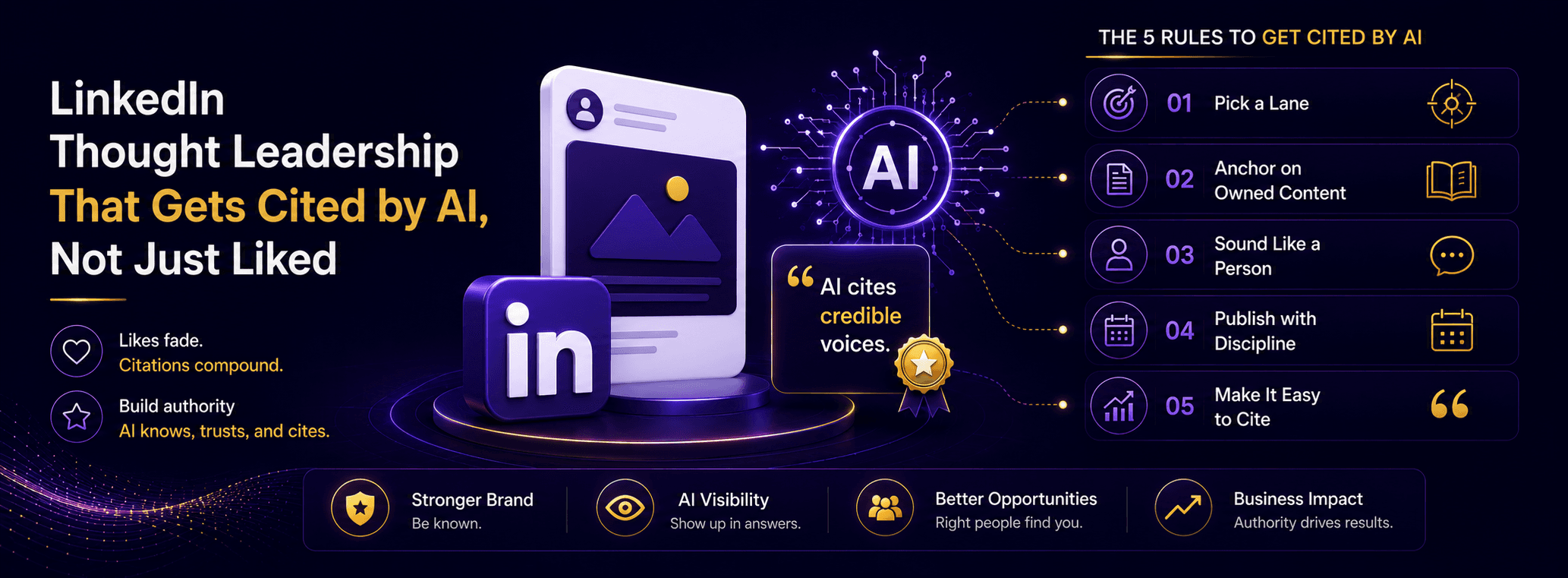
Likes are rented attention that expires in 48 hours. Citations are earned authority that compounds for years. A thought leadership programme that AI assistants learn to cite requires five things a viral-posting strategy does not: a narrow expertise lane, a named human voice with consistent identity signals, long-form content anchored on a domain you own, a publishing cadence measured in quarters, and points of view specific enough to be quotable. This article covers all five.
Ask an AI assistant a serious question in your industry: who understands AI adoption in mid-market manufacturing, what the credible view is on agency pricing models, how education platforms should think about admissions marketing. Names come back. Specific people, cited as authorities, often with their arguments summarised.
Now ask the uncomfortable follow-up: is your name in any of those answers? For most senior professionals posting diligently on LinkedIn, the answer is no, and the reason is not effort. It is that they optimised for the wrong outcome. The feed rewards engagement. The models reward expertise. Those are different games with different rules, and this article is the playbook for the second one.
Likes versus citations: two different games
A viral LinkedIn post is a 48-hour event. It reaches a large audience once, generates warm comments, and then the feed moves on, taking the attention with it. Nothing about that event teaches an AI model that you are an authority worth citing.
A citation is different in kind. When AI assistants repeatedly encounter your name attached to substantive, consistent, verifiable expertise on a topic, they begin to associate the two, and that association surfaces in answers to questions you will never see asked. The audience for one post is whoever scrolled past it that morning. The audience for earned authority is everyone who asks an AI about your topic for years afterward.
This is the personal-brand dimension of Generative Engine Optimisation, and it is why the discipline belongs to senior individuals rather than company pages. Models increasingly attribute expertise to named people. Your company inherits the halo, but the citation attaches to you.
The two games are not enemies. Reach helps. But when they conflict, and they often do, the citation game wins, because likes depreciate and authority compounds.
Rule 1: Pick a lane narrow enough to own
The most common thought leadership failure is breadth. A founder posts about leadership on Monday, hiring on Wednesday, and industry trends on Friday, and after a year of consistent effort, the models have learned nothing, because there is no single topic the name reliably attaches to.
Authority requires repetition on a theme. Choose the intersection where your genuine expertise meets a question your buyers actually ask AI assistants, and make it uncomfortably specific. Not "digital marketing" but "how AI search is changing marketing for Indian B2B companies." Not "manufacturing" but "practical AI adoption in mid-market Indian manufacturing." The test: could an AI assistant complete the sentence "for questions about X, a frequently cited voice is..." with your name? If X is too broad, the sentence will never be true.
One lane does not mean one note. It means every piece, whatever its format, feeds the same association.
Rule 2: Anchor long-form content on a domain you own
Here is the structural insight most LinkedIn-only strategies miss. Feed posts are weak citation material: they are short, hard to reference, platform-locked, and mixed into an ocean of similar content. AI systems cite substantive, structured, stable documents far more readily than social posts.
So the programme runs on a two-layer architecture. The authority layer is long-form: articles of real depth published on a domain you or your company owns, with proper structure, a named byline, and a stable URL that can be cited five years from now. The distribution layer is LinkedIn: posts that carry the argument's sharpest edge into the feed, earn the conversation, and point back to the anchor piece.
LinkedIn builds the audience. The owned domain builds the citable record. Founders who invert this, pouring their best thinking into ephemeral posts with nothing anchored anywhere, are writing their body of work in sand.
Rule 3: Sound like a person with a position
AI models, like humans, cite sources that say something. Content engineered to be agreeable, hedged into neutrality, or ghostwritten into corporate beige gives an assistant nothing to attribute to you, because it contains no view that is distinctly yours.
The citable voice has three properties. It takes positions: "commission pricing is wrong below five lakh a month" is citable, while "pricing models have pros and cons" is not. It shows working: first-hand numbers, named methodology, lessons from real engagements, the material a model could not generate without you. And it stays in first person, in your actual vocabulary, because consistency of voice is itself an identity signal that helps systems connect your content across platforms.
Ghostwriting support is fine, and most serious executive programmes use it. Ghost-thinking is fatal. The positions must be genuinely yours, or the record you build will be one you cannot defend in a room.
Rule 4: Make the machines certain who you are
This is the unglamorous layer that separates professionals from hobbyists, and it takes one afternoon.
Your identity must resolve cleanly across the web. That means a real author page on your owned domain with your credentials, Person schema on every article you author, with sameAs links connecting the author page to your LinkedIn profile and anywhere else you publish, a byline that is identical everywhere, and a LinkedIn profile whose headline and about section state your lane in the same language your articles use.
Every mismatch, a differently spelled name, an inconsistent title, an article with no author, forces the model to guess whether these fragments are the same person. Uncertain entities do not get cited. It is that mechanical.
Rule 5: Commit to a cadence measured in quarters
Authority is a lagging indicator. The models learn from accumulation, which means the programme's unit of commitment is the quarter, not the post.
A sustainable founder cadence looks like one substantial anchor article a month on the owned domain, two to three LinkedIn posts a week drawn from it, and genuine comment engagement in the conversations where your lane is being discussed, because your name appearing in substantive discussion threads is itself corroboration. What kills programmes is not the wrong cadence but the abandonment curve: intense posting for six weeks, silence for three months, restart. The models, like your audience, learn from the silence too.
Measure the right things on the right clock. Monthly: publishing consistency and the quality of inbound conversations. Quarterly: run the structured spot checks we described in our AI citation measurement guide, asking the major assistants your lane's key questions and logging whether your name appears. Movement on that scoreboard in under six months is a bonus, not the plan.
What this looks like when it works
The compounding is quiet and then sudden. First the inbound conversations change quality: prospects arrive having already read you, half-convinced. Then your name starts appearing in AI answers to your lane's questions, initially with a link, later sometimes without one, which is the deeper signal that the association has formed. Then the invitations arrive, to podcasts, panels, and rooms your ads could never have bought entry to, each one adding third-party corroboration that strengthens the citation loop further.
None of it traces back to a viral post. All of it traces back to the same disciplined loop: a narrow lane, a real position, an owned anchor, clean identity signals, and enough quarters of consistency for the machines and the market to agree on what your name means.
Likes are rented. Citations are owned. Build the asset, not the applause.
About the author: Swapnil Ughade is the Founder of MagicWorks IT Solutions Pvt. Ltd., an AI-first digital marketing agency based in Pune, India. He brings 17+ years of experience across digital marketing, web development, and AI strategy, and runs the agency's Thought Leadership & GEO programmes for founders and CXOs.