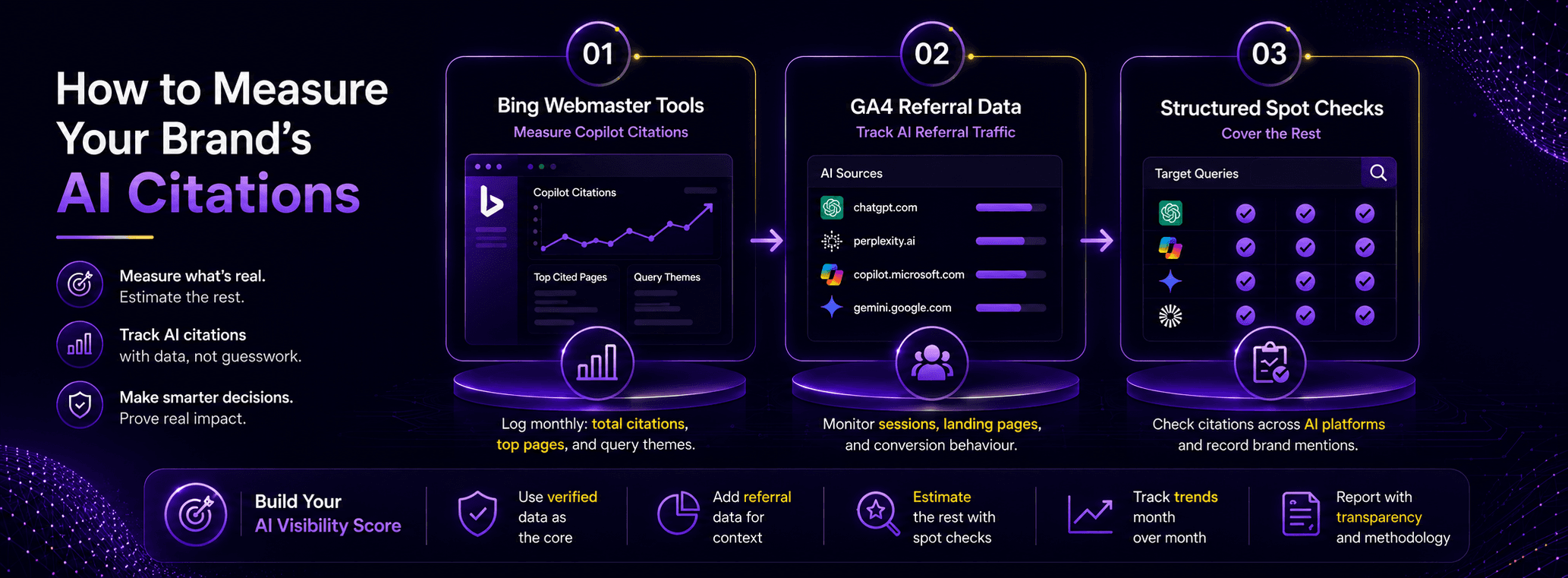
Key Takeaway
You can measure AI citations today, but only partially and only honestly. Bing Webmaster Tools gives you direct citation data for Copilot. GA4 shows referral traffic from ChatGPT, Perplexity, and Gemini. Structured monthly spot checks cover the rest. Any total cross-platform figure is an extrapolation, and this guide shows you how to build one responsibly, methodology included.
Every agency now claims to deliver "AI visibility." Almost none of them can show you how they measure it.
That gap is not the agencies' fault alone. Most AI platforms simply do not report citation data, so the industry filled the vacuum with vague scores and unverifiable claims. This guide is the opposite: a complete measurement workflow you can run yourself this week, with an honest line drawn between what you can verify and what you can only estimate.
We use this exact workflow to report client results, including the AI citation figures published in our own case studies. If a vendor ever shows you an AI visibility number, this article tells you what to ask them.
Why measurement is the missing half of AI search
Optimisation without measurement is faith. In classic SEO you had rankings, impressions, and clicks to tell you whether the work was paying off. In AI search, most of the equivalent data does not exist publicly, which creates two failure modes.
The first is abandonment: teams optimise, see nothing in three weeks, and quit before the compounding starts. The second is gullibility: teams accept any impressive-sounding number a vendor presents, because there is no obvious way to check it.
Both failure modes have the same cure. Learn what is directly measurable, measure it consistently, and treat everything else as a labelled estimate.
Step 1: Verify your site in Bing Webmaster Tools
Bing Webmaster Tools is currently the single most valuable measurement platform for AI citations, for one structural reason: Bing's index powers Microsoft Copilot and feeds ChatGPT's web browsing. Microsoft is also the only major player that surfaces citation-level data to site owners.
If your site is not verified there yet, do it today. Verification takes minutes: sign in, add your site, and confirm ownership via DNS record, an XML file, or by importing your existing Google Search Console property, which is the fastest route.
Once verified and once data accumulates, examine your search performance reporting with particular attention to how your pages surface in Copilot answers. As of mid-2026, Microsoft reports impressions and citation activity that let you see which pages are being pulled into AI answers, which queries trigger them, and how that volume trends month over month. Interface labels change often, so explore the performance section rather than hunting for one fixed report name.
Three things to log monthly from this platform: total Copilot-related citations or impressions, your top ten cited pages, and the query themes triggering them. These three numbers become the verified core of everything else in this workflow.
Step 2: Segment AI referral traffic in GA4
AI assistants increasingly link their sources, and when users click those links, the visit lands in your analytics with an identifiable referrer. Google's Analytics documentation covers the mechanics of building comparisons and exploration reports; here is what to build.
Create a segment or exploration filtering session source to include the AI platforms: chatgpt.com, perplexity.ai, copilot.microsoft.com, and gemini.google.com, plus any regional assistants relevant to your market. Save it as a reusable comparison so every standard report can be viewed through the AI-referral lens.
Then track three metrics monthly: AI referral sessions, the landing pages receiving them, and their conversion behaviour compared to organic search traffic. In our client work, AI referral visitors frequently behave like pre-qualified traffic, because they arrive after an assistant has already answered their basic questions. Verify that pattern in your own data rather than taking ours on faith, and treat it as a hypothesis until your numbers confirm it.
One honest caveat: referral traffic undercounts real influence. Many users read the AI answer, absorb your brand, and never click. Traffic is the visible edge of a larger effect, which is exactly why Step 1 and Step 3 exist.
Step 3: Run structured monthly spot checks
This is the manual layer, and it is more rigorous than it sounds if you systematise it.
Build a prompt bank of fifteen to twenty-five questions your real buyers ask, drawn from sales calls, search query data, and your FAQ pages. Include the full journey: early questions ("what is an AI process audit"), comparison questions ("best digital marketing agencies for education in Pune"), and decision questions ("questions to ask before hiring a performance marketing agency").
On a fixed day each month, run every prompt through the same four platforms: Google AI Overviews or AI Mode, Copilot, ChatGPT, and Perplexity. Log four things per prompt: whether you were cited, whether you were named without a link, which competitors appeared, and which of your pages was used. A simple spreadsheet is enough; consistency matters more than tooling.
Two disciplines keep this honest. Use a clean browser profile or incognito session so personalisation does not flatter you, and never change the prompt bank mid-year without versioning it, or your trend line becomes meaningless.
After three months you will have something most of your competitors do not: a defensible citation share trend across the platforms that matter, built from primary observation.
Step 4: Extrapolate responsibly, and show your working
Here is the step where most published AI visibility numbers quietly go wrong, so let us do it in the open.
You have verified citation data from exactly one ecosystem: Bing and Copilot. Total citations across all platforms cannot be observed directly. They can only be estimated, and the least-bad method is market-share extrapolation: if platform-usage data suggests Copilot represents a given share of AI assistant activity in your markets, your verified Copilot citations can be scaled to estimate the whole.
The mechanics are simple. Take your verified Copilot citation count, take a credible estimate of Copilot's share of AI assistant usage from a source such as StatCounter Global Stats or an equivalent published dataset, and divide. If your verified count represents a small single-digit share of the market, your estimated total is proportionally larger.
The discipline is in the disclosure. An extrapolated figure is only honest when it is published with three things attached: the verified base number, the market-share source and date, and the explicit label "estimated." This is exactly how we present the figures in our own case studies: the verified Bing and Copilot count stands on its own, and the extrapolated total is shown with its methodology. Any number presented without that chain is marketing, not measurement.
When you evaluate an agency's AI visibility claims, ask one question: "What is the verified number underneath this, and where does the multiplier come from?" The quality of the answer tells you everything.
Step 5: Build a simple monthly report
Pull the layers into one page, reported monthly, trended quarterly.
The verified section carries your Bing Webmaster Tools citation data and your GA4 AI referral metrics. The observed section carries your spot-check citation share by platform and the competitor names appearing alongside yours. The estimated section, clearly labelled, carries any extrapolated totals with their methodology stated inline.
Then read trends, not absolutes. A month-over-month rise in verified citations, a widening citation share in your spot checks, and growing AI referral conversions are the signals that your Answer Engine Optimisation work is compounding. A single big number, in either direction, means very little in a measurement environment this young.
The mistakes that corrupt AI citation data
Four patterns we see repeatedly in audits, so you can avoid them.
Checking too soon and too emotionally. Citation share moves on a timescale of months. A weekly check produces noise and anxiety, not insight.
Letting personalisation flatter you. If you research your own industry daily on your own accounts, assistants will over-serve you your own brand. Clean sessions only.
Changing the prompt bank silently. Every prompt change resets the trend line. Version it like code.
Reporting the extrapolation as the fact. The verified number is the fact. The extrapolation is the context. Reversing those two is how the industry earned its credibility problem.
What good looks like after six months
Run this workflow consistently and by month six you will know your verified Copilot citation trend, which pages earn citations and for which query themes, your citation share against named competitors on the platforms your buyers actually use, and whether AI-referred visitors convert. That knowledge feeds directly back into what you publish next, which is the real point. Measurement is not the scoreboard at the end of the game. It is the map for the next quarter of content.
Rankings win clicks. Citations win trust. Measurement is how you prove you are earning both.
About the author: Swapnil Ughade is the Founder of MagicWorks IT Solutions Pvt. Ltd., an AI-first digital marketing agency based in Pune, India. He brings 17+ years of experience across digital marketing, web development, and AI strategy, and leads the agency's Search & Answer Engine Optimisation practice.