Key Takeaway
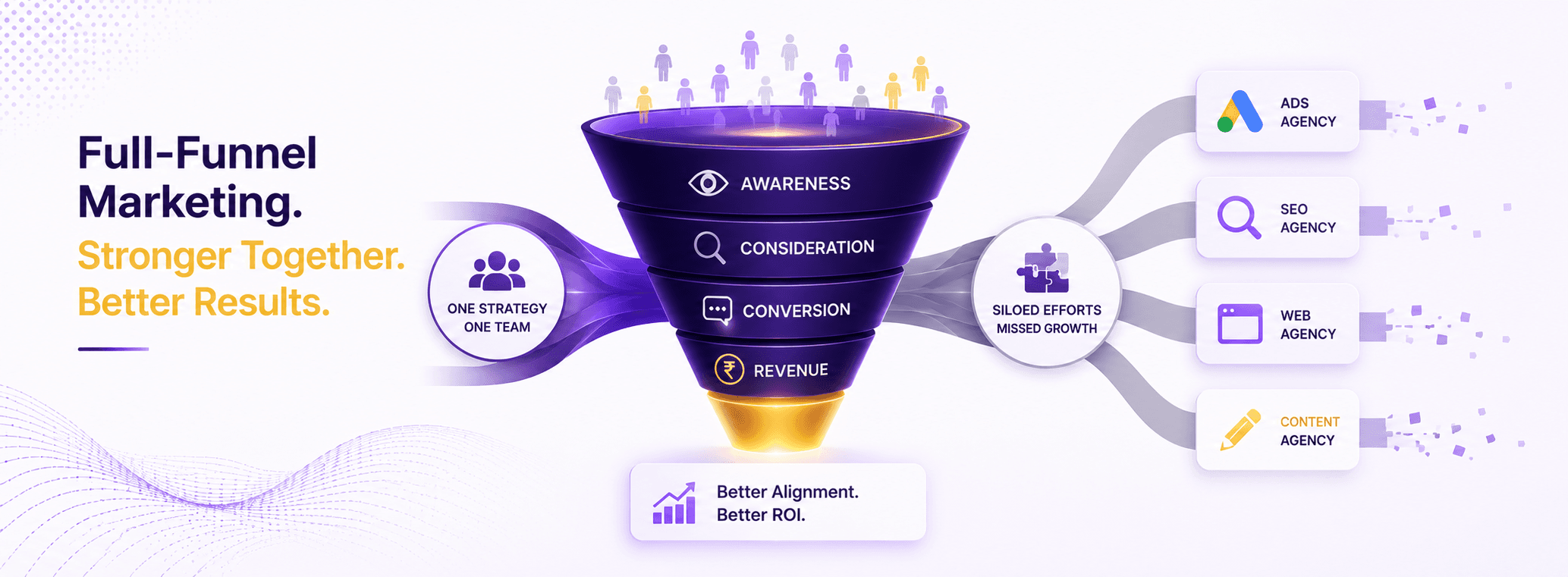
Full-funnel marketing means one accountable team owns the entire journey from first impression to closed revenue, with shared data and one strategy. Fragmented marketing, one vendor for ads, another for SEO, a third for the website, a fourth for content, looks like buying best-in-class specialists and quietly charges four hidden taxes: attribution blindness, handoff loss, incentive conflict, and coordination overhead paid in your team's hours. Specialists are not the problem. Unowned seams between them are.
There is a moment in many marketing reviews when the room goes quiet. The ads agency has presented good numbers. The SEO vendor has presented good numbers. The web developer insists the site is fine. And revenue has not moved.
Everyone in the room is telling the truth as their dashboard defines it. The problem lives in the spaces between the dashboards, and nobody in the room is paid to look there.
What full-funnel actually means
Strip the jargon and the funnel is just the journey: a stranger becomes aware of you, considers you, contacts you, and becomes revenue. Full-funnel marketing means a single accountable team owns that entire journey, with three properties that sound obvious and are rare in practice.
One strategy, so awareness activity is designed to feed the consideration activity, which is designed to feed conversion, rather than three channels each maximising their own metric. One data spine, so the same definitions and tracking follow a lead from first click to closed revenue, using shared measurement of the kind Google's Analytics documentation describes, rather than four vendors with four attribution stories. And one throat to choke, in the affectionate management sense: when revenue stalls, one partner is accountable for finding the leak, wherever in the journey it sits.
Fragmentation is the default alternative, and it usually happens by accident rather than decision: an ads freelancer hired in 2021, an SEO vendor added in 2023, a developer retained from the original site build, a content person somewhere. Each hire was individually sensible. The system nobody designed is what you now run.
Tax 1: Attribution blindness
The first hidden cost of fragmentation is that nobody can see the whole journey, so nobody can tell you the truth about it.
Your ads vendor reports on clicks and platform-attributed conversions. Your SEO vendor reports rankings and organic traffic. Each measures from their channel's first touch to their channel's last, and the real buyer, who saw an ad, later searched your brand, read two blog posts, and converted a month later, is claimed in full by everyone and understood by no one. Budget decisions then get made on channel-flattering numbers rather than journey truth, which is how spend drifts toward whatever is easiest to attribute rather than whatever actually creates customers.
A full-funnel setup does not make attribution perfect, nothing does, but it puts one team behind one measurement framework with no incentive to flatter any single channel.
Tax 2: The handoff loss
Every seam between vendors is a place where performance leaks, and the leaks compound because no vendor's scope covers the seam.
The classic example is the one we wrote about in our website speed article: an ads agency buying excellent traffic that a slow landing page discards. The ads agency's scope ends at the click. The developer's scope is uptime, not conversion. The leak between them can quietly consume a meaningful share of the ad budget for years, because it is in nobody's job description to notice.
The same seam pattern repeats everywhere. SEO content written without knowing which queries the paid team already wins, so both teams pay for the same intent twice. Landing pages built without the follow-up process in mind, feeding half-qualified enquiries into an unprepared sales motion, the exact failure chain we mapped in our education funnel article. Creative learnings from paid social that never reach the organic content calendar. Each individual leak looks small. A funnel is a multiplication of stages, and small percentage losses multiplied across five stages produce the flat revenue line that started this article.
Tax 3: Incentive conflict at your expense
Fragmented vendors are not villains, but their incentives are shaped by their scope, and scoped incentives produce predictable distortions.
A vendor paid on a single channel will always sincerely believe your next rupee belongs in that channel. When the honest answer to "why are conversions down" sits in another vendor's territory, raising it means starting an inter-vendor conflict on your time, so the diagnosis quietly narrows to whatever is fixable in-scope. And when results stall, fragmented setups produce the blame carousel: ads points at the landing page, the developer points at traffic quality, SEO points at the algorithm, and each claim is unfalsifiable because no one holds the full data.
None of this requires bad faith. It only requires everyone doing exactly the job they were scoped and paid to do. The distortion is structural, which is why hiring better specialists does not fix it.
Tax 4: You became the integration layer
The least visible cost is the one your own calendar pays. In a fragmented setup, the only place the full picture exists is inside your head, which means you are performing an unpaid second job: briefing each vendor on what the others are doing, reconciling contradictory reports, mediating the blame carousel, and carrying context between meetings.
For a founder or marketing head, this coordination overhead routinely consumes hours every week, and it is the most expensive labour in the company doing work an integrated team would do as a matter of course. Worse, integration quality is capped by your availability: the month you are busy with a launch or a funding round is the month the seams go unwatched.
The honest counterargument, and where it holds
Fairness requires saying this plainly: fragmentation is sometimes right, and full-funnel is not a universal answer.
A genuinely rare specialist need, say a complex marketplace SEO problem or a niche creative discipline, can justify a dedicated expert no generalist team matches. Very large organisations with strong in-house marketing operations can act as their own integration layer and manage best-in-class specialists well, because the full picture lives inside a capable internal team rather than one overloaded founder. And a single-channel business genuinely dependent on one motion may not have enough funnel to integrate.
The question that decides it is not "specialist or generalist." It is: who owns the seams? If you have a strong internal owner of the whole journey, specialists can work. If the honest answer is "me, in the evenings," fragmentation is charging you all four taxes right now.
What to look for in a full-funnel partner
Consolidation only pays if the integrated partner is actually integrated, so interrogate that directly.
Ask to see how their strategy document connects stages: does the ads plan reference the content plan, does the website work carry conversion accountability, is there one measurement framework from click to revenue? Ask who, by name, is accountable when revenue stalls, and what their diagnosis process looks like across channels. Ask for an example where they moved budget away from one of their own services because the data said so, which is the integrated equivalent of the question we recommend asking commission-model agencies. And be suspicious of "full-service" shops that are really one strong discipline with resold everything else; integration is an operating model, not a service list.
A funnel is one system. The vendors can be many or one, but the accountability cannot be fragmented, because revenue does not happen in channels. It happens in the seams, and someone has to own them.
About the author: Swapnil Ughade is the Founder of MagicWorks IT Solutions Pvt. Ltd., an AI-first digital marketing agency based in Pune, India. He brings 17+ years of experience across digital marketing, web development, and AI strategy. MagicWorks delivers performance marketing, search and answer engine visibility, and website development as one accountable system.