Key Takeaway
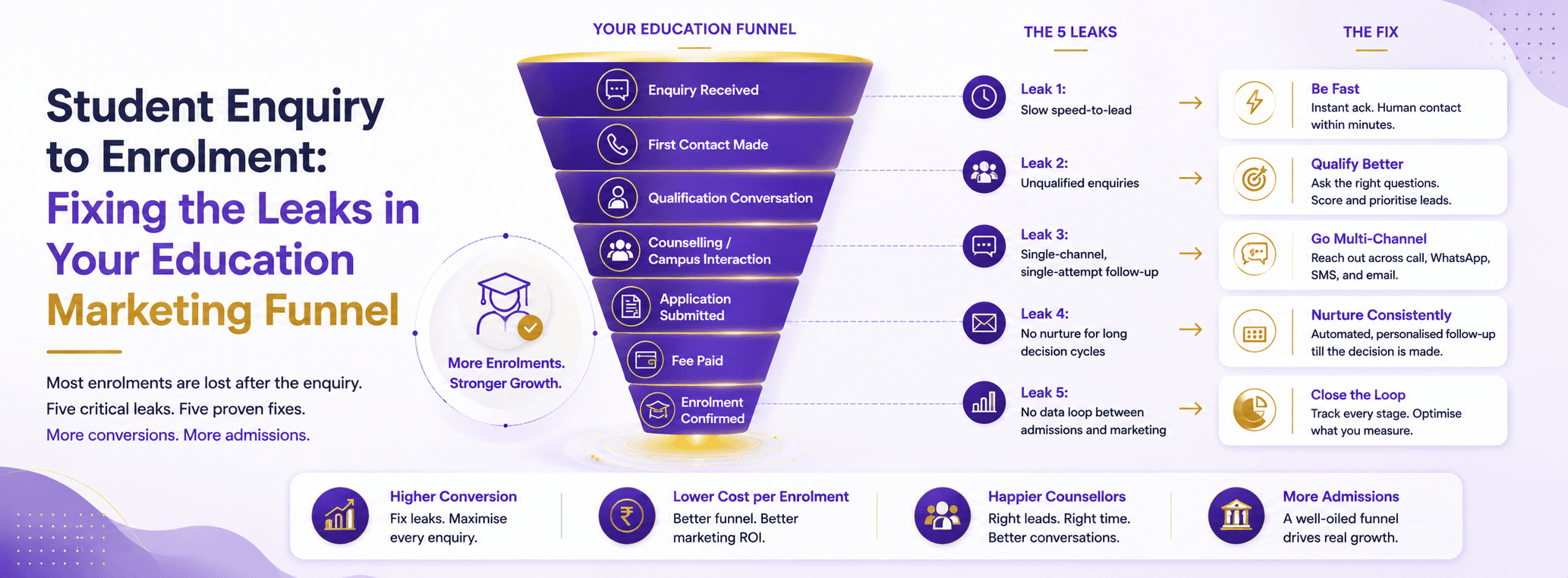
Most education institutions do not have a lead generation problem. They have a lead conversion problem. The costly failures happen after the enquiry arrives: slow first response, unqualified enquiries drowning counsellors, single-channel follow-up, no nurture for long decision cycles, and no data loop between admissions and marketing. This article maps all five leaks and gives you a specific fix for each.
Here is a pattern we see constantly in education marketing audits. The institution wants more enquiries. The ad accounts are working. The counsellors are busy. And the enrolment numbers refuse to move.
The instinct is always to buy more enquiries. The arithmetic almost never supports it, because doubling a leaky funnel just doubles the leakage. Having generated tens of thousands of qualified education leads for admissions clients over the years, we can tell you where the enrolments actually go missing: in the five stages between "enquiry received" and "seat confirmed."
Walk your own funnel through this article. You will likely find at least two of these leaks running right now.
First, map the funnel you actually have
Before fixing leaks, name the stages. A typical education funnel runs: enquiry received, first contact made, qualification conversation, counselling or campus interaction, application submitted, fee paid, enrolment confirmed.
Now pull one number for each stage transition from your last full admission cycle. Most institutions can tell you their enquiry count to the last digit and cannot tell you what percentage of enquiries ever received a first call. That blind spot is the funnel talking. Wherever you cannot produce a number, you have found a place nobody is accountable for, and unaccountable stages are where enrolments disappear.
With the map in hand, here are the five leaks in the order they occur.
Leak 1: The speed-to-lead gap
A student who submits an enquiry to you has, in the same sitting, usually submitted three more to your competitors. The first institution to respond meaningfully sets the frame for every conversation that follows, and in high-intent categories the advantage of responding within minutes rather than hours is enormous. Response speed is the cheapest competitive weapon in education marketing, and the most commonly surrendered.
Audit yourself brutally: take last week's enquiries and measure the median time to first human contact. Include evenings and weekends, because students and working professionals enquire when they are free, not when your office is open.
The fix has three layers. Instant automated acknowledgment on the channel the enquiry came from, ideally WhatsApp, with a genuinely useful next step rather than "we will get back to you." A hard internal SLA for human contact, measured in minutes during working hours. And routing that pushes new enquiries directly to counsellor phones instead of a CRM inbox someone checks twice a day. None of this requires new budget. It requires the decision that speed is a policy, not a hope.
Leak 2: Unqualified enquiries drowning your counsellors
The opposite failure to Leak 1: counsellors so flooded with low-intent enquiries that high-intent ones get the same shallow treatment as everyone else. This leak usually traces back to the marketing itself: broad targeting, "free counselling" hooks that attract the merely curious, and forms so short they capture nothing but a phone number.
The fix starts before the enquiry exists. Tighten your form to capture the two or three fields that predict intent for your programmes, such as intended intake, current qualification, and budget comfort where appropriate. Google's lead form documentation covers the mechanics of asking qualifying questions at the ad level. Then score enquiries on arrival, even with simple rules, so counsellors call the high-intent list first and the low-intent list enters automated nurture instead of eating call time. A counsellor hour spent on a scored, ready enquiry is worth ten spent dialling cold curiosity.
One honest trade-off: qualification questions reduce raw enquiry volume. Accept that openly. You are not paying for enquiries. You are paying for enrolments.
Leak 3: Single-channel, single-attempt follow-up
The typical follow-up pattern we find in audits: one call, unanswered, marked "not reachable," closed. Meanwhile the student who did not pick up an unknown number at 2 pm would have replied to a WhatsApp message the same evening.
Education decisions involve multiple touchpoints and, for younger students, multiple decision-makers, because a parent is often the real economic buyer. A single-channel, single-attempt process treats a considered decision like an impulse purchase.
The fix is a written follow-up cadence that every counsellor runs identically: a defined sequence across call, WhatsApp, and email over the first two weeks, with each touch adding something useful, such as a fee structure, placement information, a comparison guide, or a counsellor introduction video. The WhatsApp Business platform supports structured, consent-based follow-up at exactly this cadence. Two disciplines keep it honest: every touch must offer value rather than pressure, and the sequence must have a defined end, because a prospect who has said no deserves to stop hearing from you.
Leak 4: No nurture for the long decision cycle
Not every genuine enquiry is ready this intake. A working professional comparing MBA options may research for months before committing, and a parent may enquire a full year before their child's admission window. The standard funnel treats these as dead leads. They are actually your cheapest future enrolments, because you have already paid to acquire them.
The fix is a nurture track separate from the active-intake cadence: a monthly rhythm of genuinely useful content, such as programme comparisons, alumni outcomes, scholarship deadlines, and honest answers to the questions students ask at each stage. Then re-engage the whole nurture list when the next admission window opens. Institutions that do this well quietly harvest enrolments each intake from enquiries their competitors generated, paid for, and abandoned two cycles ago.
Leak 5: No data loop between admissions and marketing
The final leak is structural. Marketing optimises campaigns on enquiry volume and cost per enquiry, while admissions knows which sources produced students who actually enrolled, and the two teams never reconcile the data. The result is predictable: budget flows toward channels that produce cheap enquiries and away from channels that produce enrolments, because nobody is measuring the metric that matters.
The fix is closing the loop: pass enrolment outcomes back against lead source, campaign, and even ad level, then optimise campaigns on cost per enrolment rather than cost per enquiry. The first time an institution runs this analysis, at least one "expensive" channel usually turns out to be the cheapest source of actual students, and at least one favourite channel turns out to be manufacturing phone numbers. Until this loop exists, every optimisation upstream is guesswork with a dashboard.
How to prioritise the five fixes
If you can only fix one thing this quarter, fix speed to lead. It requires no new budget, touches every enquiry you already generate, and pays back within the same intake. Qualification and the follow-up cadence come next, because they multiply each other: scored enquiries plus a disciplined cadence transforms counsellor productivity. Nurture and the data loop are the compounding plays; they pay less this intake and more every intake after.
And measure one master metric through all of it: enquiry-to-enrolment rate, tracked by source, compared cycle over cycle against your own baseline. Industry benchmarks vary too much by programme type, ticket size, and region to be trustworthy; your own trend line is the only benchmark that cannot mislead you.
The institutions winning admissions right now are rarely the ones spending the most. They are the ones losing the least between the enquiry and the seat.
About the author: Swapnil Ughade is the Founder of MagicWorks IT Solutions Pvt. Ltd., an AI-first digital marketing agency based in Pune, India. He brings 17+ years of experience across digital marketing, web development, and AI strategy, with education among the agency's priority verticals, including performance marketing programmes that have generated tens of thousands of qualified admissions leads.