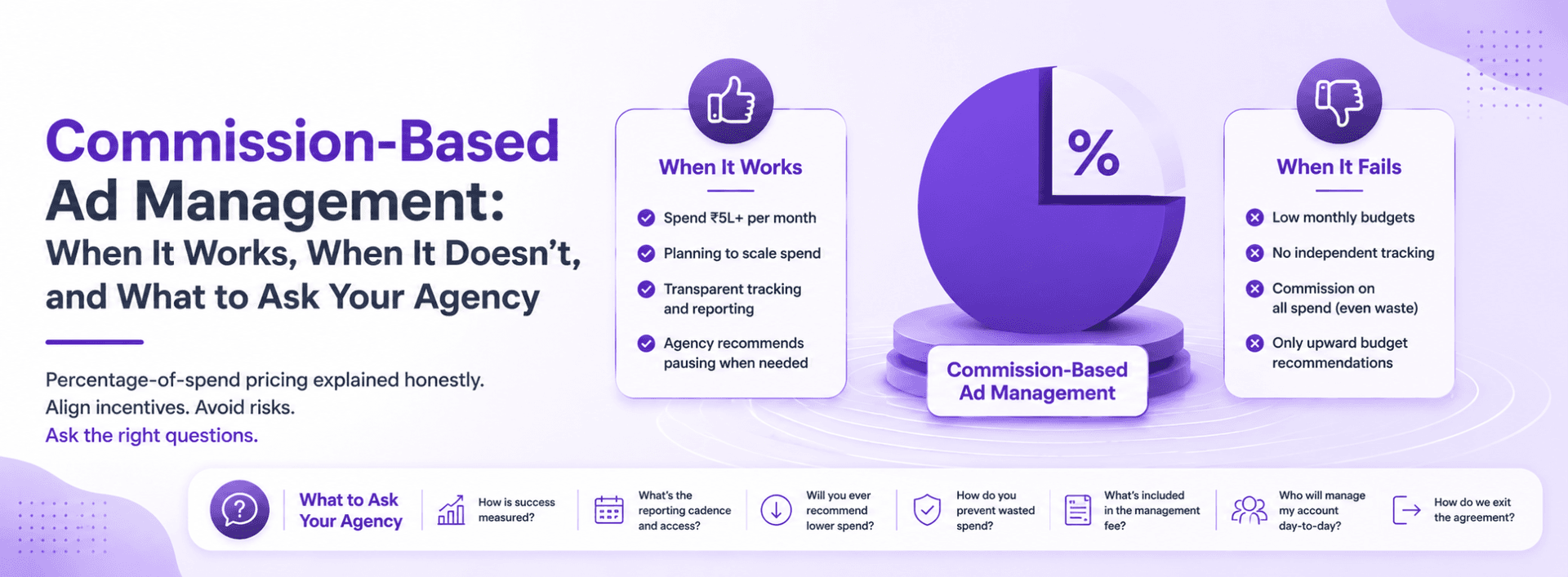
Key Takeaway
Commission-based ad management, where the agency charges a percentage of your monthly ad spend, aligns incentives well for advertisers spending roughly Rs 5 lakh a month or more, because the agency's effort scales with account complexity. Below that level it usually distorts incentives or underpays the work. The model itself is neither good nor bad; the safeguards around it decide everything, and this guide gives you the seven questions that expose whether those safeguards exist.
If you spend serious money on Google and Meta ads, you have met the percentage-of-spend proposal. The agency takes a commission of whatever you spend each month, and the pitch writes itself: "we only grow when you grow."
That pitch is half true, which is precisely what makes it dangerous. This article explains the model honestly, from an agency that uses it, including the situations where you should refuse it.
How do agencies charge for ad management?
Three pricing models cover nearly the entire market, and each one bends the agency's behaviour in a different direction.
Flat retainer. A fixed monthly fee regardless of spend. Predictable for you, and it removes any incentive to inflate your budget. Its weakness appears at scale: an account spending Rs 15 lakh a month needs far more optimisation work than one spending Rs 1 lakh, and a flat fee either overcharges the small account or starves the large one of attention.
Percentage of spend, the commission model. The agency charges an agreed percentage of your monthly ad spend. Fees scale automatically with account size and complexity, which is honest at high spend. Its weakness is the obvious one: the agency earns more when you spend more, whether or not the spend performs.
Performance and hybrid models. Fees tied partly to outcomes such as leads or revenue, often layered on a smaller base fee. Attractive on paper, but they require clean attribution and conversion tracking that both sides trust, and they can push agencies toward short-term volume tactics that damage lead quality.
There is no fourth model that fixes everything. There are only trade-offs, managed well or badly.
When does commission-based pricing work?
The model earns its keep under specific conditions, and it is worth being precise about them.
Your monthly spend is roughly Rs 5 lakh or higher. At this scale, account complexity genuinely grows with budget: more campaigns, more creative variants, more audience segments, more bid strategy work, more that can quietly go wrong. A fee that scales with spend funds the attention the account actually needs. This is exactly why we work on this model with advertisers in the Rs 5 to Rs 10 lakh and above range, and why we do not pitch it below that level.
Your growth plan involves scaling spend. If you intend to grow the budget as performance proves out, a commission model means you never renegotiate fees at each stage. The commercial relationship scales with the business relationship.
Conversion data flows freely. The model only stays honest when both sides stare at the same conversion numbers. Google's and Meta's own conversion tracking documentation describes the plumbing; the point is that it must be in place, verified, and visible to you before a commission arrangement starts.
The agency's recommendations sometimes cost the agency money. This is the tell. A commission-model agency that has ever told you to pause spend, cut a campaign, or hold budget flat during a weak season has proven the safeguards work. One that has only ever recommended increases has proven the opposite.
When does commission-based pricing fail?
Equally specific, and worth reading before any contract.
Low monthly budgets. Below a few lakh a month, a percentage fee is too small to fund real management, so the account gets junior attention and templated campaigns, or the agency pads the percentage until you are overpaying a retainer in disguise. At low spend, a transparent flat fee is almost always the better structure.
No independent conversion tracking. If the only performance numbers come from the agency's own reports, the incentive problem has no counterweight. Spend can drift upward on vanity metrics: impressions, clicks, and reach that never becomes revenue.
Commission on everything, including waste. Some contracts charge commission on total spend even when a portion of it is demonstrably wasted, such as broad-match bleed or placement junk the agency never audited. The model should reward managed spend, not gross spend.
Quarterly budget recommendations with no downward option. If every quarterly review ends in "increase the budget," you are not receiving strategy. You are receiving a sales process with a dashboard attached.
The incentive problem, and how honest agencies solve it
Let us name the conflict plainly, because most agencies will not. Under a commission model, the agency's revenue rises with your spend, and your interest is efficient spend, not maximal spend. Those two lines do not automatically point the same way.
Four safeguards make them converge, and any agency worth hiring will already have them in writing.
First, performance-tied review, not spend-tied review: budget recommendations justified by cost per conversion and revenue trends, never by "opportunity" language alone. Second, your ownership of the ad accounts, always, so you can see raw platform data and leave with your history intact. Third, reporting built on conversions and cost per conversion rather than impressions and clicks. Fourth, a written willingness to recommend spending less when the data says so, demonstrated in practice at least once before you should fully relax.
We hold ourselves to those four, and we would rather lose a proposal than remove them, because a commission model without safeguards eventually costs the client trust and the agency its reputation. Both are more expensive than any fee.
The seven questions to ask before signing a commission agreement
Take these into any agency conversation, including one with us.
1. "What percentage, calculated on what, exactly?" Gross spend, managed spend, or spend net of waste? Ambiguity here compounds monthly.
2. "Who owns the ad accounts and the data?" The only acceptable answer is you. Anything else is a hostage arrangement dressed as convenience.
3. "Show me a client where you recommended reducing spend." The single most revealing question on this list. Watch for a specific story, not a philosophical answer.
4. "What conversion tracking will we verify together before launch?" No shared source of truth, no commission model.
5. "Is there a minimum fee, and what happens in low-spend months?" A reasonable floor is normal and honest; it funds baseline work in seasonal dips. An undisclosed one is a red flag by omission.
6. "What does the monthly report lead with?" If the answer starts with impressions and reach rather than conversions and cost per conversion, the incentives have already leaked into the reporting.
7. "What would make you tell us to fire you?" Confident agencies have an answer, because they have refused misfit work before. Agencies that need every client cannot afford honesty, and that shows up in your budget eventually.
The one-line summary
Commission-based ad management is the right model for serious spenders working with a disciplined agency, and the wrong model everywhere else. The percentage is not the thing to negotiate hardest. The safeguards are.
About the author: Swapnil Ughade is the Founder of MagicWorks IT Solutions Pvt. Ltd., an AI-first digital marketing agency based in Pune, India. He brings 17+ years of experience across digital marketing, web development, and AI strategy. MagicWorks manages performance marketing for advertisers on a commission model, which is exactly why this article names its weaknesses.