
Every marketer feels the same pull. A new platform launches. A new feature drops. The feed fills with people saying it changes everything. You feel behind before you have even read what it does.
This guide is about how to evaluate marketing trends before they cost you time or budget. It is a filter of five questions, drawn from the anchor of this series, Same War, New Weapons, and from the idea that most new tools are new weapons, not new wars. The questions simply help you tell which is which, before the hype decides for you.
Adoption is easy. Value is not.
Look at what actually happened with AI in marketing. By 2026, around 87 percent of marketers use it in at least one workflow, up from 51 percent two years earlier, according to Salesforce's State of Marketing. Near everyone adopted. Yet only a small share, somewhere between 6 and 30 percent by most counts, has truly built it into how they work, and fewer than one in five can point to a clear return.
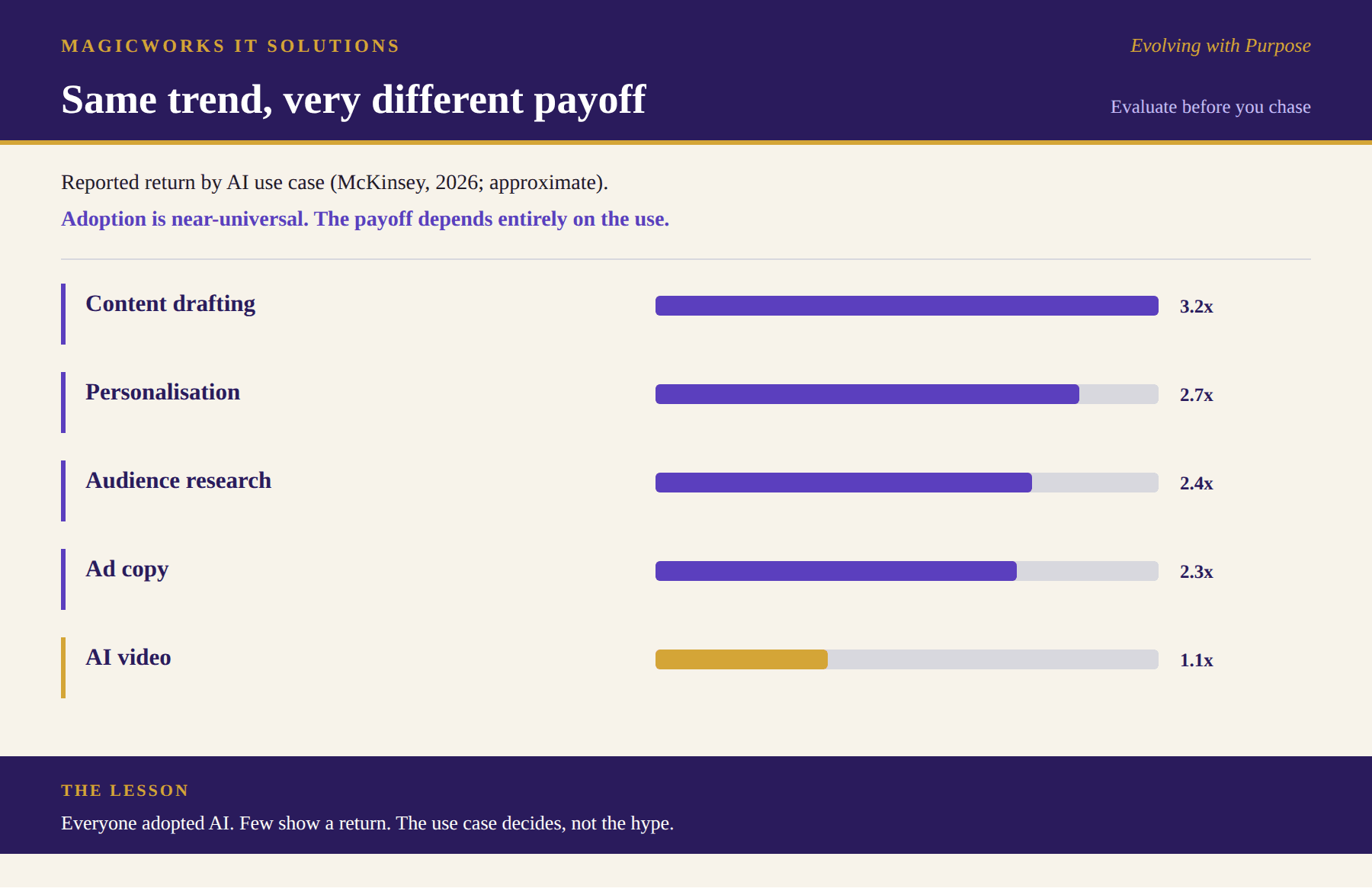
The lesson is not that the trend was fake. It is that adopting a trend and profiting from one are different things. Return swings wildly by use. McKinsey puts AI content drafting near 3.2 times return and ad copy near 2.3 times, while AI video sits closer to 1.1. Same trend, very different payoff. So the question is never “is this popular”. It is “does this pay, for me”. That is what these five questions test.
Question 1: Is this a new war, or a new weapon?
Start here, because it settles most of the panic. A new war would change your strategy: who you target, what you promise, how you measure. A new weapon only changes how you carry out a strategy you already have.
Almost everything is a weapon. A new bidding type is a weapon. A new ad format is a weapon. If it is a weapon, your plan still holds. You are calm. You just have a new way to run an old play.
If your strategy survives the news, it was a weapon. Breathe, then test it.
Question 2: What old thing is this, really?
Name its ancestor. Every new tool is a new version of something proven. Performance Max is broad targeting plus automated bidding, both older than the name. Answer engines are a new front door to search, which is decades old.
If you can name the old thing, you already know most of the rules. If you cannot name it, slow down. Something with no ancestor is either rare, or oversold.
Question 3: Who gains if you adopt it today?
Follow the incentive. When a platform pushes a feature hard, early adoption usually helps the platform first. That does not make the feature bad. It just means the loudest voice in the room is not neutral.
The shopkeeper most excited to sell you the new thing is the one who profits from the sale. Listen, then decide for your own account, on your own numbers.
Question 4: What does it cost to be wrong?
This is the question that protects your budget. Ask what you lose if the new thing fails.
A farmer offered a new seed does not plant the whole field. She tries it on one plot. If it works, she expands next season. If it fails, she has lost a plot, not a harvest. Run new tools the same way. If the downside is small and reversible, test it on one plot of budget. If the downside is large or hard to undo, wait and watch someone else go first.
An automated change can reshape an account overnight, which is why capping first and trusting later matters. And the caution is not just anecdotal. Gartner found that 45 percent of marketing leaders now sometimes end campaigns early because performance slips. Being wrong is common. Keeping the cost of it small is the skill.
Question 5: Can you measure if it worked?
If you cannot measure it, you cannot judge it. Before you switch anything on, decide the one number that will tell you if it worked, and check that you can actually track that number.
This is where most trend-chasing quietly fails. Fewer than one in five teams that adopted AI can show a clear return on it. Not because it does not work, but because they never set up the measurement to tell. A tool you cannot measure is not a test. It is a guess with a bigger bill. No measurement, no adoption.
What chasing every trend actually costs
Saying yes to every new tool feels like progress. It is usually the opposite. Each new thing pulls your attention, splits your budget, and resets your team's learning. The cost is rarely the subscription fee. It is the focus you give up.
There is a pattern in the data. Near everyone has adopted AI in marketing, yet only a small share can show a return on it. The gap is not access to the tools. It is depth. The teams that win are not the ones running the most tools. They are the ones who picked a few and got genuinely good at them.
Chasing everything carries a quiet tax too: context switching. Every half-learned tool is a tab left open in your head. Three trends chased at once usually means none learned well, and a team too busy tool-hopping to notice which one was actually working. Doing less, better, is not caution. It is how the return finally shows up.
A worked example: running one trend through the test
Take a live one: answer engines, and the rush to optimise for AI answers. Run it through the five questions.
War or weapon? Weapon. People still search for what they need; the answer just appears in a new place. Your goal, being the trusted source, has not moved. What old thing is it? Being the clearest, best answer to a question, which is what good SEO always chased. Who gains if you adopt today? The tool sellers, first. What does it cost to be wrong? Little, if you test on a few pages before rewriting the whole site. Can you measure it? Only if you set up tracking to see the referrals and mentions, which most teams have not.
Four of five say weapon, cheap, testable. The verdict writes itself. Try it on a small set of pages, measure, then decide. No panic, no full rebuild. That is the whole point of a test you can run in five minutes.
| Metric | Green light | Red flag |
|---|---|---|
| War or weapon? | Your strategy still holds | It claims to rewrite your whole plan |
| What old thing is it? | You can name the ancestor | No clear ancestor, lots of noise |
| Who gains today? | Clear gain for your account | Mainly the platform gains early |
| Cost of being wrong? | Small and reversible | Large or hard to undo |
| Can you measure it? | One clear metric, tracked | No way to tell if it worked |
Mostly green lights? Test it on one plot of budget, measure the one number, then decide. Mostly red flags? Do nothing yet. Bookmark it, watch who goes first, and revisit in a quarter. Doing nothing is a valid, and often winning, move.
Doing nothing is a decision too
The five questions often point to a quiet answer: not yet. That is the hardest call to make, because inaction feels like falling behind. It rarely is. For most new tools, the second mover pays less and learns from the first mover's mistakes. Waiting a quarter usually costs almost nothing. Rushing in can cost a budget, and a lesson you did not need to buy.
Waiting is not the same as ignoring. Keep a simple watchlist: the trend, the date you looked, and the one signal that would change your mind. When a tool clears the questions, or the evidence finally arrives, you move, on purpose and on your own timing. That is the difference between being deliberate and being late. One is a choice, the other is a habit.
A short filter, run calmly, does something the feed never will. It hands you back your attention, and points it at the few things that actually pay.
Free Download
A one-page version of this five-question test you can run on any new tool in five minutes. Free to download, no sign-up.
Download the Trend evaluation scorecard (PDF).
Not Sure If the New Thing Is Worth It?
We help teams tell the weapons from the wars, so budget goes to what moves the number and not to what is trending this week.
Part of the Same War, New Weapons series on the performance marketing principles that survive every platform update.