Key Takeaway
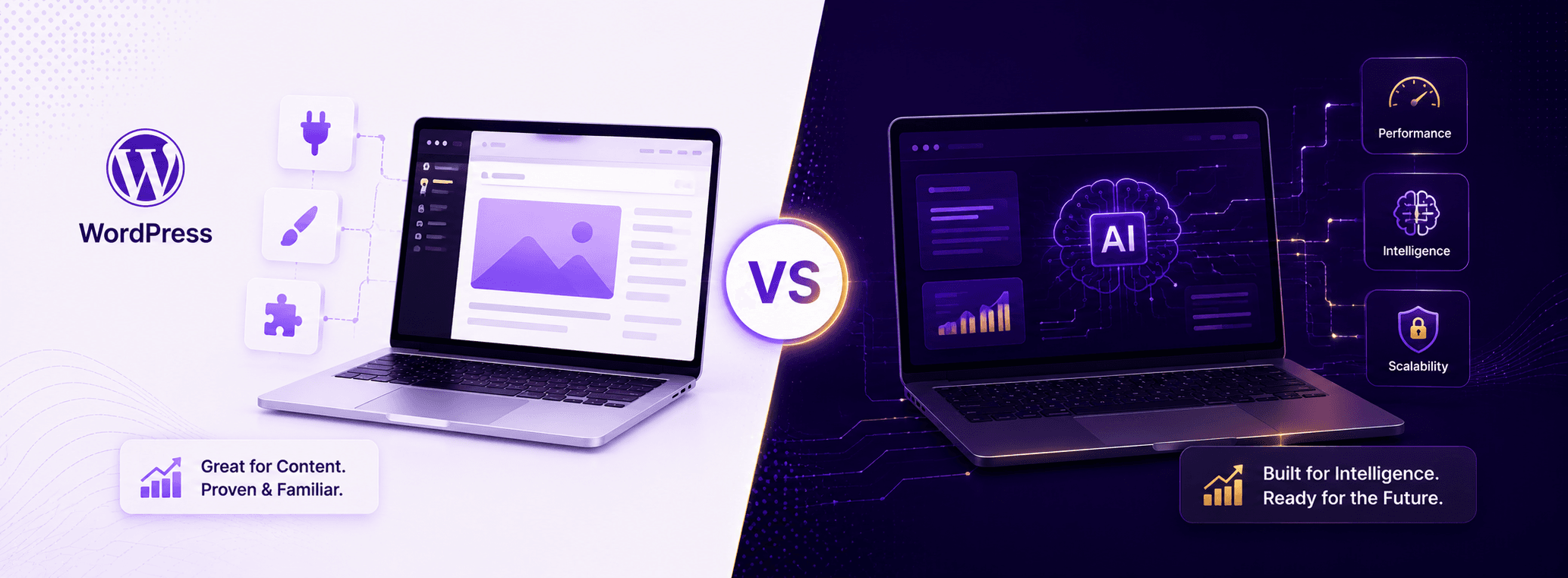
This is not a war with a winner. WordPress remains the right choice when your website's job is publishing content and establishing presence on a modest budget with in-house editing. An AI-Native stack is the right choice when your website has processing work to do, when performance is a revenue lever, or when the site must grow intelligent capabilities over its lifetime. Choose based on the site's job description, not the industry's fashion cycle.
Ask this question in the wrong room and you will get a religious answer. WordPress loyalists will tell you it powers a huge share of the web, which is true. Modern-stack advocates will tell you WordPress is a 2008 architecture dragging a decade of plugins, which is also, often, true.
You do not need a religion. You need a decision, and decisions come from matching tools to jobs. Here is the framework we use, including the cases where we recommend against our own premium service.
The honest case for WordPress
Any comparison that opens by burying WordPress is marketing, not analysis, so let us start with what it genuinely does well.
WordPress is the most proven publishing system ever built. For a content-led site, a blog, a news operation, a straightforward business presence, it offers an editing experience your team already knows, an ecosystem with a plugin for nearly everything, the largest talent pool in web development, and a build cost that modern stacks struggle to match at the entry level. It is also self-owned and portable in a way page builders and closed platforms are not.
If your website's complete job description is to publish content, present credibility, and capture enquiries, and your budget is modest, WordPress executed well is not a compromise. It is the correct engineering answer, and a disciplined WordPress build, lean theme, few plugins, decent hosting, will serve that job for years.
The key phrase is executed well, which brings us to how WordPress actually fails.
How WordPress actually fails in the wild
WordPress's problems are rarely WordPress. They are the ecosystem habits that accumulate around it.
The typical five-year-old WordPress site carries a heavyweight multipurpose theme chosen for its demo, a page builder on top of that, and fifteen to forty plugins, each one a separate developer's code, update cadence, and security surface. The compound result is a site that is architecturally slow, expensive to secure, and fragile to update, where every performance round buys less than the last because the weight is structural.
The second failure is the ceiling. WordPress was designed to manage and display content, and it is superb at that. Ask it to be an application, to process, evaluate, match, or run intelligent workflows, and you are building against the grain. Possible with enough custom development, but you end up paying application-engineering prices for a foundation that resists the work.
What the AI-Native stack changes
An AI-Native website is one where intelligence is part of how the site functions, screening applications, understanding questions, processing documents, rather than a widget on the surface.
Architecturally, that means an application framework such as Next.js as the foundation, a headless CMS so editors still get a clean writing experience while the presentation layer stays fast and free, and backend services where LLM-driven capabilities live behind proper engineering: cost controls, quality checks, privacy handling.
Three properties fall out of this architecture. Performance by construction rather than by optimisation, because there is no theme-and-plugin sediment to fight. A real home for intelligence, so capabilities can be added over the site's life instead of bolted against the grain. And clean, structured output that both search engines and AI answer engines parse well.
The honest costs, stated plainly: a higher build investment, a smaller (though rapidly growing) talent pool than WordPress, and a dependency on developers rather than plugins for new functionality.
The decision framework: five questions
Run your project through these in order. They resolve most cases without a single religious argument.
1. What is the website's job in one sentence? Publishing content and presenting the company points to WordPress. Screening, matching, processing, answering, or personalising at volume points to AI-Native. If your sentence contains a verb the site performs on the business's behalf, you have an application requirement wearing a website's name.
2. Is performance a revenue lever for you? If you run serious paid traffic or compete in organic and AI search, speed is money. A disciplined WordPress build can be fast; an AI-Native build is fast by default and stays fast, because there is no plugin sediment accumulating.
3. What will you want this site to do in year three? A website is a five-to-seven year asset. If intelligent capabilities are plausibly in your future, the architecture decision is being made now, whether or not the features launch on day one. Retrofitting intelligence onto WordPress is the most expensive path of all.
4. Who maintains it, honestly? A capable in-house editor with no developer access is an argument for WordPress's self-service ecosystem. A relationship with a development partner removes that advantage and lets the architecture question be decided on merit.
5. What does the budget actually need to cover? If the budget is entry-level, a lean WordPress build beats a compromised modern build every time. An underfunded AI-Native project is the worst of both worlds.
The three verdicts
Choose WordPress when the job is publishing and presence, the budget is modest, editing independence matters most, and no processing work is on the roadmap. Then protect the choice: lean theme, minimal plugins, proper hosting, and the discipline to keep it that way.
Choose the AI-Native stack when the site has work to do beyond display, when performance is tied to revenue, or when the asset must be able to grow intelligence over its lifetime. Pay for engineering once and let the architecture earn its premium.
Beware the middle path: the heavily customised WordPress build straining to act like an application. It combines WordPress's ceiling with custom development's price, and it is where most of the worst websites we audit were born.
The stack question, asked properly, was never which technology is better. It was what is this website's job, and once that sentence is written honestly, the technology usually picks itself.