Key Takeaway
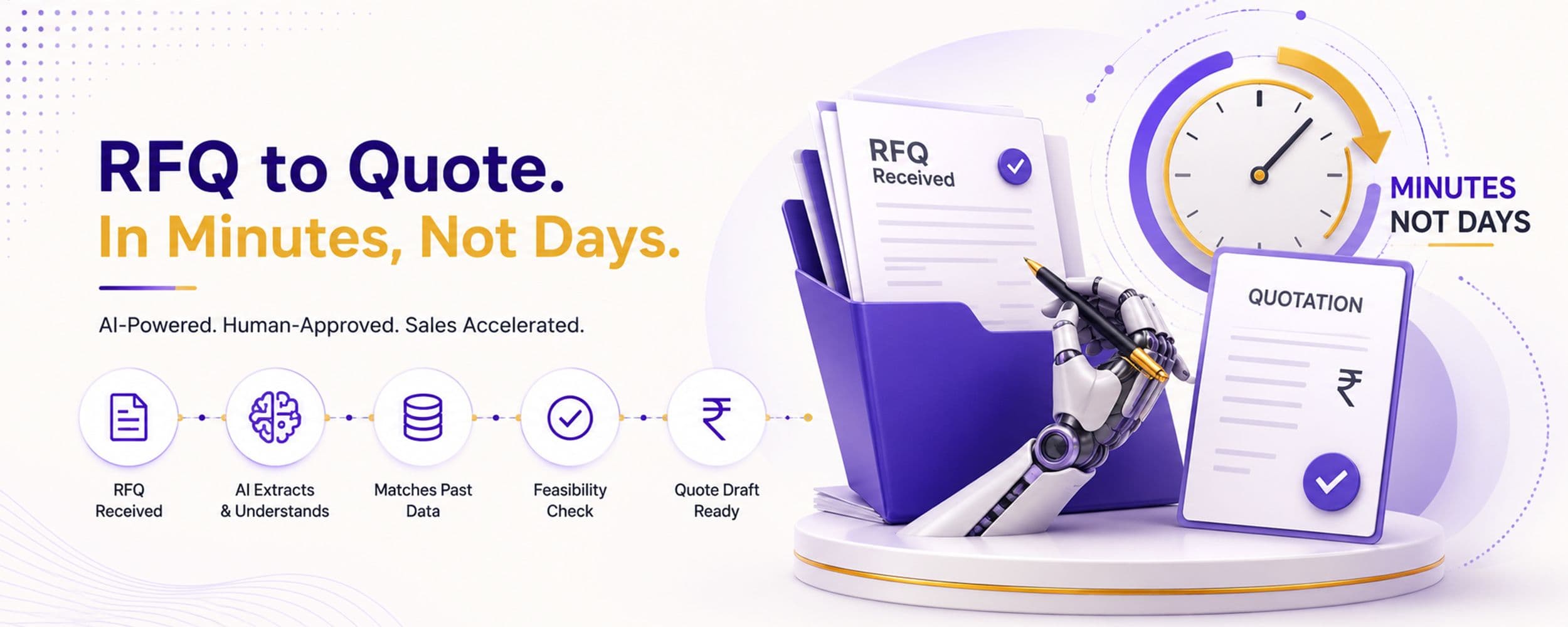
In most mid-market manufacturers, every RFQ waits in the queue of one or two senior people who alone can read the requirement, check it against capability and history, and price it. That queue is the most expensive bottleneck in the commercial operation, because slow quotes lose winnable orders silently. AI now compresses the excavation stages of quoting so the senior person's days of preparation become an hour of judgment. The pricing decision stays human. The waiting disappears.
Walk into the commercial office of a typical mid-market manufacturer and ask one question: where are this week's RFQs right now?
The answer is almost always a queue, and the queue almost always ends at the same desk. One senior person, sometimes two, who alone can look at a customer's requirement and see the whole picture: what is really being asked, whether the plant can make it, what it resembles from the past, and what it should cost. Everything waits for that desk. And while it waits, a competitor whose desk moves faster is answering the same customer.
The real cost of the quotation queue
The lost orders you never see. Procurement teams increasingly work on shortlists and deadlines. When your quotation arrives on day nine and a competitor's arrived on day two, you frequently were not rejected. You were simply no longer in the conversation. Speed of response is treated by buyers as a proxy for reliability of supply.
The senior time spent on excavation, not judgment. Watch what your estimator actually does with an RFQ: hunting through the document for what is being asked, chasing the customer for missing details, digging through old folders for the similar job from three years ago, checking with production about a particular operation. Most of it is retrieval and reconstruction. The judgment occupies a fraction of the elapsed time.
The key-person fragility. When quoting lives in one head, that head's leave, illness, overload, or eventual retirement is a direct revenue risk. Many manufacturers experience this as mysterious monthly variation in quote output that maps exactly to one person's calendar.
The compounding follow-up failure. Because producing each quote is so expensive, following up on sent quotes gets starved. The queue does not just slow quotes down. It consumes the capacity that should be winning them after they are sent.
What actually happens between RFQ and quote
Stage one: comprehension. Someone reads the RFQ, often a PDF, an email chain, a spec sheet, sometimes drawings with accompanying notes, and works out what is actually being requested. In the wild, this information arrives incomplete, inconsistent, and formatted differently by every customer.
Stage two: structuring. The comprehended requirement gets organised into your internal shape: line items against your product or process categories.
Stage three: retrieval. The estimator searches the company's memory: have we made this or something like it, what did it cost, what went wrong last time, which customer-specific quirks apply?
Stage four: feasibility. Can we actually do this: capability, capacity, material availability, any specification that needs a production conversation before promising anything?
Stage five: pricing and assembly. Costs are built up, margins applied with commercial judgment, and the quotation document is assembled in the expected format.
The honest observation: stages one through four are dominated by reading, searching, matching, and checking. Stage five contains the irreplaceable human decisions. The queue, however, forms in front of all five stages equally, because one person owns them all.
What AI does to each stage
Modern AI systems, properly implemented around your own data, change the shape of the work like this.
Comprehension and structuring become minutes. The system reads the incoming RFQ in whatever form it arrived, extracts what is being requested, and structures it against your categories, flagging explicitly what is missing or ambiguous, so the clarifying email to the customer goes out on day one rather than emerging on day four.
Retrieval becomes instant and complete. Matched against your quotation and job history, the system surfaces the genuinely similar past work: what was quoted, what it actually cost, margins achieved, issues recorded. This is the stage where the gain is largest, because human retrieval is limited by memory and patience, while the system checks everything.
Feasibility gets a first pass. Requirements are checked against your documented capabilities and known constraints, with anything unusual flagged for a production conversation, so the human review starts from a marked-up document rather than a blank one.
Assembly becomes a draft awaiting judgment. The system prepares the quotation skeleton: structured line items, retrieved cost references, flagged risks. What lands on the senior person's desk is no longer an RFQ requiring days of excavation. It is a prepared case file requiring an hour of the thing they are actually irreplaceable for: judgment about feasibility edge cases, pricing, and commercial strategy.
And what AI should not do: price autonomously and send. The pricing decision encodes relationship knowledge, market feel, and strategic intent that belongs with your commercial leadership. The design principle throughout is preparation by machine, decision by human.
Implementing without breaking what works
Start by capturing the baseline. Median turnaround, the over-a-week share, quotes produced per month, win rates where you can get them. Without the before, there is no proof of after.
Feed the system your history before expecting magic. Retrieval is only as good as what can be retrieved. The unglamorous first phase is assembling your past quotations, job records, and costing data into a form the system can search.
Run parallel before running live. For the first period, the system prepares while the existing process continues, and the estimator compares. This builds calibrated trust in what the system gets right, and documented knowledge of where it needs correction.
Keep the senior person at the centre, promoted rather than replaced. The estimator's new role is reviewer, corrector, and final judge, with their scarce expertise now applied to every quote rather than rationed by the queue.
The measurement that makes it undeniable
The elegant property of this application is that its success metric already exists and is already understood by everyone from the owner to the sales team: how long does a quote take, and how many go out?
Track four numbers from baseline through implementation: median RFQ-to-quote time, share of RFQs answered inside the customer-relevant window, quotations produced per month with unchanged headcount, and, over a longer horizon, win rate on quotes delivered fast versus slow. When the median falls from days to hours, no one in the boardroom asks whether the AI initiative is working.
The queue in front of your estimator's desk has been treated as a fact of manufacturing life for so long that it has become invisible. It is not a fact of life. It is the most expensive line in your commercial operation that never appears in any account, and it is now, finally, fixable.