Key Takeaway
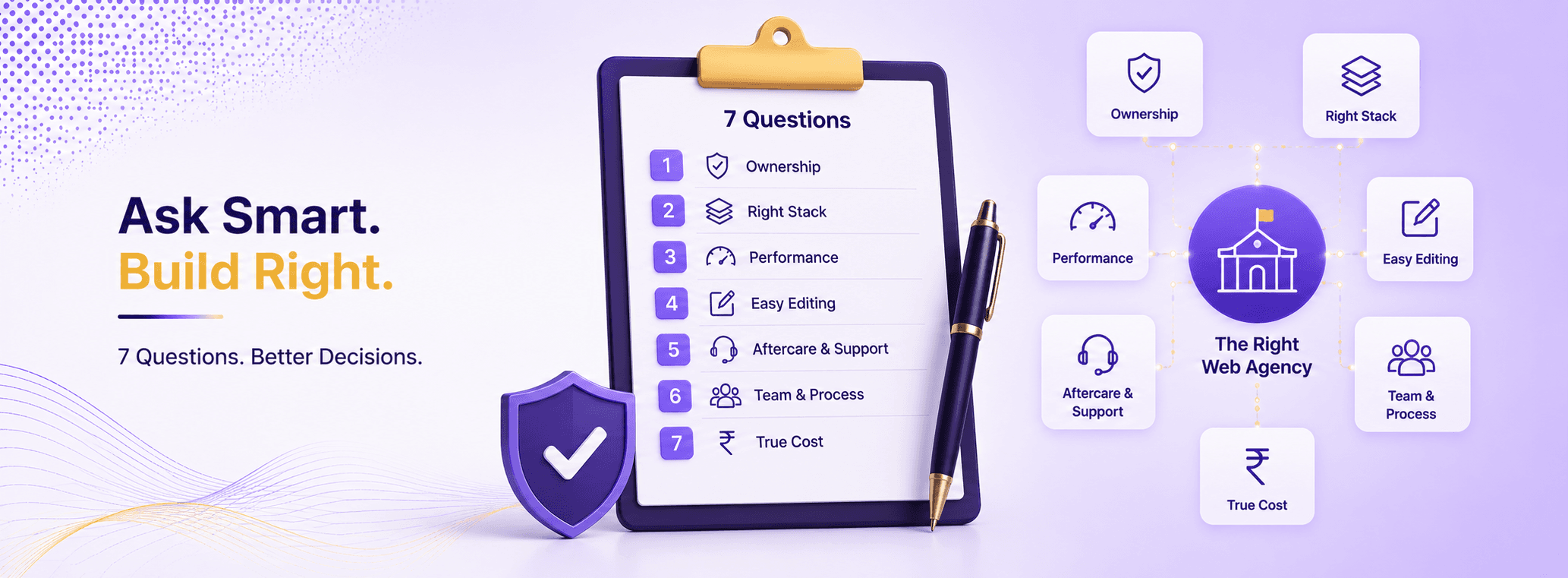
Most website projects fail on terms that were visible in the first meeting, if anyone had asked. Seven questions expose almost everything: who owns the code, domain, and hosting; why this stack for this job; what performance is promised in numbers; how you will edit content without the agency; what happens after launch; who actually does the work; and what the quoted price excludes. An agency that answers all seven plainly is rare. Hire that one.
Nobody hires a web agency planning to end up hostage to one. Yet the pattern repeats across the audits we run: a business that cannot log in to its own hosting, a completed site nobody can edit, a launch price that turned out to be an instalment.
None of these failures were hidden. Every one of them was sitting in plain sight during the sales conversation, waiting for a question nobody asked. Here are the seven, with the answers that should satisfy you and the ones that should end the meeting. We build websites for a living, so read this as the checklist we expect to be examined against.
Question 1: Who owns the code, the domain, and the hosting accounts?
The only acceptable answer is you, in writing, for all three. The domain registered in your account, the hosting contract in your name or transparently accessible to you, and the code and content yours on full payment, with credentials handed over as a deliverable, not a favour.
The failure pattern is the quiet hostage arrangement: the domain registered under the agency's account for convenience, hosting bundled invisibly into a maintenance fee, code that lives only on the agency's server. Everything is fine until you want to leave. A worthy agency separates these cleanly, including hosting as its own transparent line item, precisely so the relationship continues because you want it to, not because leaving is expensive.
Question 2: Why this stack, for this specific job?
You are not testing the technology. You are testing the reasoning. The right stack follows from the website's job description, and an agency should be able to connect the two in plain language.
The red flag is the single-answer shop: every project gets the same platform because that is what the shop sells, whether the platform fits or not. Ask what they would recommend for a job unlike yours, and listen for whether the answer changes. An agency that recommends a simpler, cheaper build than you expected has just shown you its incentives are pointed the right way.
Question 3: What performance are you promising, in numbers?
Fast is not a commitment. Ask for the commitment in measurable terms: target scores or Core Web Vitals thresholds, measured on mobile, on the finished site with real content, verifiable by you in PageSpeed Insights.
The reason to be firm here is economic: a slow site taxes every rupee of marketing you will ever run on it, so a build without performance commitments is a build with a hidden recurring cost. Also ask to test two or three of the agency's recent live sites yourself, on your phone, right now. Their portfolio's real-world speed is the most honest performance promise they can make.
Question 4: How will my team edit content without calling you?
The dependency trap is the most common post-launch complaint in the industry: a beautiful site where changing a headline requires a ticket and an invoice. Before signing, get specific: which parts of the site can your team edit through an admin interface, what does that interface look like (ask for a demonstration, not a description), and what genuinely requires developer work?
Modern architectures have removed the old excuse; a well-built site on any serious stack gives editors a clean self-service experience. An agency that cannot show you the editing experience before the contract is asking you to buy the steering wheel sight unseen.
Question 5: What exactly happens after launch?
A website is not a delivery; it is the start of an operating life. Ask what the first ninety days include, what warranty covers defects versus what counts as new work, what a maintenance arrangement contains and costs, and critically, what happens if you choose not to buy maintenance from them. The answer to that last one tells you whether aftercare is a service or a leash.
Get response expectations in writing for the scenarios that matter: the site is down, the form stopped delivering enquiries, a security patch is urgent. Vague aftercare is where good projects go to rot.
Question 6: Who, by name, will actually do the work?
The person who impresses you in the sales meeting is frequently not the person who builds your site. Sometimes the work is subcontracted entirely, which you discover only when questions start taking a week to answer.
Ask who will be on your project by name and role, whether any part will be outsourced, and who your single point of contact is once the build begins. What you are screening out is the anonymous production line, where your project is a ticket queue and context evaporates at every handoff.
Question 7: What does this price not include?
The quoted price is rarely the whole price, and the honest agencies distinguish themselves by volunteering the boundary before you ask. Walk the list explicitly: content writing and migration, photography, third-party licences, hosting, integrations, revisions beyond the agreed rounds, and what a change of scope costs and how it gets approved.
The pattern to fear is not the higher quote; it is the suspiciously low one, because a price that undercuts the market has to recover its margin somewhere. The complete question is never what does it cost. It is what does it cost to get everything I actually need, from build through year one, compared across bidders on the same definition.
The pattern behind all seven
Read the seven questions again and notice they are one question wearing seven outfits: does this agency's business model depend on you being informed, or on you not being? Ownership, reasoning, measurable promises, self-service, defined aftercare, named humans, and transparent pricing are all versions of the same posture, and agencies either hold that posture everywhere or nowhere.
Take the list into your next three agency conversations and score the answers honestly. The winner is usually obvious by question four, and it is not always the biggest name or the lowest bid. It is the one that answered fastest and flinched least, because they had nothing in the model that required you not to ask.