Key Takeaway
The founder of a platform business knows it better than anyone alive, and that is precisely the problem at certain decisions. Deep context comes bundled with sunk commitments, survivorship stories, and a roadmap full of choices the founder is emotionally invested in defending. Outside counsel earns its fee at five specific inflection points: when growth stalls despite effort, before major technology or rebuild bets, at monetisation redesign, ahead of fundraising scrutiny, and when the roadmap has become a queue of loud requests rather than a strategy.
Every platform founder carries a private map: why the onboarding flow works the way it does, which early decision saved the company, which feature exists because the biggest customer demanded it, where the bodies of abandoned experiments are buried. No consultant will ever hold that map. This is the honest argument against outside advice, and founders are right to make it.
And yet the same map is the trap. The founder's knowledge of the platform is inseparable from their investment in it: the architecture they chose, the pricing they defended, the pivot they resisted. At most moments, that intimacy is an advantage. At a handful of specific moments, it is the exact thing standing between the founder and the decision the business needs.
Why the smartest founders have the hardest time seeing it
Sunk decisions defend themselves. The stack, the marketplace mechanics, the commission structure: each was chosen for good reasons at the time, and each has since accumulated advocates, workarounds, and identity. Evaluating them freshly requires pretending you did not spend two years defending them, which is not a thing human beings do well.
The loudest signal wins the roadmap. Founders hear disproportionately from three sources: the biggest customers, the most recent churn, and the board. All three are real, none is representative, and a roadmap assembled from their requests will drift from strategy to appeasement one reasonable-sounding feature at a time.
Survivorship stories calcify. Whatever worked during the platform's survival phase becomes the house theory of how growth happens, long after the market, the competition, and the platform itself have changed. The theory is defended hardest exactly when it stops working, because questioning it feels like questioning the founding.
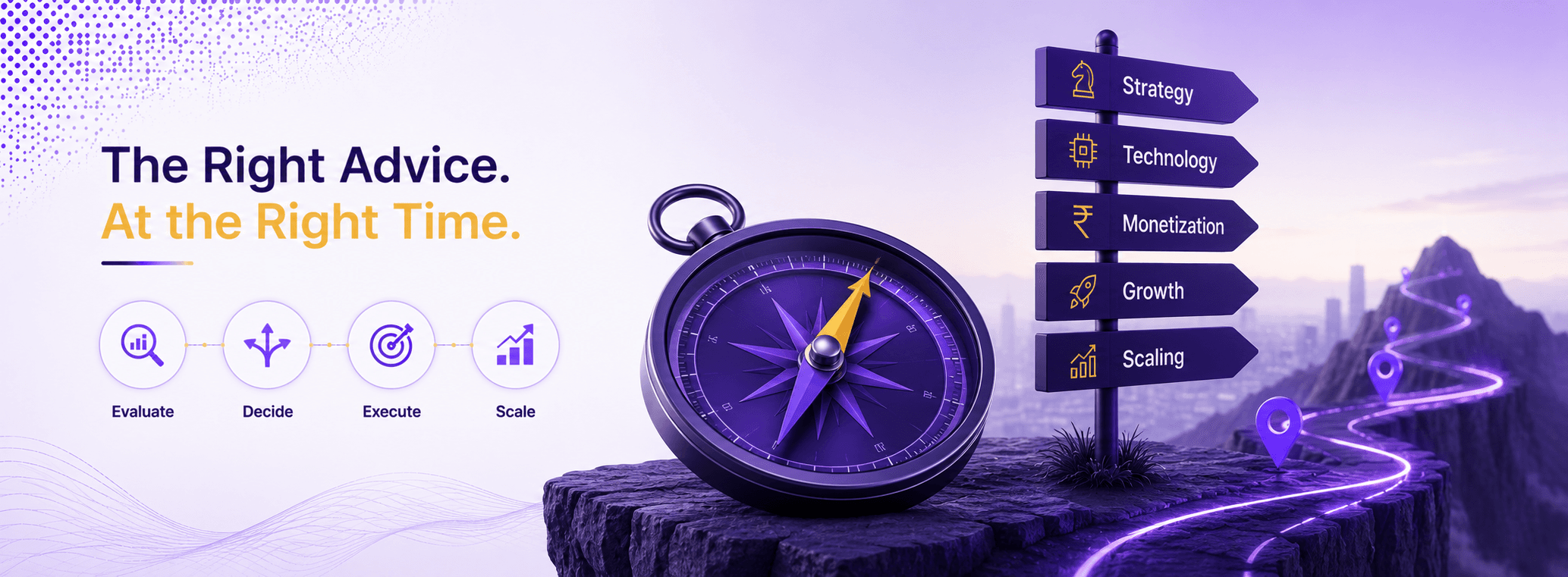
The five inflection points where outside counsel pays
1. Growth has stalled and the internal explanations have stopped changing. Every stall produces a house diagnosis, usually we need more marketing or we need feature X. When two or three quarters of acting on the diagnosis have not moved the line, the diagnosis itself is the suspect, and an internal team cannot easily indict the theory its own leadership authored.
2. Before a major technology bet. The rebuild, the re-platform, the version 2 that will consume a year of engineering. These decisions are where sunk-cost gravity is strongest in both directions. An independent review of the actual constraint is cheap insurance against the single most expensive category of platform mistake.
3. When monetisation needs redesign, not tuning. Commission levels can be tuned internally. But when the question is structural, listings versus subscriptions versus transactions versus services, outside counsel brings the pattern library of what has worked across comparable platforms, and, more valuably, no stake in which answer wins.
4. Ahead of serious external scrutiny. A fundraise, a strategic partnership, an acquisition conversation. Sophisticated counterparties will audit your roadmap, your metrics, and your strategy with cold eyes; meeting that audit for the first time in the data room is the expensive way to do it.
5. When the roadmap has become a queue. Open your roadmap and ask of each item: is this here because of strategy, or because someone asked loudly? When the honest answer is mostly the latter, the platform is being steered by its inbox.
What to buy, and what never to hand over
What outside counsel should deliver is diagnosis and evaluation: your platform's position, economics, and roadmap examined against evidence; options ranked with visible reasoning; technology and vendor choices assessed independently. The deliverable should survive without its author.
What outside counsel should never become is the hands on the wheel. The moment the advisor starts executing, their independence dies, because every subsequent recommendation is shaped by what they would then get to build. We hold this boundary formally in our own platform advisory work: consultation and vendor evaluation only, never execution of what we evaluated. It regularly costs us follow-on revenue, and it is the entire reason the counsel is worth paying for.
Your map of the platform is irreplaceable, and it has blind spots exactly where your investment is deepest. The founders who scale past those spots are not the ones who never take advice or the ones who outsource their judgment. They are the ones who know the five moments to rent an unowned pair of eyes, and who buy sight, never steering.