Key Takeaway
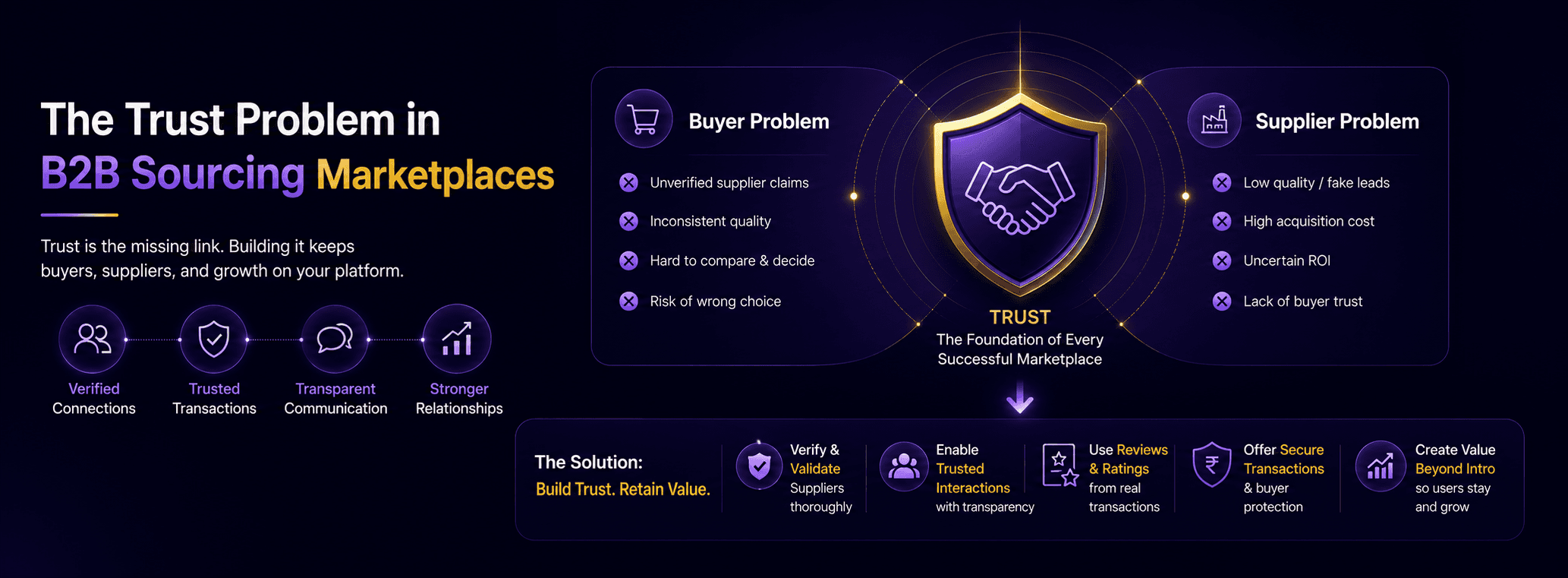
B2B sourcing marketplaces are built on a promise of connection, and quietly undermined by a double deficit of trust: buyers do not trust unverified supplier claims, and suppliers do not trust the quality of the leads they pay for. The result is the category's open secret, disintermediation: the moment two parties find each other, they take the relationship offline and the platform loses everything after the introduction. Blocking contact does not fix this; it accelerates it. The platforms that win solve trust as an engineered product so that leaving the platform means losing protection, not saving commission.
Every B2B sourcing marketplace pitch contains the same beautiful arithmetic: thousands of suppliers, thousands of buyers, and a platform in the middle of every transaction. Every operating B2B marketplace contains the same uncomfortable reality: the platform is in the middle of the first transaction, at best, and then watches the relationship walk out the door.
The double deficit
Buyers do not trust the supply. A procurement engineer searching the platform finds two hundred suppliers, all claiming the same certifications, the same capacities, the same leading manufacturer status, most with self-declared profiles nobody has checked. The buyer's rational response is to treat the platform as a phone book: useful for names, worthless for judgment, and everything important to be verified offline through the channels they already trusted.
Suppliers do not trust the demand. A supplier pays for a membership or for leads and receives enquiries that are unqualified, duplicated across competitors, price-fishing, or fake. Their rational response is to stop investing in the platform: minimal profile effort, slow responses, and a standing suspicion that renewals are paying for noise. Which degrades the buyer experience further, completing the loop.
Notice the structure: each side's rational self-protection makes the platform worse for the other side. This is the trust spiral that also afflicts education marketplaces, but sharper, because B2B transactions are larger, relationships are longer, and the cost of a bad supplier is not a disappointing course but a broken production schedule.
Disintermediation is a symptom, not the disease
The category's most discussed pathology is the leak: buyer and supplier meet through the platform, then conduct every subsequent transaction directly, leaving the marketplace with an introduction fee at best. Founders try to fix it with the standard toolkit: hiding contact details, blocking phone numbers in chat, contractual anti-circumvention clauses.
Here is the honest assessment of that toolkit: it fails, and it deserves to. Determined businesses will always find each other, and every barrier the platform erects is friction charged to its best, most serious users. Worse, the blocking strategy reveals the platform's self-image: a toll gate, extracting rent from an introduction. Businesses despise toll gates and will spend real effort routing around them.
The reframe that changes everything: disintermediation is not users stealing from the platform. It is users telling the platform, accurately, that after the introduction it adds nothing worth paying for. The leak is the invoice for the trust deficit. You do not fix an invoice by hiding the exit. You fix it by becoming worth staying for.
What staying-worthy actually looks like
Verification that means something. Not a badge for uploading a certificate, but verification with teeth: documents checked against issuing bodies, factory capabilities confirmed, claims audited on a cycle, and honest tiers that state exactly what was and was not checked. Verification that costs the platform something is the only kind buyers believe. Modern AI has changed the economics here meaningfully, document checking and cross-referencing claims against public records can now run at platform scale.
Reputation tied to transactions, not opinions. Open review systems in B2B fill with noise and manipulation. Reviews that count are attached to verified, on-platform transactions: this buyer bought this category from this supplier, and here is what happened to delivery, quality, and dispute. A transaction-verified reputation is an asset a supplier cannot take with them off-platform.
Protection inside the transaction. Escrow or milestone-based payment structures, dispute resolution that is faster and cheaper than the alternative, and documented terms for quality and delivery. The moment the platform carries risk the parties cannot carry alone, the commission stops being a toll and becomes an insurance premium, and insurance premiums are paid willingly.
Value at every stage, not just discovery. RFQ structuring that makes buyer requirements clear enough to quote accurately, logistics and documentation support, financing partnerships, repeat-order tooling. Each one is a reason the second transaction happens on-platform.
The pattern across all four: the winning platforms stopped asking how do we prevent users from leaving and started asking what would make leaving irrational.
The founder's roadmap tension
Everything above collides with a hard commercial fact: trust mechanics are slow, expensive, and unglamorous, while the directory business, memberships and lead sales, pays today. The suppliers who pay most under the directory model are frequently the ones verification would embarrass, which means the loudest revenue voices are structurally opposed to the exact investments the platform's future depends on.
The founders who escape the trap sequence deliberately: pick one category and one corridor, build the full trust stack there until the on-platform transaction is demonstrably safer than the alternative, prove the retention and take-rate math in that wedge, and expand from evidence. Depth first, breadth from proof.
The B2B sourcing opportunity in India is genuinely enormous, and the graveyard of the category is full of platforms that grew impressive traffic on top of the double deficit and never noticed they were phone books until the renewals stopped. The prize goes to the founder willing to say the quiet part in their own boardroom: nobody trusts anybody on our platform yet, and fixing that, category by category, transaction by transaction, is the entire company.