Key Takeaway
AI ROI in Indian manufacturing does not hide in factory automation. It hides in the commercial and administrative work around the factory: quoting, document handling, quality documentation, sales follow-through, and the knowledge locked inside a few senior people. These are information-heavy processes, performed by scarce people, at high volume, and that is exactly the pattern where AI pays back fastest and most predictably.
The question mid-market Indian manufacturers ask most often about AI is: where do we start? The right answer is rarely where the demos are. Factory floor robotics and production-line vision systems make compelling presentations. They are also capital-intensive, technically complex, and carry real disruption risk for a plant running at capacity.
The processes that actually pay back first share a different profile. They are not on the shop floor. They are in the offices around it: the commercial team handling enquiries, the back office processing documents, the quality department generating reports, and the sales team following up, or failing to, on every quote that goes out.
The pattern that predicts AI payback
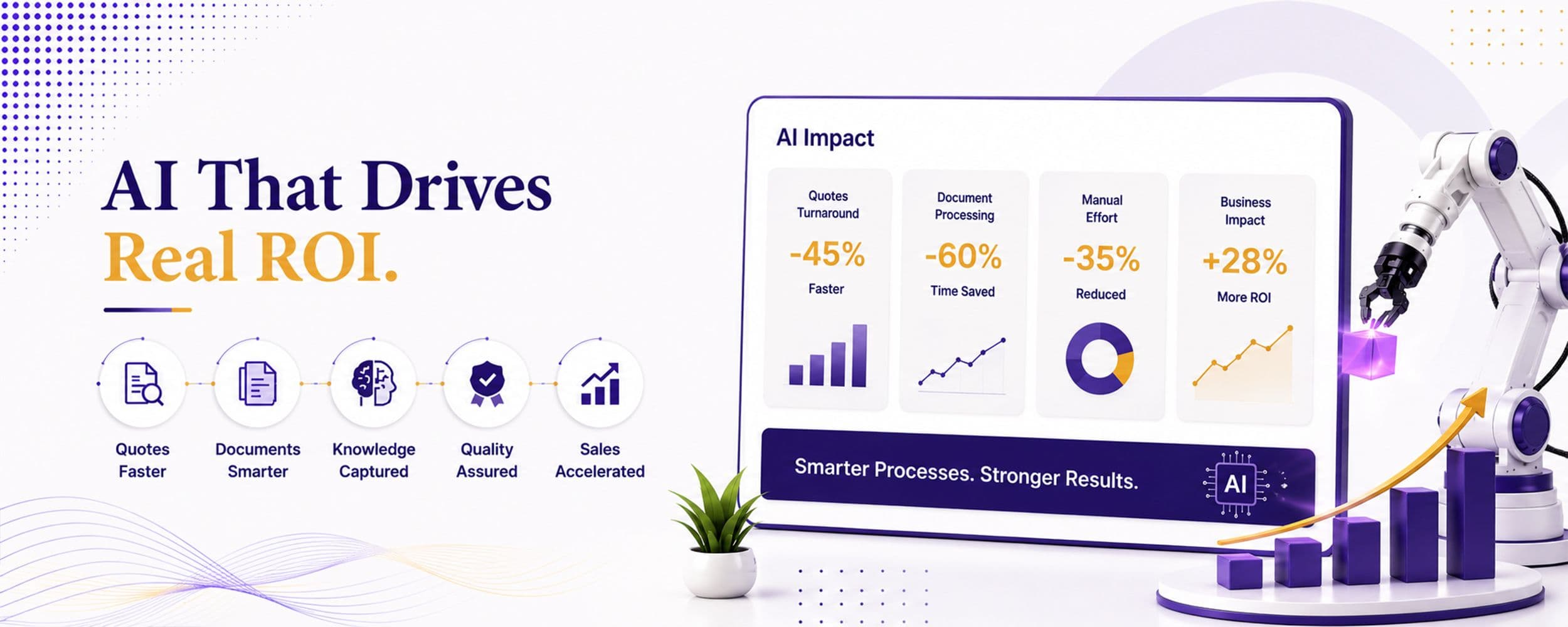
Across the manufacturers we have worked with, the applications that generate the clearest, fastest return share three characteristics: high information volume, scarce human expertise as the bottleneck, and a measurable output that the business already cares about.
Quotation turnaround is the clearest example. In most mid-market plants, every RFQ waits in the queue of one or two senior people who alone can price it. That queue is the most expensive commercial bottleneck the business has, because slow quotes lose winnable orders silently. AI compresses the excavation stages of quoting, reading the requirement, matching it to history, running a feasibility check, so the senior person reviews a prepared case file rather than starting from raw material.
Document handling runs a close second. RFQs, purchase orders, quality records, compliance certificates: information arrives in many formats, must be read and routed by someone qualified to interpret it, and delays cost real money at every stage. Systems that read incoming documents, extract the relevant details, and route them correctly turn a reactive queue into a same-hour workflow.
Where manufacturers consistently overestimate ROI
Two categories attract over-investment relative to their actual return in the mid-market context.
Predictive maintenance is compelling in theory and difficult in practice for plants without clean sensor data, consistent machine connectivity, and a maintenance team ready to act on predictions. The data infrastructure cost frequently exceeds the downtime savings unless the plant is already well-instrumented.
Demand forecasting improves with AI, but the improvement is most valuable when procurement and production planning are already disciplined enough to act on a more accurate forecast. In organisations where planning is informal, a better forecast does not automatically produce better decisions.
The measurement discipline that makes it work
The manufacturers who succeed with AI adoption share one practice the ones who fail almost always skip: they measure the baseline before they deploy anything. Median quote turnaround, hours spent on document processing, error rates in quality documentation. Without the before, there is no proof of after, and proof is what funds the next project.
This measurement-first sequence is the foundation of a proper AI process audit, and it is why the audit should precede the tool, not follow it. The plants that start with a tool and hope to measure ROI later are the ones that end up with a quietly cancelled subscription and a house verdict that AI does not work.
It does work, in the right places, measured from the right baseline. The article on RFQ-to-quote automation, which this article introduces, is the deepest single example of that principle in practice.