Key Takeaway
An AI readiness audit answers the two questions every leadership team should settle before spending a rupee on AI tools: where in this specific company would AI pay back first, and is the company actually ready, in data, process ownership, and people, to capture that payback? It delivers a measured process baseline, a ranked list of AI candidates scored on value and feasibility, an honest readiness gap list, and a sequenced roadmap. It costs a fraction of one failed pilot, which is exactly the disaster it exists to prevent.
There is a question mid-market manufacturers almost never ask before buying AI, and it is the only question that predicts whether the purchase will work: ready for what, exactly?
Readiness sounds like an abstraction until you watch its absence in action. A company buys a capable tool, discovers its data is scattered across folders and one veteran's memory, finds no one owns the process the tool was meant to improve, and quietly shelves the subscription eight months later. The tool was fine. The company was not ready, and nobody had checked. An AI readiness audit is the check.
What an audit actually examines
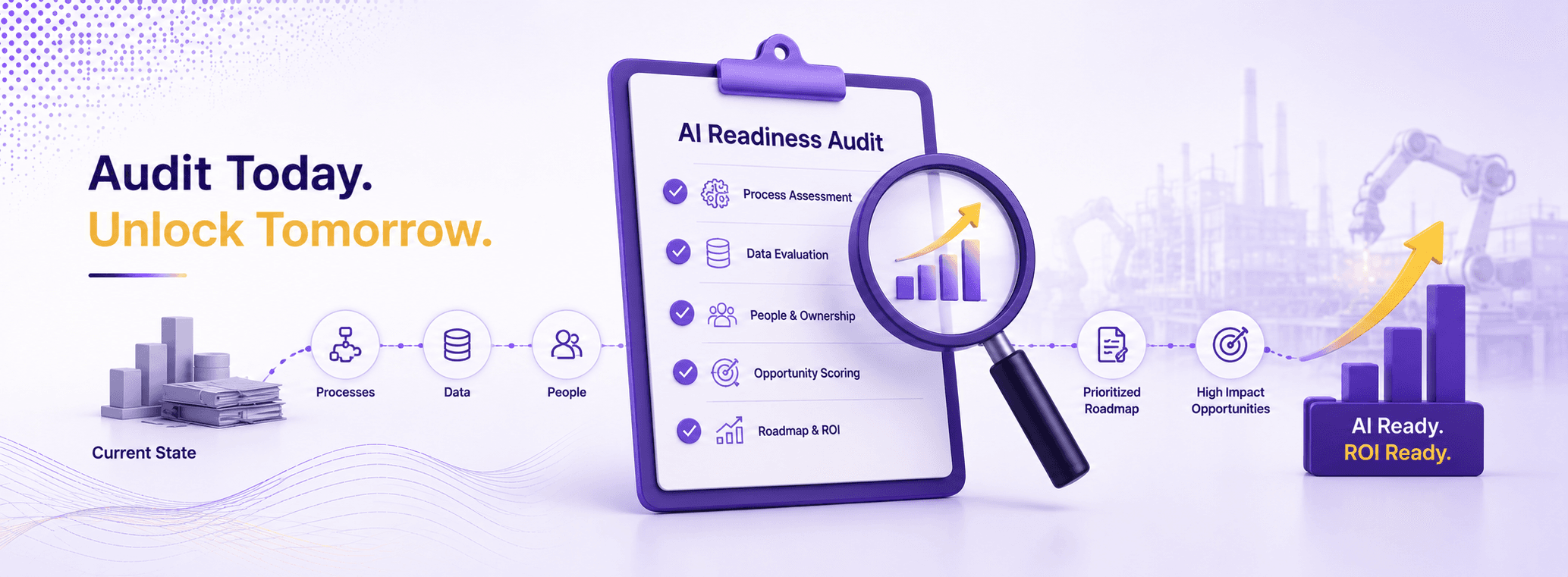
A serious audit works through four layers, in order, because each layer's findings shape the next.
Layer one: the process map with numbers attached. The audit begins where our article on manufacturing AI ROI argued everything should begin: with the work, not the technology. The information-heavy processes of the business get mapped and, critically, measured. Turnaround times, hours consumed, error rates, volumes, and the honest answer to who is the one person this process cannot run without. Most leadership teams are seeing these numbers for the first time, and the baseline alone frequently justifies the audit, because you cannot improve, or even prioritise, what you have never measured.
Layer two: the data reality check. Every AI application runs on the company's own information, so the audit asks, per candidate process: does the data this would need actually exist, where does it live, what state is it in, and what would organising it cost? A readiness gap discovered during implementation costs five times what it costs when discovered on paper.
Layer three: ownership and people. Tools do not adopt themselves. For each candidate, the audit identifies whether there is a natural owner with the authority and motivation to run the change, how the affected people are likely to receive it, and what the review-and-correction workload looks like in the parallel-running phase. It also surfaces the quiet blocker in many plants: the key person whose cooperation the project needs and whose job the project appears, wrongly or rightly, to threaten.
Layer four: the ranked roadmap. Every candidate process gets scored on two axes, payback value from the measured baseline, and feasibility from the data and ownership findings, and ranked. The roadmap then sequences them deliberately: an opening project chosen for clean measurement and cheap disruption, typically administrative rather than production-critical, followed by the heavier projects the first one's verified return will fund.
What a good audit deliverable looks like
Commission an audit and you should receive four things in writing, and you should refuse to accept fog on any of them.
A process baseline document with actual numbers, which becomes the before against which every future AI claim in your company is tested. A scored and ranked candidate list, with the scoring visible, so leadership can argue with the reasoning rather than receive a verdict. A readiness gap list stating plainly what must be organised, assigned, or cleaned before each project, with effort estimates. And a sequenced roadmap with an explicitly recommended first project and the measurement plan that will prove or disprove it.
Notice what is absent from that list: a product recommendation. A readiness audit that concludes with and therefore you need our platform was a sales process wearing a clipboard.
Who needs one, and who does not
The audit earns its fee when the company runs real process volume, when leadership senses AI matters but cannot rank where to start, when one or two previous tool purchases have quietly failed, or when the company is about to spend serious money on an AI initiative and wants the decision de-risked first. Mid-market manufacturers sit squarely in this zone: enough volume for real returns, short enough decision chains to act on findings this quarter.
The audit is premature when the business is too small for process volume to matter, when a single obvious and well-understood pain point already dominates everything else, or when leadership wants a document to file rather than a plan to execute.
The economics of checking first
A failed AI pilot costs the subscription, the integration effort, the months of organisational attention, and, most expensively, the credibility of the next attempt, since we tried AI and it did not work becomes the house verdict for years. An audit costs a fraction of that, and its entire function is to spend that fraction finding out, on paper, what the pilot would have found out in production.
And there is a quieter benefit that outlasts any single project. The audit process itself, measuring the processes, naming the owners, confronting the data reality, is the first act of becoming the kind of company that adopts technology deliberately rather than fashionably. Manufacturers who have been through it make better decisions about every subsequent tool, because they have acquired the habit the audit encodes: baseline first, tool second, proof always.