Key Takeaway
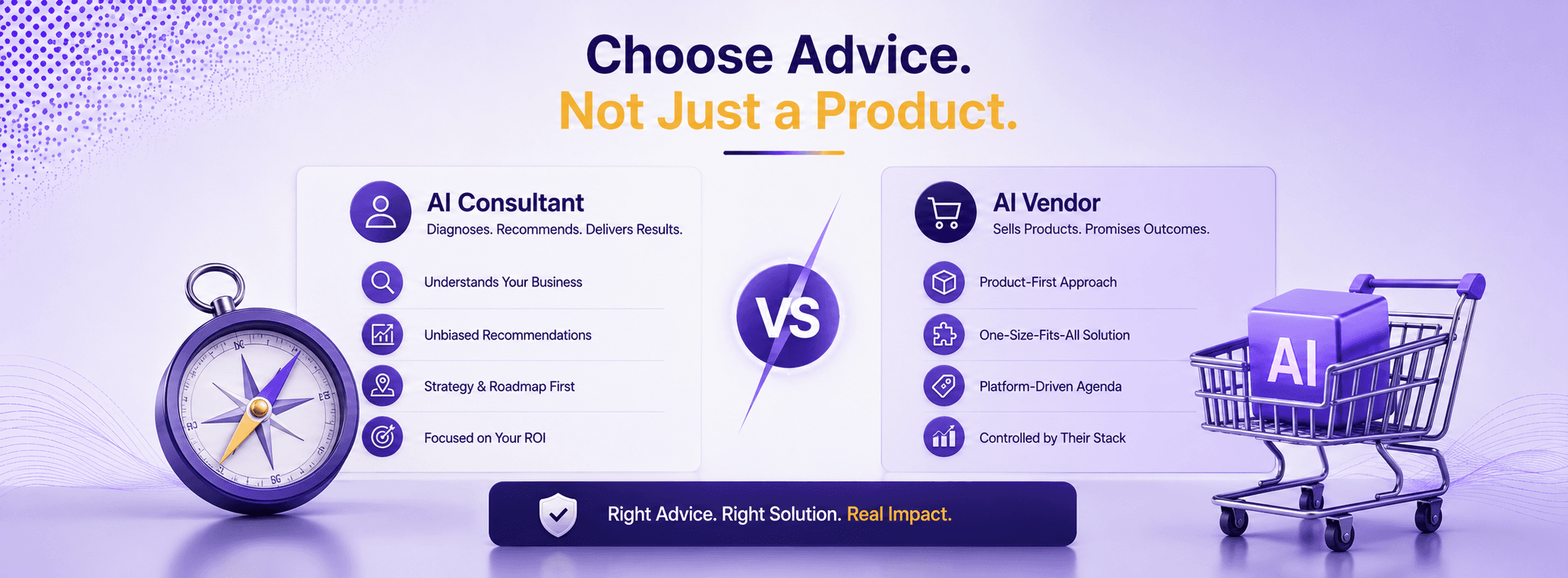
A vendor's job is to sell you their product. A consultant's job is to diagnose your situation and recommend whatever serves it, including products the consultant does not sell and, sometimes, no product at all. Both roles are legitimate, but they are different jobs with different incentives, and most wasted AI spend traces to one confusion: taking a vendor's assessment as if it were a consultant's diagnosis. The test is one question: can this person's advice ever cost them money? If the answer is no, you are in a sales process, however consultative it feels.
Here is a scene playing out in mid-market boardrooms across India this quarter. A company knows AI matters and does not know where to start. A firm arrives offering a free or cheap AI assessment. The assessment is professional, the workshop is genuinely useful, and its conclusion is that the company's highest-priority opportunity happens to be solved by the assessing firm's platform.
Nobody lied. The demo was real, the platform may even be good. But something important got smuggled past the buyer: a sales process was consumed as if it were a diagnosis, and the company is now evaluating one product instead of understanding its own situation.
Two legitimate jobs, one dangerous confusion
A vendor builds and sells a product. Good vendors are deep experts in their product's domain, their demos are informative, and when your problem matches their product, buying from them is exactly right. A vendor's advice is not dishonest; it is scoped. Ask a vendor how to solve your problem and you will receive the truthful answer to a slightly different question: how their product would address it.
A consultant, properly defined, sells diagnosis and judgment. Their deliverable is an understanding of your situation, your processes measured, your options ranked, your readiness gaps named, and a recommendation that is allowed to land anywhere: on a vendor's product, on a different vendor's product, on an internal fix, or on not yet. The defining property is not superior intelligence. It is that the recommendation is structurally free to disappoint the person making it.
The confusion arises because vendors have learned to package sales processes in consulting language: assessments, audits, roadmaps, workshops. The vocabulary is identical. The incentives are not.
Why AI makes this distinction expensive
The buyer usually cannot check the work. A manufacturer can evaluate a machine against decades of domain knowledge. Most leadership teams evaluating AI have no equivalent instincts yet, which means the assessor's framing goes unchallenged. Whoever defines the problem has effectively chosen the solution.
The field is moving too fast for locked bets. Capabilities shift quarterly, and pricing with them. Advice that locks you into one vendor's roadmap carries a currency risk that independent advice, re-evaluated per project, does not.
The real work is rarely the tool. As we have argued across this series, AI payback lives in measured processes, organised data, named owners, and disciplined adoption. A vendor's assessment systematically underweights all of that, not from malice but from scope: their product is the deliverable, so the surrounding organisational work becomes a footnote called implementation, which is precisely where unready companies then fail.
The tells: how to know which one you are talking to
Follow the money to its destination. Ask directly: how do you earn, and does any of it depend on which tools I end up buying? An honest answer to this question, whatever it contains, is itself a good sign.
Ask what they recommended against, recently. A real consultant has a story of advising a client not to buy, not to build, or to wait, told with specifics.
Watch where the first meeting goes. A vendor's first meeting moves toward the demo. A consultant's first meeting moves toward your processes. If you have seen a product screen before anyone has asked what your quote turnaround time is, you know which meeting you are in.
Check whether the deliverable survives without them. A diagnosis you have paid for should be a document you own: baselines, ranked options, gaps, a roadmap you could execute with anyone. If the assessment's findings are inseparable from the assessor's platform, you did not buy a diagnosis.
Notice whether no is on the menu. Ask what would make them tell you not to proceed with AI in a given process. A consultant answers immediately, because half their value is preventing bad projects.
Using both, in the right order
The conclusion is not never talk to vendors. It is sequence and role clarity. Diagnosis first, independent of any sale: your processes measured, your candidates ranked, your readiness gaps priced. Then vendors, evaluated against a problem you now own the definition of. Then implementation with whoever earns it, measured against the baseline the diagnosis established.
In that sequence, vendors become more useful, not less: you ask them sharper questions, compare them on your criteria, and negotiate from an understanding they did not author.
Our own position, stated plainly
Fairness requires that we apply the test to ourselves, in public. MagicWorks sells AI Process Audits: diagnosis, ranked candidates, readiness gaps, and a roadmap. We do not sell an AI platform, and our audit conclusions are deliberately structured to survive without us, so implementation can be competed. That boundary costs us revenue with some regularity. It is also the entire reason the advice is worth paying for.
Ask everyone who advises you on AI the one-question version of this article: can your advice ever cost you money? Then watch the answer, not the brochure.