The short answer
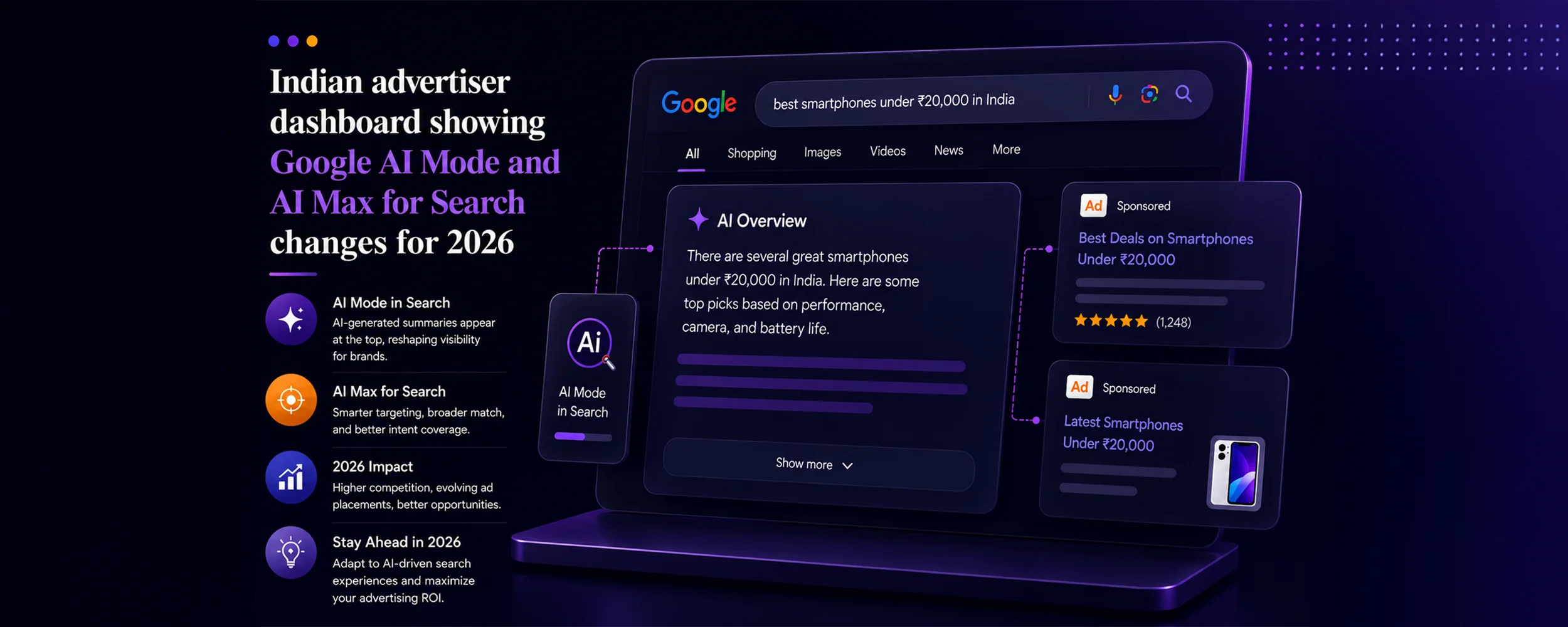
On April 15, 2026, Google announced that AI Max for Search was moving out of beta. Starting in September 2026, eligible Search campaigns using Dynamic Search Ads, automatically created assets, or campaign-level broad match settings will automatically upgrade to AI Max. This is documented in the official Google Ads blog post titled “Dynamic Search Ads are upgrading to AI Max.”What this article covers
- What changed in Google Ads in early 2026
- Why this matters more for sales heads than for marketing teams
- How AI Mode and AI Max will likely hit your pipeline
- Does AI Max for Search actually work? What independent data shows
- A 90-day Google Ads action plan, by week
- How to read your Google Ads data when reporting becomes less transparent
- Industry-specific notes for education, travel, manufacturing, and B2B services
- What to brief your CEO before the September 2026 deadline
- Frequently asked questions
What changed in Google Ads in early 2026
Two changes matter, and they happened almost on top of each other. If you run Google Ads in India and you have not adjusted to either, your account is already operating on assumptions that no longer hold.Change 1: Ads in AI Overviews are now available in India
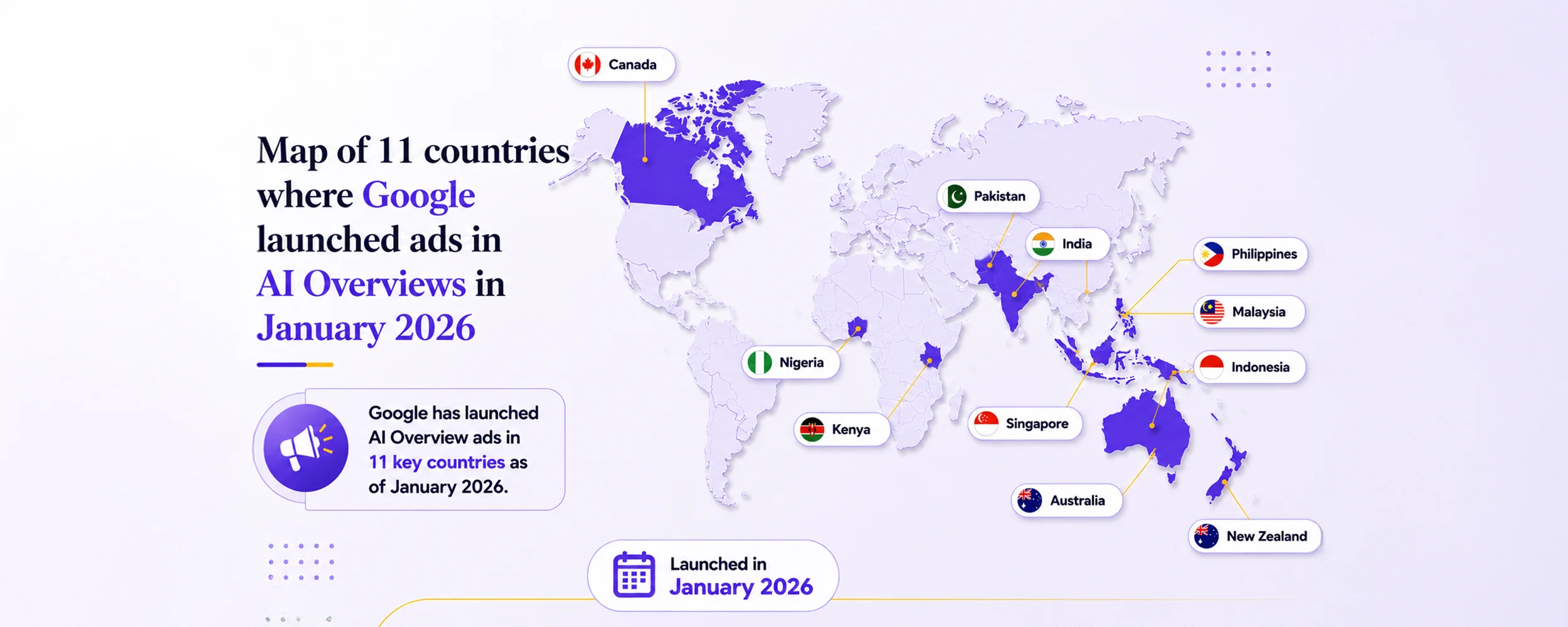
Google Ads Help currently states that ads in AI Overviews are available in English on mobile and desktop in India and several other markets. This is the safest wording to use unless the article adds a separate, verifiable source for the exact January 2026 launch date.
In plain language: when a customer in India types or speaks a query into Google, an AI-generated answer is now increasingly appearing at the top of the results page. Your ads can show above, below, or inside that AI answer. You cannot opt out. Reporting does not separate AI Overview performance from regular search results.
Three things flow from this. First, the queries triggering AI Overviews tend to be longer and more conversational, which means traditional exact-match keyword strategies are losing ground to broader matching. Second, click-through rates are dropping on queries where AI Overviews appear, by 61 percent on average according to Seer Interactive’s November 2025 study covering 25.1 million impressions. Third, and this is the part most advertisers miss, the user often gets their answer from the AI summary and never clicks anything. Semrush data from September 2025 shows that 93 percent of Google AI Mode queries end without a single click to any external website.
Change 2: AI Max for Search went generally available on April 15, 2026
On April 15, 2026, Google announced that AI Max for Search moved out of beta. Starting in September 2026, eligible Search campaigns using Dynamic Search Ads, automatically created assets, or campaign-level broad match settings will automatically upgrade to AI Max. This is documented in the official Google Ads blog post titled “Dynamic Search Ads are upgrading to AI Max.”
AI Max for Search is a suite of three AI-powered features you can enable on existing Search campaigns: search term matching, text customization, and final URL expansion. Search term matching uses broad match and keywordless technology to expand reach beyond your keyword list. Text customization generates headlines and descriptions based on your landing pages, ads, and keywords. Final URL expansion routes users to the page on your site that Google’s AI considers most relevant to their intent.
The September 2026 deadline matters specifically. If your account uses Dynamic Search Ads, automatically created assets, or campaign-level broad match, those campaigns will be automatically upgraded to AI Max in September. You have roughly five and a half months to prepare. This is shorter than any previous major Google Ads campaign-type sunset. The 2022 Smart Shopping to Performance Max migration ran nine months. This one runs five and a half.
“For sales heads in India, the question is not whether AI Max will affect your lead flow. It will. The question is whether you will be the team that prepared, or the team that finds out from a quarterly pipeline review that something changed and nobody knows what.”
Why AI Mode matters more for sales heads than marketing teams
Most articles about Google Ads changes are written for marketers, in marketer language: CTR, CPM, quality score, asset optimization. Important, but not how a sales head reads the world. A sales head reads the world in lead quality, sales cycle length, conversion rate from lead to opportunity, opportunity to close, and average deal size. Those are exactly the metrics that move when Google’s underlying matching technology changes, and they often move before anyone notices the marketing dashboard has shifted.
Here is what AI Mode and AI Max are likely to do to a typical Indian B2B or B2C pipeline in the next two quarters. These are operator-level observations from working with Indian businesses across education, travel and wellness, manufacturing, and B2B services, supported by independent testing data.
Lead volume becomes more variable
Keywordless matching means your ads will start showing up for queries you never bid on, including queries you might not even recognize. Some of these will produce excellent leads. Some will produce noise. The variance is wider than what you are used to. A sales team that was getting 200 reasonably qualified leads a month from Google Ads might suddenly see 280 leads, of which 80 are completely unrelated to what your sales team can actually sell.
The lead quality drift will not show up in marketing reports
Standard Google Ads reports will show CTR up, conversion volume up, cost per lead steady or improved. The marketing team will report progress. Meanwhile, the sales team will be calling more leads, talking to more wrong-fit prospects, and closing the same number of deals. This is the gap that destroys trust between marketing and sales heads if it is not caught early.
Sales cycle length will lengthen for some categories
Customers who used to land on a specific service page directly from a tightly-matched ad now sometimes land on a different page chosen by AI. A buyer searching for “online MBA fees Pune” who lands on a generic homepage instead of the program-specific page is a slower-moving lead than one who landed where they expected to. Add a week or two to your sales cycle for some segments. Plan for it.
Cost per lead will look fine while pipeline value drops
This is the most dangerous pattern. Cost per lead, the number most marketing teams report up, can stay flat or improve while qualified pipeline value drops. The sales team feels it immediately. The marketing team does not see it for a quarter. By the time someone connects the dots, three months of budget have been spent in the wrong direction.
Will AI Mode hurt my Google Ads performance? Two scenarios to expect
Different businesses will feel these changes differently. From what we are seeing across our client work and from the independent testing data, two scenarios are most common in Indian B2B and considered-purchase B2C categories.
Scenario A: The lead volume spike that does not convert
You enable AI Max or have it enabled by default. In the first 30 to 45 days, your lead volume jumps 20 to 40 percent. The marketing team is delighted. The sales team starts complaining about lead quality within two weeks. By day 60, your sales-qualified lead rate has dropped from say 18 percent to 11 percent. Your absolute SQL volume is up slightly, but your cost per SQL has risen significantly because your sales team is spending more time qualifying out the noise.
This is consistent with what an analysis by Monks Agency found across roughly 30,000 AI Max search terms: 99 percent of impressions had zero conversions, and less than half of search terms could even be matched back to an existing keyword. Source: Monks Agency analysis, reported via PPC.Land. Your sales team will be the first to feel this. They will be right.
Scenario B: The slow grind of irrelevant placements
Your account does not see a dramatic volume change. Instead, your conversion rate slowly drifts down by half a percentage point a week. Your impressions are stable, your CTR looks fine, but actual outcomes are softening. This pattern often shows up first in landing page reports. Customers are arriving at pages that do not match what they were searching for, because final URL expansion sent them to whatever page Google’s AI considered closest. They bounce. The marketing dashboard shows the bounce. The sales dashboard shows missing pipeline. Few people connect the two.
This pattern hits service-based businesses harder than product-based ones. Education institutions running multiple programs, B2B services with several distinct service lines, and travel companies with multiple destination categories are particularly exposed. A user searching for one program lands on the wrong program page, leaves, and the lead is lost without ever being captured. The same dynamic applies to AI search visibility, which we covered in our companion article on Generative Engine Optimization for Indian businesses.
Does AI Max for Search actually work? What independent data shows
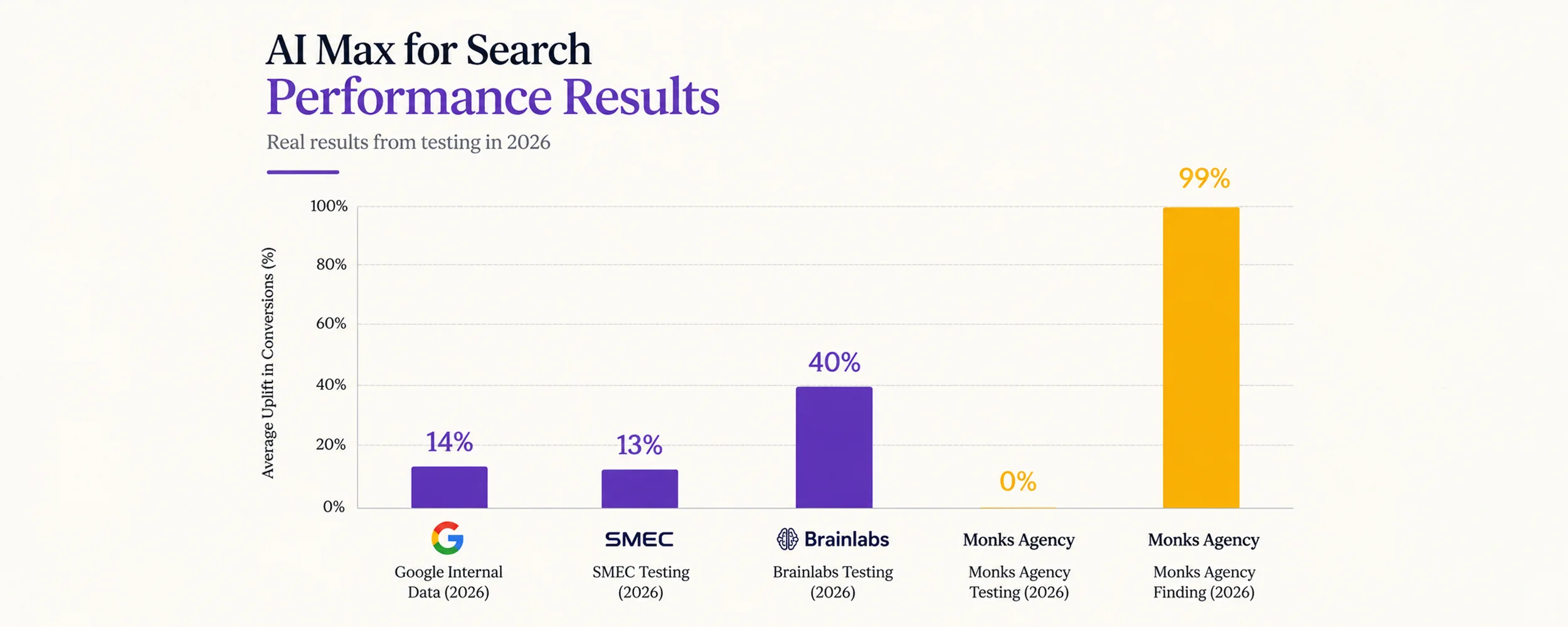
Google’s AI Max communication includes two different performance claims that should not be mixed. Google’s 2025 AI Max announcement says advertisers activating AI Max in Search campaigns typically see 14 percent more conversions or conversion value at similar CPA/ROAS. Google’s April 2026 DSA-upgrade post says Search campaigns using the full AI Max feature suite see 7 percent more conversions or conversion value compared with using search term matching alone. Independent advertisers and agencies have published a wider range of results, and the spread is dramatic.
| Source | Finding | What this means |
|---|---|---|
| Google internal data, 2026 | +7% conversions, full-feature AI Max vs matching-only AI Max (non-Retail) | Smaller than the 14% headline figure, and not a comparison to standard Search |
| SMEC agency testing, 2026 | +13% revenue, +16% CPA improvement | Genuine performance gain in well-prepared accounts |
| Brainlabs, 2026 | 40% of test campaigns saw success | Most campaigns did not see improvement |
| Monks Agency, 30,000+ AI Max search terms | 99% of impressions drove zero conversions | Severe waste in poorly-prepared accounts |
| Adriaan Dekker LinkedIn poll, PPC professionals | 16% reported good performance, 84% reported neutral or negative results | Industry sentiment is mixed at best |
“AI Max is the rare Google Ads feature where it is genuinely possible to materially damage your account by enabling it without preparation. Most previous changes punished inattention with mediocre results. This one can punish it with significant losses.”
How to prepare Google Ads for AI Mode: a 90-day plan
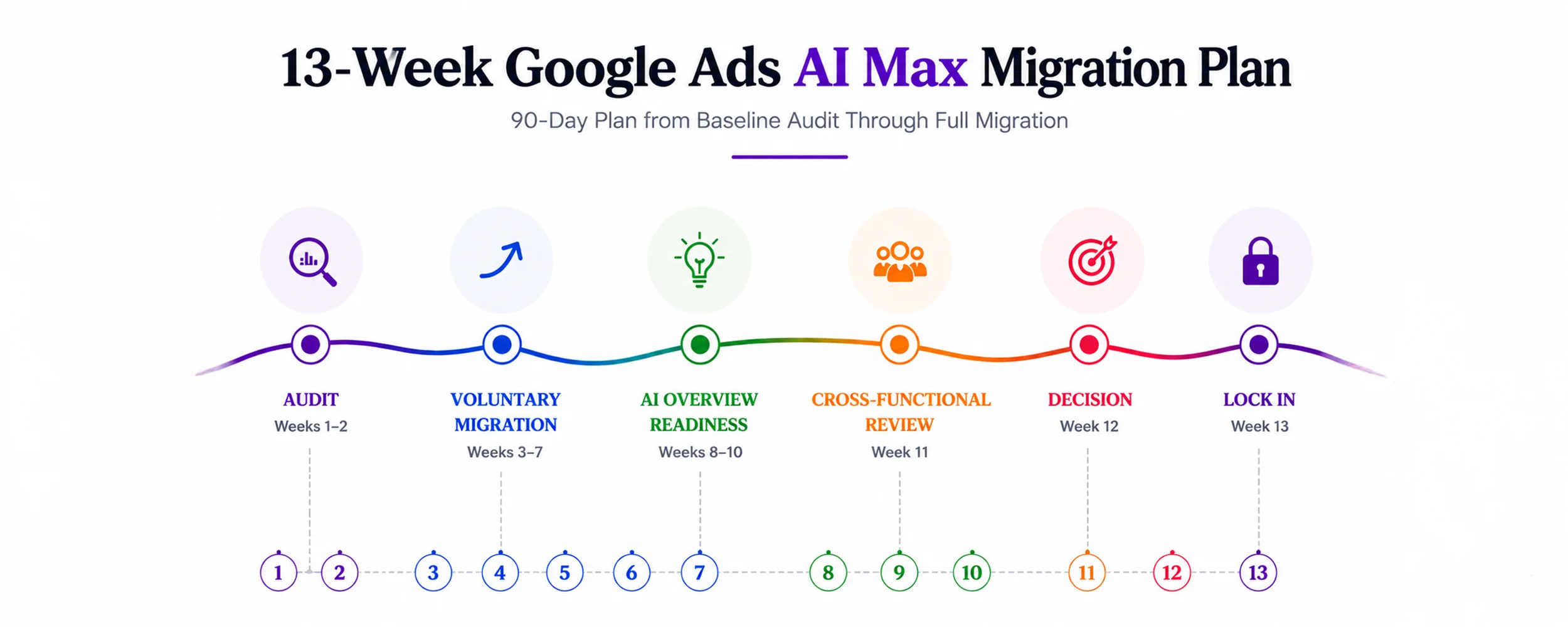
This plan is built for a sales head and marketing head working together. It is structured by week so the work is bounded and the pipeline impact stays visible. The total time commitment is roughly 6 to 10 hours per week of dedicated focus across the two functions, less if you have a strong agency partner running the operational layer.
Weeks 1 to 2: Audit your current state honestly
- Pull a 90-day report on cost per qualified lead by campaign and by ad group. This is the baseline. If you do not have the SQL data flowing back from your CRM into Google Ads, fix that this week. Without it, you cannot detect lead quality drift later.
- List every campaign that uses Dynamic Search Ads, automatically created assets, or campaign-level broad match. These are your auto-upgrade candidates for September 2026. Your account team or agency should produce this list within three working days.
- For each of these campaigns, document the current performance: CTR, conversion rate, cost per conversion, and most importantly cost per qualified lead. Save these baselines.
- Run a quick search on the 10 most important commercial queries in your category. Note whether AI Overviews are appearing for those queries. AI Overviews trigger far more often on informational queries than commercial ones, but the line is moving every quarter.
Weeks 3 to 4: Voluntary AI Max migration on a test campaign
- Choose one Search campaign to migrate to AI Max voluntarily in week 3. Do not pick your largest campaign. Pick a mid-sized one that you can monitor closely without risking your top revenue line.
- Run it as a 50-50 split experiment against an unchanged control campaign. This is the best way to measure incrementality rather than coincidence.
- Set up daily review for the first 14 days. Watch search term reports closely for queries that should not be triggering your ads. Add aggressive negative keywords as patterns emerge.
- Critical for sales heads: have your sales team rate the first 50 leads from the new AI Max traffic on a 1 to 5 quality scale. Compare to the rating of the previous 50 leads from the same campaign. This single piece of data is worth more than any Google Ads dashboard report.
Weeks 5 to 6: Strengthen your AI Overview readiness
- Identify the 20 long-tail conversational queries most likely to trigger AI Overviews in your category. Examples: instead of “online MBA,” think “what is the best online MBA for working professionals in India under 30.” These longer queries are where AI Overviews live.
- Audit whether your existing landing pages can win for those queries. Most cannot, because they were optimized for short keywords, not for being cited inside an AI-generated answer.
- Rebuild your top three landing pages to be answer-first. The first 200 words must directly answer the question. Add structured FAQ schema. Add named author credentials. This work compounds for both AI Overviews and broader Generative Engine Optimization visibility, which we covered in detail in our GEO playbook for Indian businesses.
- Update your Performance Max creative assets if you run them. AI Overview ads pull from existing campaign creative. Weak creative gets weak placement.
Weeks 7 to 8: Build the cross-functional review rhythm
- Establish a 30-minute weekly call between marketing head and sales head, with one shared dashboard tracking: cost per qualified lead, SQL rate from each major campaign, sales team’s qualitative lead quality rating, and average sales cycle length by source.
- Add a single new metric to this dashboard: pipeline value generated per ₹1 lakh of Google Ads spend, broken down by campaign. This is the metric that exposes the silent damage scenarios from earlier.
- Write down the three numbers that, if they move past a defined threshold, will trigger an immediate review. For most accounts: SQL rate dropping more than 3 percentage points, average sales cycle growing more than 7 days, or pipeline value per spend rupee dropping more than 15 percent. These are your tripwires.
Weeks 9 to 10: Decide on full migration strategy
- Review the experiment results from your test AI Max campaign. If the split test shows positive sales-qualified outcomes, plan migration of additional campaigns starting week 11. If results are negative or unclear, document what you learned and plan a second test with adjustments before broader migration.
- For campaigns you do not voluntarily migrate, confirm with your team or agency exactly when the September 2026 auto-upgrade affects each campaign. Get this in writing. Surprises are not acceptable.
- Begin the brand control work. AI Max introduced text guidelines (term exclusions and messaging restrictions) that became globally available on February 26, 2026. Source: Google announcement. Use this layer to lock down what AI-generated copy can and cannot say about your brand.
Weeks 11 to 13: Lock in the new operating model
- By this point, you have one campaign successfully on AI Max, baselines on the others, and a working sales-marketing review rhythm. Use weeks 11 to 13 to migrate additional campaigns voluntarily, in priority order by lowest risk first.
- Document what you have learned in a one-page playbook for your team. This document, more than any dashboard, will protect your operation when something else changes in the next 12 months. And it will.
- Brief your CEO. They will ask. The CEO briefing section below covers what to say.
How to read Google Ads data when reporting becomes less transparent
One of the most uncomfortable parts of the new Google Ads era is that reporting transparency is going down, not up. Ads in AI Overviews do not get segmented reporting, by Google’s own admission. Source: Google Ads Help. AI Max search terms often cannot be traced back to a specific keyword. The dashboard tells you less about why something happened than it used to.
This is bad news if you rely entirely on the Google Ads dashboard to understand your performance. It is solvable if you build a small number of supplementary practices.
Track outcomes, not platforms
Stop measuring success by what Google Ads tells you happened. Measure success by what your CRM tells you happened. If your sales team is closing more deals from leads tagged as Google Ads source, your campaign is working, regardless of what the dashboard says about CTR or CPC. If your sales team is closing fewer deals while the dashboard shows progress, your campaign is failing, regardless of what the dashboard says.
Use experiments, not feelings
Every meaningful change to a campaign should run as an A/B experiment for at least four weeks. This was always good practice. With AI Max, it has become non-negotiable. The variance in results is too wide to trust gut feel or short-term data.
Build pipeline-source attribution by hand if you must
For high-value B2B businesses, manual lead source tagging at the moment of first conversation often beats automated attribution. Train your sales team to ask every new lead one question: how did you find us. Three months of this data is worth more than any platform-level attribution report.
Watch the search terms report like a hawk
The single most valuable diagnostic tool for AI Max performance is the search terms report. Look for queries that should not be triggering your ads. Add them as negatives. Do this weekly for the first 60 days after enabling AI Max, monthly thereafter. The accounts that thrive are the accounts that maintain aggressive negative keyword discipline.
Industry-specific notes: education, travel, manufacturing, B2B
The patterns above apply broadly, but the specifics differ by industry. Brief notes on what to watch for in the four sectors where we do most of our work.
Education and EdTech
Education is the most exposed sector to lead quality drift. Course-specific pages, fee-specific queries, and program-specific landing pages are precisely the kind of tightly-matched setups that AI Max’s final URL expansion can route around. A user searching for a specific online MBA program who lands on a generic course catalog page is a much weaker lead than one who landed where they expected. The decision cycle is already long in education (often 30 to 90 days from inquiry to enrollment). A small drop in landing page relevance can extend that cycle by another two to three weeks. Sales heads in education should pay particular attention to the time-from-first-inquiry-to-counsellor-call metric, which is sensitive to landing page quality.
Travel, hospitality, and wellness
Travel and wellness benefit from AI Mode in an unusual way: long, conversational, identity-driven queries are the exact kind that AI Overviews handle well. “Where should I go for a wellness retreat in Kerala in November as a first-timer” is a query that AI is going to synthesize an answer for, and the brand cited inside that answer captures meaningful consideration. The risk is on the paid ads side. Travel campaigns that depend on tightly-matched destination keywords (“Kerala wellness retreat package”) will see traffic shift to broader matching, which will pull in users in earlier stages of consideration. Plan for longer nurturing cycles. Consider repositioning some budget from immediate-conversion campaigns to retargeting and brand-building activity.
Manufacturing and industrial B2B
Manufacturing and industrial B2B accounts have the most to lose from lead quality drift, because each unqualified lead consumes meaningful sales-team time. A manufacturing distributor running ads on “industrial fasteners supplier Pune” who suddenly starts seeing impressions on “how do industrial fasteners work” is wasting budget on educational queries that will not convert. Negative keyword discipline becomes the single most important practice for these accounts. The good news: well-prepared B2B accounts often see the largest gains from AI Max, because the keywordless matching surfaces real high-intent queries that traditional keyword strategies missed. The two outcomes (gain or loss) hinge almost entirely on the quality of negative keyword management in the first 60 days.
B2B services
B2B services (financial services, professional consulting, marketing services, healthcare administration, and similar) sit between manufacturing and education in their exposure. The lead quality risk is real, but the AI Mode visibility upside is substantial because B2B buyers are heavy users of AI search for early-stage research, particularly Claude (favoured for senior decision-maker research) and Microsoft Copilot (embedded into the Microsoft 365 environment most Indian B2B operations run on). Recent Similarweb data found 55 percent of enterprise buyers use AI to begin their search. Source: Similarweb 2026 GEO research. Plan for two distinct workstreams: protecting paid lead quality, and capturing AI Overview visibility for high-consideration B2B queries.
What to brief your CEO before September 2026
Most CEOs of growing Indian businesses are aware that “AI is changing search” but have not connected that change to specific implications for the business this year. If you are the marketing or sales leader, you should brief them. Here is the shortest possible version, in language a CEO will actually use.
There are three things to tell them. First, Google has changed how its advertising platform works in two specific ways that directly affect our pipeline, and the changes are happening across Q2 and Q3 2026. Second, the marketing dashboard is becoming less transparent about what is actually driving results, which means we will rely more on what the sales team and CRM are telling us than on the platform reports. Third, if we do nothing, our cost per qualified lead will likely deteriorate before we notice. We are running a 90-day plan to get ahead of this. Here is what we are doing, and here are the three numbers we will report on monthly.
Then give them the three numbers. The same tripwire metrics from week 7. CEOs read by exception. They want to know what would trigger action and what good looks like. They do not want a Google Ads tutorial.
What to do this week
If you have read this far, you understand the shape of the change. The work is bounded, the timeline is real, and the September deadline is non-negotiable. Here is the shortest possible action list to start this week.
- Get the list of campaigns auto-upgrading in September. Three working days, from your team or agency.
- Confirm that sales-qualified lead data flows from your CRM into Google Ads as a conversion. If it does not, fix it this week. Nothing else matters as much as this.
- Schedule a 30-minute marketing-sales weekly review starting next week. Make it permanent.
- Identify one mid-sized Search campaign to use as your AI Max test campaign. Have it ready to migrate in two weeks.
- Draft a one-page brief for your CEO. Send it within two weeks. Do not wait until September.
“The bottom line: Indian advertisers running Google Ads in 2026 must voluntarily test AI Max on one campaign before September, fix CRM-to-Google-Ads conversion tracking, and establish a weekly sales-marketing review rhythm. Skip these three steps and you will spend the rest of the year diagnosing problems you could have prevented.”
AI Overviews, AI Mode, and AI Max are not temporary algorithm changes. Together, they signal a new structure for Google Search and Search advertising. Indian advertisers who treat the next 90 days as a routine update may spend avoidable budget learning that the rules have changed. The ones who treat this as a structural shift, get their CRM data clean, run real experiments, and build the marketing-sales review rhythm, will be better positioned by October than competitors who wait until after the September upgrade.
You have until September 2026. The work fits in that window, but only if you start now.
Frequently asked questions about Google AI Mode and AI Max
Common questions Indian advertisers, sales heads, and marketing leaders are asking about Google AI Mode, AI Overview ads, and AI Max for Search in 2026.
Are ads in AI Overviews available in India?
Yes. Google Ads Help currently lists India among the countries where ads in AI Overviews are available in English on mobile and desktop. Ads may appear above, below, or within AI Overviews, depending on the query, the AI Overview content, and existing campaign eligibility. Unless a separate launch-announcement source is added, avoid saying the India launch happened in January 2026.
What is AI Max for Search and how does it differ from Performance Max?
AI Max for Search is an optional suite of three AI-powered features — search term matching, text customization, and final URL expansion — that you enable on existing Google Search campaigns. It is not a new campaign type. Performance Max, by contrast, is a separate campaign type that runs across Google channels including Search, Display, YouTube, Gmail, Discover, and Maps. AI Max focuses on Search and provides more Search-specific controls than Performance Max. AI Max moved out of beta on April 15, 2026.
When does Google auto-upgrade my campaigns to AI Max?
Google will automatically upgrade campaigns using Dynamic Search Ads, automatically created assets, or campaign-level broad match settings to AI Max in September 2026. The exact day in September has not been confirmed by Google. Advertisers can voluntarily migrate before the auto-upgrade deadline to maintain control over default settings. The total migration window is approximately 5.5 months from announcement to completion.
Will AI Max hurt my Google Ads lead quality?
It depends entirely on account preparation. Independent testing data shows wide variance: SMEC agency reported a 13 percent revenue increase, while Monks Agency found 99 percent of impressions on AI Max search terms drove zero conversions in their testing of 30,000 search terms. A LinkedIn poll by Adriaan Dekker found 16 percent of PPC professionals reported good performance with AI Max while 84 percent reported neutral or negative results. Well-prepared accounts (with clean conversion tracking, comprehensive negative keywords, and strong landing pages) typically see gains. Poorly-prepared accounts often see significant lead quality drift that does not show up in standard marketing reports for several weeks.
Should I enable AI Max now or wait for the September auto-upgrade?
Voluntary early migration is generally the better choice for accounts running Dynamic Search Ads, automatically created assets, or campaign-level broad match. Voluntary migration gives you control over which features activate, time to set up A/B experiments, and the ability to add aggressive negative keywords before performance drifts. Waiting for the September auto-upgrade means default settings are applied and you are managing reactively. The exception: if your account does not currently use any of those three older campaign types, you do not face the auto-upgrade deadline at all and can plan migration on your own timeline.
How do I track Google Ads performance now that AI Overview reporting is not segmented?
Build supplementary measurement practices because the Google Ads dashboard alone is no longer sufficient. The four practices that work: track outcomes (sales-qualified leads, closed deals, pipeline value) from your CRM rather than relying on platform CTR and conversion metrics; run every meaningful change as a four-week A/B experiment; train your sales team to manually tag lead source at first conversation; and review the search terms report weekly for the first 60 days after enabling AI Max, monthly thereafter.
Does my industry matter for AI Max preparation?
Yes, significantly. Education and EdTech advertisers face high exposure because course-specific landing pages get bypassed by final URL expansion. Manufacturing and industrial B2B advertisers face the highest cost per unqualified lead because sales-team time is expensive, making negative keyword discipline critical. Travel and wellness advertisers benefit from AI Mode visibility on conversational queries but should plan for longer nurturing cycles. B2B services sit between these extremes with both notable risk on paid lead quality and notable upside on AI search visibility, especially since enterprise B2B buyers increasingly use Claude and Microsoft Copilot for early-stage research.
How is GEO related to Google AI Mode advertising strategy?
Generative Engine Optimization (GEO) is the practice of structuring content to be cited inside AI-generated answers, including Google AI Overviews and answers from ChatGPT, Claude, Microsoft Copilot, Gemini, and Perplexity. GEO and Google Ads strategy now work together in a way they did not in 2024. The brands that show up inside AI Overviews organically (through GEO) are also the brands that get stronger ad placements in those AI Overviews when they show up paid. Investing in GEO and paid AI Mode advertising in parallel produces compounding results over 12 to 24 months. Investing in only one leaves significant value on the table.

About the author:
Founder of MagicWorks IT Solutions Pvt Ltd, an AI-first digital marketing agency based in Pune. MagicWorks helps Indian businesses across education, travel and wellness, manufacturing, and B2B services build AI-driven marketing systems that turn traffic into measurable revenue.
Connect with Swapnil on LinkedIn.
Want a GEO audit for your business?
MagicWorks runs a 14-day GEO Visibility Audit for Indian businesses, covering citation analysis across ChatGPT, Claude, Microsoft Copilot, Google AI Mode, Gemini, and Perplexity, content gap mapping, third-party platform readiness assessment, and a custom 90-day action plan.
Call: +91-9764566644 Email: sales@magicworksitsolutions.com
- Follow the expert:
Related reading from MagicWorks
Articles that pair well with this one:
- GEO for Indian Businesses: How to Be Cited by ChatGPT, Claude, Microsoft Copilot, and Google AI Mode. The companion guide to this article, focused on the organic side of AI search visibility across all major AI platforms.
Sources cited in this article
In line with our editorial standard, every external claim in this article is sourced from a public, verifiable document. The list below is for readers who want to verify any specific statement.- Google Ads Help: “About ads and AI Overviews”
- Google Ads blog: “Dynamic Search Ads are upgrading to AI Max” (April 2026)
- Search Engine Land: “Google Zero misses the real problem” (Semrush 93% AI Mode zero-click data)
- Search Engine Land: “AI Max for Search: Everything you need to know”
- ALM Corp: “Google AI Max Recommendation 2026” (independent testing including Monks Agency findings)
- Digital Applied: “Google AI Max GA: DSA Sunset Playbook” (April 2026 timeline analysis)
- Similarweb: “Generative AI Statistics for 2026”
- Exchange4media: “Google AI Mode in India setting marketers on a new Search?”
- Google India Blog: “Google Search: Introducing AI Mode in India”
- Google Ads Help: “About ads and AI Overviews”
- Google Ads Blog: “Dynamic Search Ads are upgrading to AI Max”
- Google Ads Blog: “Unlock next-level performance with AI Max for Search campaigns”