
The Rs 15,000 Website That Cost a Manufacturer Rs 40 Lakh
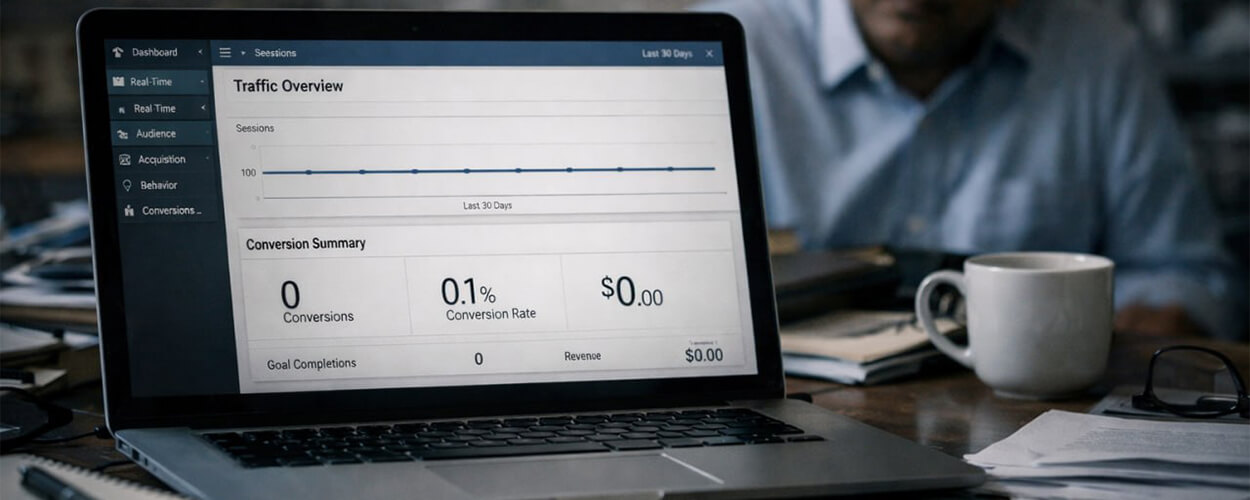
Consider a mid-sized manufacturing company that invested Rs 15,000 in a website. On the surface, it had the essentials: product catalogue pages, a contact form, a company overview. The developer delivered on time. The site went live. The owner moved on.
Over the following year, nothing moved. Traffic flat-lined. Enquiries from the site were sparse and low-quality. Meanwhile, two smaller competitors with better-built sites steadily took the top search positions for every product keyword that mattered.
When Magicworks audited this business, the numbers were stark. Factoring in the leads their competitors were capturing, the industry conversion benchmarks for their category, and their average deal size, the estimate came to over Rs 40 lakh in potential business that had simply passed through their fingers in twelve months.
The website hadn’t cost Rs 15,000. That was just the invoice. The real cost was the revenue that never arrived.
The 5 Places a Cheap Website Silently Bleeds Your Business
Most business owners evaluate a website vendor the way they’d evaluate a printer or a piece of equipment on upfront cost. But a website isn’t a cost centre. It’s a revenue channel. And judged by that standard, cheap website development in India fails across five critical dimensions:

Speed Kills Conversions Before They Start
Low-budget sites are typically built on bloated pre-made themes, hosted on shared servers, and never optimised for load time. In India, where mobile data speeds vary significantly across geographies, a site that loads in 5 seconds loses a majority of its visitors before a single word is read. Google’s Core Web Vitals have made page speed a direct ranking factor — meaning a slow site isn’t just losing visitors, it’s being actively buried in search results. Revenue impact: Visitors leave before engaging. Google buries you. Competitors capture the traffic you paid to attract.

No SEO Foundation Means No Organic Visibility
The majority of budget developers build websites they don’t build search-optimised digital assets. There’s a significant difference. An SEO-friendly website in India requires keyword architecture mapped to buyer intent, technical SEO configuration (schema, sitemaps, canonical tags), properly structured metadata, and internal linking strategy. Without this, a website is essentially invisible to the 70%+ of B2B buyers who start their vendor search on Google. Revenue impact: Your competitors appear when buyers search. You don’t. That gap compounds every month.

A Broken Mobile Experience Is a Direct Lead Killer
Over 70% of B2B website traffic in India now arrives on mobile devices. A site that renders poorly on a smartphone text too small, buttons misaligned, forms that don’t submit correctly communicates one thing to a potential buyer: this company doesn’t pay attention to detail. Budget builds rarely include rigorous mobile testing across device types, screen sizes, and network conditions. Revenue impact: High-intent mobile visitors encounter friction and leave. Your bounce rate rises. Your rankings drop further.

Security Gaps Put Your Business and Your Buyers at Risk
Cheap builds frequently skip SSL certificates, miss security patch updates, and leave CMS installations with default configurations that are trivially exploitable. A security incident defacement, data breach, or malware injection doesn’t just cause downtime. It destroys the credibility that took years to build. In B2B, where trust is a prerequisite for a commercial relationship, a security incident can be the end of a sale pipeline. Revenue impact: One breach or defacement incident can permanently damage your brand credibility with buyers who were evaluating you.

No Integrations Mean Your Website Works Alone
A static website with no connection to your CRM, your email platform, your analytics, or your lead management system is a dead end. Every enquiry has to be manually retrieved and routed. There is no lead scoring, no automated follow-up, no visibility into which pages or campaigns are generating quality enquiries. You are operating blind and doing manual work that a properly built, integrated website would handle automatically. Revenue impact: Manual lead handling means slower response times, missed follow-ups, and zero data to improve your pipeline over time.
What a Conversion-Optimised Website Actually Looks Like
At Magicworks, we describe a professional business website not as a “design project” but as a revenue system with a front end. Every element has a job and that job is to convert a visitor into a qualified enquiry. Here is what that looks like in practice for the B2B businesses we work with across Pune and across India:
A Structured Conversion Funnel, Not Just Pages
Every page maps to a stage in the buyer journey. Service pages answer specific buying questions. Landing pages are purpose-built for campaigns with a single clear CTA. Lead capture happens at multiple points not just a buried contact form on page seven.

SEO Architecture Built Around Buyer Intent
Pages are structured around the actual search terms your buyers use when they’re ready to engage a vendor not generic industry terms. Technical SEO is configured from day one: sitemaps, schema markup, canonical structure, page speed optimisation, and Core Web Vitals compliance.

Performance Engineered for India’s Network Reality
Images are compressed and served in next-gen formats. Scripts are deferred and minified. Hosting is chosen for Indian latency, not global averages. The result is sub-3-second load times across mobile and desktop the threshold at which conversion rates stop dropping sharply.

Mobile Experience Designed for Thumb Navigation
The mobile version is designed first, not adapted from desktop as an afterthought. Tap targets, form fields, and CTAs are sized and spaced for touch interaction. Testing happens across 15+ device and browser combinations before launch.

An Integrated Tech Stack That Talks to Your Business
CRM integration routes leads directly into your sales pipeline with source tracking. Analytics is configured to track meaningful conversions, not just sessions. Where appropriate, AI chatbot integration ensures that high-intent visitors at 11 PM get a response not a contact form.

The Numbers: Rs 15K vs Rs 2L Over Two Years
The objection we hear most often from business owners is a reasonable one: “We’re not ready to spend Rs 2 lakh on a website.” It’s worth stress-testing that logic against the actual revenue numbers using conservative, realistic assumptions for B2B businesses in the Indian market.| Metric | The Rs 15,000 Expense | The Rs 2,00,000 Investment |
|---|---|---|
| Initial investment | Rs 15,000 | Rs 2,00,000 |
| Monthly visitors | ~1,000 (flat, no SEO) | ~3,000+ (SEO-driven growth) |
| Conversion rate | 0.5% (passive, no funnel) | 2.0% (optimised funnel + CTA) |
| Leads per month | 5 | 60 |
| Avg. deal value | Rs 50,000 | Rs 50,000 |
| Revenue / month | Rs 2.5 lakh | Rs 30 lakh |
| Revenue over 2 yrs | Rs 60 lakh | Rs 7.2 crore |
| Net return (2 yrs) | Rs 59.985 lakh | Rs 7.198 crore |
The revenue gap: Rs 6.6 crore over two years – not from a magical spike, but from a realistic improvement in organic visibility, conversion rate, and lead volume. This is the cost of the Rs 15,000 decision.
The maths reframes the question entirely. The issue is not whether you can afford a professionally built website. It’s whether your business can afford to operate without one particularly in a market where your competitors are already making that investment.
The question to ask your next web developer isn’t: “How much does this cost to build?”
It’s: “How much revenue will this generate, and how will we measure it?”
If they can’t answer the second question, you already know the value of what they’re building.
Your Website Is Already Open for Business The Question Is, for Whose?
Every day your current website is live, it’s either actively working to generate enquiries or passively sending visitors to competitors who built their digital presence more seriously. There is no neutral position.
For business owners who are scaling or considering a move to a more serious digital presence the single most valuable first step is understanding exactly what your current website is costing you. Not in development fees. In revenue.
Your website is either your hardest-working salesperson or your most expensive unused asset. The only way to know which is to look.
Frequently Asked Questions
Is a cheap website bad for business?
A cheap website often lacks SEO, speed, and conversion optimisation, leading to lost traffic and revenue over time.
How much should a business website cost in India?
A professional business website in India typically costs between ₹1.5L to ₹3L depending on features, SEO, and integrations.
Why do cheap websites fail to generate leads?
They lack proper SEO structure, fast loading speed, mobile optimisation, and conversion funnels.
What is the ROI of a good website?
A well-optimised website can generate consistent leads and deliver high ROI through organic traffic and conversions.
How can I check if my website is losing revenue?
You need to audit traffic, conversion rate, SEO visibility, and lead tracking to estimate missed opportunities.